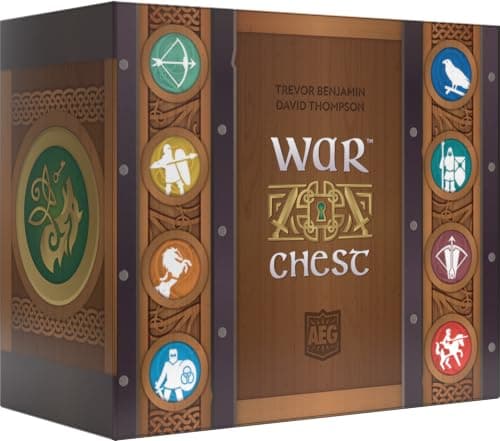
War Chest is a bag-building battlefield strategy game published by Alderac Entertainment Group for 2-4 players at 30-60 minutes, ages 14 and up, designed by Trevor Benjamin and David Thompson. You draw three unit coins from a bag each round and spend them to act. It is excellent at two and it is not a two-player-only design.
We earn a commission when you buy through links on this page, at no extra cost to you. It does not change which games we recommend or what we say about them. How this site is funded.
War Chest is the game people recommend when someone asks for chess with less memorization. It looks like an abstract -- a board, control markers, chunky poker-chip units -- and it plays like a game about command rather than about geometry, because the units you want to move are sitting in a cloth bag where you cannot reach them.
It is also by Trevor Benjamin and David Thompson, the pair who designed both Undaunted games already covered here. That connection is the reason people search for one against the other, and it is the most useful thing to understand before buying either.
One correction first, because it affects whether this site recommends it at all: AEG lists 2-4 players on its own product page, and its description of how the game ends refers to a four-player game played in teams. This is a game that is superb at two, not a game built only for two, and the difference is stated below rather than rounded away.
01
What you are actually buying
AEG publishes it for 2-4 players at 30-60 minutes, ages 14 and up, designed by Trevor Benjamin and David Thompson. The publisher's page states no release year and no reference entry for the base game was reachable, so no year appears anywhere on this page.
The box is heavy for what looks like an abstract: 79 poker-chip-style game pieces, 16 cards, a game board, four bags, 16 cardboard tokens and a rulebook. The coins are the reason the game feels expensive in the hand -- they are the component everyone mentions first, and they do the work that cards or miniatures would do in another design.
It is one of the pricier boxes on this site, and that is worth saying plainly because two of our abstract picks cost considerably less. The live price sits on the button below with the date it was checked; if budget is the deciding factor, read the Onitama and Hive entries before this one.
02
The bag is the whole idea
AEG's own description of the core loop is one sentence: each round you draw three unit coins from your bag and then take turns using them to perform actions. That is the entire engine, and everything interesting follows from it.
What it means in practice is that your plan and your means arrive separately. You can see the whole board, you know exactly which units you own, and you still do not know which three you will be holding this round. So the question stops being what is the best move and becomes what is the best move available to me now, which is a different and considerably more interesting question.
The publisher frames the skill as managing not only the armies on the battlefield but those waiting to be deployed, and that is the honest description. The bag is a planning horizon you control indirectly: what you put in it, and how often, decides what you are likely to be able to do three rounds from now.
03
One coin, several jobs
Each coin shows a military unit on one side, and the publisher states that a coin can be used for one of several actions. That one design decision is where the tension lives.
A coin in your hand is not an order, it is a choice between orders, and spending it one way forecloses the others. This is the same pressure a hand of cards creates in a good card game, compressed into a single physical object you are turning over in your fingers while you decide. It is why the game reads as elegant rather than fiddly despite the component count.
It also means the teach is short for the weight of game you get. AEG calls it easy to learn and tricky to master, which is marketing copy, but the structure supports it: there is one loop to explain, and the depth is in what you choose to do inside it rather than in exceptions you have to remember.
04
How you win, and why that shapes every turn
The game ends when one player -- or one team, in a four-player game -- has placed all of their control markers. The publisher says so directly, and it is the sentence that explains why this does not play like a war game despite the medieval army dressing.
You are not trying to destroy the other army. You are trying to finish placing markers, and the other army is the thing standing between you and the squares you need. Combat exists to clear a path or deny one, not as the objective, and that keeps the game shorter and more pointed than the component count suggests.
For a pair, this is the mechanical reason the game stays tense to the final turn. A marker race has a visible scoreboard on the board itself, so you always know how close you both are, and there is no phase where one of you is quietly out of it but still playing.
05
Built for two, or plays at two?
Plays at two, on this site's labeling. AEG states 2-4 players, and its own text about the ending describes a four-player game decided by teams, which is a design with somewhere else to go.
The practical cost to a two-person household is small and worth knowing anyway. Nothing is scaled down for a pair, the marker race works exactly as designed, and the box ships four bags -- one per player -- rather than two with a workaround. What you do not get is the guarantee this site exists to provide: that every part of the design budget was spent on your situation.
If that guarantee is what you are shopping for, Undaunted: Normandy is the same designers' two-player-only game and Hive and Onitama are published for exactly two. If you simply want the best duel on the shelf and do not mind that it also seats four, this is a straightforward recommendation.
06
War Chest or Undaunted: Normandy?
Same designers, opposite feelings, and this is the comparison worth making before you spend anything. Both ask you to act with the units you happen to be holding rather than the ones you want. Undaunted does it with a deck where casualties permanently remove cards for the rest of a scenario; War Chest does it with a bag you draw three coins from each round.
The difference is what a bad outcome costs. In Undaunted, losing a firefight thins the deck you will be drawing from for the next forty minutes, so the game has a downward slope you have to fight. In War Chest, the bag resets the question every round, so a bad round is a bad round rather than a lasting injury. One is a game about attrition, the other about tempo.
Buy Undaunted: Normandy if you want exactly two players, a specific historical campaign and consequences that accumulate. Buy War Chest if you want a cleaner, more abstract contest you can set up and finish inside an hour, and if a 2-4 player count does not bother you. We would not call either the better design; they are different evenings.
07
Who this is genuinely for
Pairs who like abstracts but have exhausted the short ones. This is the step up in weight from Onitama and Hive without a step up in rules overhead.
Anyone who finds pure perfect-information games stressful. The draw means the stronger player does not win every single time, and on this site that is a recurring reason households stop playing a game at all.
Households that want one box to carry a lot of plays. Four expansions exist, which matters below, and the base game varies enough between plays to earn its place first.
Players who want conflict without a war theme they have to care about. The medieval setting is a coat of paint on a marker race, and that is a feature if the subject matter of a game like Undaunted or Memoir '44 is not something you want on the table.
08
Who should skip it
Skip it if you want a game published for exactly two. AEG lists 2-4, and if you have been repeatedly sold scaled-down group games as two-player games, the label is the whole reason this site exists -- filter to Built for two and buy from that list instead.
Skip it if you want the draw to be irrelevant. Drawing three coins from a bag is the design, not a difficulty setting, and some players genuinely want a game where only their judgment decides the result. That is a real preference and this is the wrong game for it; Hive and Onitama have no cards, no dice and no bag.
Skip it if the price is the sticking point. This is one of the more expensive boxes we cover and the cheaper abstracts on this site are not consolation prizes -- they are two of the best games here.
And be aware of the expansion pressure before you start. AEG sells Nobility, Siege, Nightfall and Shock Tactics, all of which add units. The base game is complete and we would play it for a long time before buying any of them, but if an incomplete-looking collection bothers you, this is a line with four more boxes at the end of it.
09
What we did instead of playing it
We have not played this. What we did: took the player count, playing time, age rating, designers and the full box contents from AEG's own product page for the game, along with the publisher's own description of the core loop -- three coins drawn per round, a coin usable for one of several actions, and the game ending when a player or team has placed all of its control markers. The expansion names come from the same page.
Availability was checked before featuring it: the base game was listed in stock at the retailer when this page was written, and the buy button carries the live price with the date checked.
What we deliberately do not state: a release year, because AEG's page gives none and we could not reach a reference entry for the base game; the exact number of control markers or how the sixteen cards are used in setup, because the publisher's page does not spell either out. Where a figure cannot be cited here, it is not printed, and no price appears in this prose.
What we would buy
Picks drawn from the games covered on this site, chosen against the criteria above.
We earn a commission when you buy through links on this page, at no extra cost to you. It does not change which games we recommend or what we say about them. How this site is funded.
War Chest
Plays at two2-4 players · 30-60 minutes · ages 14+
Bag-building married to board control, from the designers of Undaunted -- the most elegant big-box duel on this shelf.
A bag-building battlefield strategy game for 2-4 players. Each round you draw three unit coins from your bag and spend them to perform actions, and the game ends when one player or team has placed all of its control markers. 79 poker-chip-style unit coins, 16 cards, a board, 4 bags and 16 tokens. Designed by Trevor Benjamin and David Thompson, the pair behind Undaunted.
Players
2-4
Playing time
30-60 minutes
Age
14+
Designer
Trevor Benjamin and David Thompson
Publisher
Alderac Entertainment Group
Who should skip it
Skip it if you want certainty rather than a draw. You pull three unit coins from a bag each round, so what you are allowed to attempt is decided before you decide how to attempt it.
The best two-player war game in print, and the only one on this list that teaches deck-building and squad tactics at the same time.
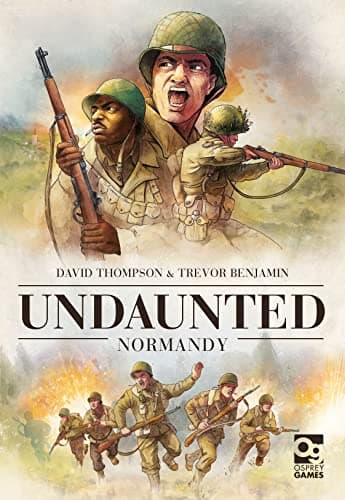
A two-player-only deck-building war game. Each side commands American or German forces across a campaign of World War II scenarios, with 108 cards, 18 large map tiles, dice and tokens. Your deck is your squad, and losses thin it permanently.
Players
2
Playing time
45-60 minutes
Age
14+
Designer
David Thompson and Trevor Benjamin
Publisher
Osprey Games
Published
2019
Who should skip it
Skip it if losing a unit permanently for the rest of a scenario will frustrate you. Casualties remove cards from your deck, so a bad turn keeps costing you.
Perfect information, sixteen move cards, and a rules explanation that takes under two minutes.
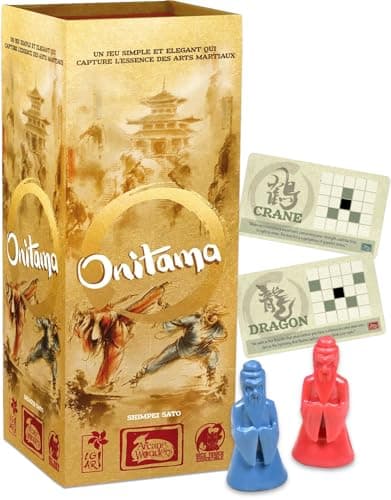
A two-player-only abstract on a 5x5 grid. Five move cards are in play at once and they physically pass between the two of you, so arming yourself always arms the opponent.
Players
2
Playing time
15 minutes
Age
14+
Publisher
Arcane Wonders
Who should skip it
Skip it if you dislike losing to a mistake you can see clearly in hindsight. Nothing is hidden, so every loss is yours.
It is excellent at two, but AEG lists 2-4 players on its own product page and describes the four-player game as being decided by teams. On this site that makes it Plays at two rather than Built for two.
+−Is War Chest worth it?
Yes, if you want an abstract-feeling duel with more weight than a fifteen-minute game and no rules overhead to match. It is not worth it if you want the result to rest on judgment alone, or if the price is the deciding factor -- Hive and Onitama cost less and are genuinely excellent.
+−How does War Chest actually work?
Each round you draw three unit coins from your bag and take turns spending them, and each coin shows a military unit that can be used for one of several actions. The game ends when one player or team has placed all of their control markers.
+−How long does a game of War Chest take?
AEG states 30-60 minutes. The age rating on the box is 14 and up, which is the same rating Osprey gives Undaunted: Normandy.
+−Do you need the War Chest expansions?
No. The base box is a complete game with 79 unit coins, 16 cards, a board, four bags and 16 tokens. AEG sells Nobility, Siege, Nightfall and Shock Tactics, all of which add units, and none of them is needed to get full value from the base game.
+−War Chest or Undaunted: Normandy?
Both are by Trevor Benjamin and David Thompson. War Chest for a cleaner, more abstract contest that seats up to four and resets each round; Undaunted: Normandy for exactly two players, a historical campaign and casualties that permanently thin your deck.
+−Is War Chest like chess?
It shares the feel of moving distinct pieces for position on a board, and the retail listing itself describes it as chess-like. The difference is the bag: in chess every option is always available, and here you can only act with the three coins you drew.