Undaunted: Normandy is a two-player-only deck-building war game from Osprey Games, listed at 45-60 minutes for ages 14 and up. Your deck represents your squad, casualties permanently remove cards from it, and a campaign booklet teaches the rules across successive scenarios.
We earn a commission when you buy through links on this page, at no extra cost to you. It does not change which games we recommend or what we say about them. How this site is funded.
Undaunted: Normandy is the game that made war games approachable again. It takes the deck-building idea most people met in a fantasy game, points it at a World War II squad, and produces something that plays in under an hour and teaches itself as you go.
It is also the most-recommended entry point into two-player war gaming for good reason: there is no hex grid to learn, no combat results table to look up, and no rulebook marathon on the first evening.
01
Your deck is your squad, and that changes everything
Every card in your deck is a soldier. Play a scout card and that scout moves; play a rifleman and that rifleman shoots. The cards are not abstract resources, they are the people on the map.
So when a unit takes a casualty, the corresponding card is removed from your deck permanently for the rest of the scenario. That is the mechanism the whole game turns on. Losing a firefight is not a one-turn setback -- it thins the deck you will be drawing from for the next forty minutes, which means your hand quality degrades exactly when you most need it.
The counter-pressure is that you can reinforce, adding cards back. Deciding whether to spend a turn strengthening your deck or pressing an attack while you still have the cards to do it is the recurring decision, and it never gets easier.
02
Fog of war without hidden information
Both maps are fully visible, so there is no hidden movement and nothing to track behind a screen. The uncertainty comes from your own deck instead: you know exactly what units you have, and you do not know which of them will be in your hand this turn.
That is a smart substitution. It produces the feeling of an order that does not reach the right unit in time, without any of the bookkeeping that usually creates fog of war in this genre. It also means the game is completely open to both players, so neither of you is waiting while the other consults a hidden chart.
03
The campaign is the tutorial
Osprey lists a campaign booklet in the contents, and it does double duty. The early scenarios use a restricted set of units and add new ones as you progress, so the rules arrive in usable pieces rather than all at once.
For two people this matters more than it would for a group. There is no shared enthusiasm to carry you through a slow opening evening -- if the first session is a rules lecture, there may not be a second. Undaunted front-loads play instead, and that single design decision is why it converts people who bounced off war games before.
04
Who should skip it
Skip it if permanent losses will frustrate you. Casualties removing cards for the rest of a scenario is the central mechanism, not a difficulty setting, and there is no variant that softens it. Some players find the mounting pressure gripping; others find a bad early turn spoils the whole scenario.
Skip it if the subject matter is not something you want on the table. This is a specific historical campaign handled seriously, and that is doing real work in the design rather than being a coat of paint.
And skip it if you want a game you can finish in twenty minutes. The publisher states 45-60 minutes and that is honest, which puts it in main-event territory rather than filler.
05
What we did instead of playing it
We have not played this. What we did: took the player count, ages, playing time, contents, designers and publication year from Osprey Games' own product page, and checked the stock status on that same page before featuring it anywhere on this site. It was listed as in stock when this was written.
What we would buy
Picks drawn from the games covered on this site, chosen against the criteria above.
We earn a commission when you buy through links on this page, at no extra cost to you. It does not change which games we recommend or what we say about them. How this site is funded.
The best two-player war game in print, and the only one on this list that teaches deck-building and squad tactics at the same time.
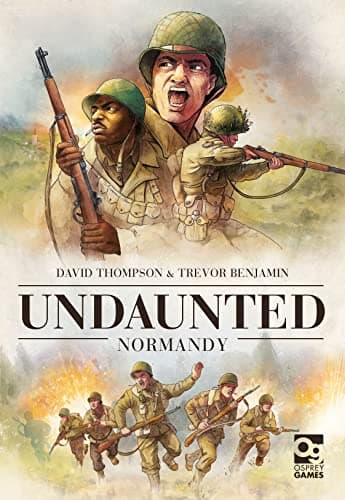
A two-player-only deck-building war game. Each side commands American or German forces across a campaign of World War II scenarios, with 108 cards, 18 large map tiles, dice and tokens. Your deck is your squad, and losses thin it permanently.
Players
2
Playing time
45-60 minutes
Age
14+
Designer
David Thompson and Trevor Benjamin
Publisher
Osprey Games
Published
2019
Who should skip it
Skip it if losing a unit permanently for the rest of a scenario will frustrate you. Casualties remove cards from your deck, so a bad turn keeps costing you.
The same engine as Normandy, fifteen minutes shorter, and the better buy if you only want one of the two.
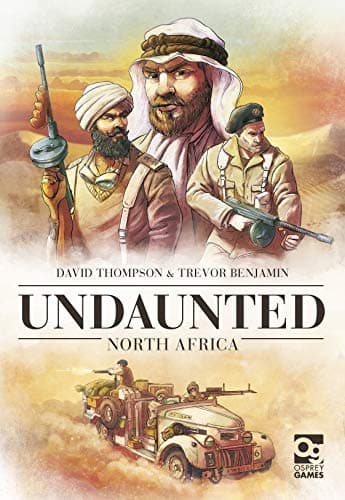
A two-player-only deck-building war game and standalone sequel to Undaunted: Normandy. Desert warfare across a campaign, with 100+ cards, 22 large map tiles, 4 dice and tokens. Shorter scenarios than Normandy at 30-45 minutes.
Players
2
Playing time
30-45 minutes
Age
14+
Designer
David Thompson and Trevor Benjamin
Publisher
Osprey Games
Who should skip it
Skip it if you already own Normandy and expected something new. The core system is identical -- this is a different theater, not a different game.
Asymmetric, historical, and finished inside an hour -- the shortest route into serious card-driven games for two.
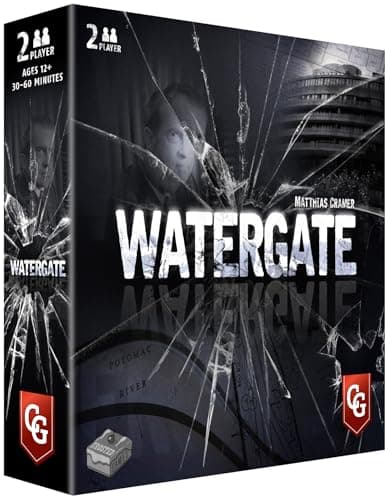
A two-player-only asymmetric card-driven game. One side is the Nixon administration, the other the Washington Post, and every card is both an action for you and a resource for the opponent.
Players
2
Playing time
30-60 minutes
Age
12+
Designer
Matthias Cramer
Publisher
Capstone Games
Published
2019
Who should skip it
Skip it if you both want the same experience. The two sides play very differently and one of you will prefer a side.
Yes. Osprey Games lists 2 players, ages 14+, at 45-60 minutes. It is a genuine two-player design with no scaling rules for additional players.
+−Do you need to know war games to play Undaunted: Normandy?
No. There is no hex grid and no combat results table, and the campaign booklet introduces units and rules across successive scenarios rather than in one rulebook sitting.
+−What happens when a unit takes a casualty?
The corresponding card is removed from your deck for the rest of the scenario. Your deck is your squad, so losses permanently degrade the hands you draw rather than costing you a single turn.
+−Should I buy Undaunted: Normandy or North Africa first?
North Africa is shorter at a stated 30-45 minutes against 45-60, so it is the easier single purchase. Normandy is the more common starting point and the one most people mean when they recommend the series.