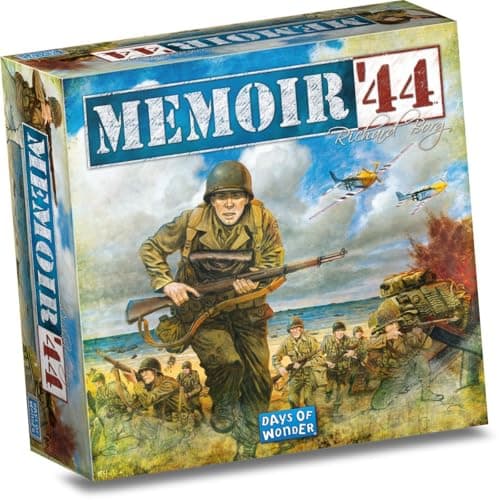
Memoir '44 is a historical war game published by Days of Wonder for 2-4 players at 30-45 minutes, ages 8 and up, designed by Richard Borg. A hand of command cards decides which part of the battlefield you can order each turn. It is the most approachable war game in print, and it is not a two-player-only design.
We earn a commission when you buy through links on this page, at no extra cost to you. It does not change which games we recommend or what we say about them. How this site is funded.
Memoir '44 is the game that gets people who say they do not like war games to play one. It has plastic soldiers, a hex board, and a rules explanation that takes about ten minutes, which puts it in a completely different category from the stack of chits-and-hexes games it shares a shelf with.
It is also widely assumed to be a two-player-only game, and it is not. Days of Wonder lists 2-4 players on its own page, and the famous large-scale Overlord scenarios need a second copy of the box. That matters on a site organized around exactly this distinction, so the review below is precise about it rather than rounding it in the game's favor.
01
What you are actually buying
Days of Wonder publishes it for 2-4 players at 30-45 minutes, ages 8 and up, designed by Richard Borg. It first appeared in 2004 and has stayed in print ever since, which on this site counts as a quality signal in its own right.
The box is unusually full for the price bracket: a double-sided board, 144 army miniatures split between Axis and Allied forces, 36 obstacles, 44 double-sided terrain tiles, 60 command cards, 22 summary cards, 8 attack dice, 6 activation tokens, two cardholders, a rulebook and a scenario book.
Each scenario sets up a specific historical engagement -- the terrain, the forces on each side, and what each army has to achieve. You lay out the tiles, place the miniatures as the scenario diagram shows, and play. Setup is a real part of the evening, which is worth knowing before you buy.
02
The command cards are the entire design
This is the mechanism that makes a war game teachable in ten minutes, and it is genuinely clever. The battlefield is a hex grid divided by two lines into three sections: a left flank, a center, and a right flank. You hold a hand of command cards, and each card lets you order units in a particular section, or a particular type of unit, or occasionally something special.
So you do not get to move whatever you like. You get to do what your hand allows. If your cards are all left-flank orders and the fighting is on your right, you are watching a crisis you cannot respond to, and the decision becomes which of several inadequate options does least damage.
That is the replacement for the command-and-control rules a traditional war game would spend six pages on. You are not consulting a chart to see whether your orders get through; you are holding three cards and wishing one of them were different. It communicates the same idea and it costs nothing to learn.
03
How much the dice decide, honestly
A lot, and this is the single most important thing to know before buying. Combat is resolved with the eight attack dice, and the dice are unapologetically swingy. A full-strength unit in good terrain can be wiped out by one unlucky volley, and a hopeless last stand sometimes holds.
If you want a war game where careful play reliably beats careless play, this will frustrate you, and the people who bounce off Memoir '44 almost always bounce off exactly this. The design is aiming at the feeling of a battle report rather than the fairness of a chess problem, and it hits that target.
The structural counterweight is the scenario format. Games are short, scenarios are asymmetric by design, and the standard way to play is to fight the same scenario twice with the sides swapped. That turns a swingy single game into a reasonable two-game comparison, and it is how we would recommend playing it from the start.
04
Built for two, or plays at two?
Plays at two, on this site's labeling, and the distinction is real rather than pedantic here. Days of Wonder states 2-4 players. At three or four you play in teams, with players sharing command of one army, and the publisher's page points to an Overlord mode that asks you to play with two copies of the core game.
What that means practically for a pair: two is the standard, clean way to play this game, and nothing is scaled down or patched to accommodate you. Most of the scenario book is a one-against-one fight. But the design has somewhere else to go, and some of its most celebrated content -- the big Overlord battles -- is out of reach unless you buy a second box.
If you specifically want a war game published for exactly two players with no larger ambitions, Undaunted: Normandy is the one that meets that spec. If you want the game that a non-wargamer will actually agree to play, this is it, and the 2-4 on the box costs you nothing on a normal evening.
05
Memoir '44 or Undaunted: Normandy?
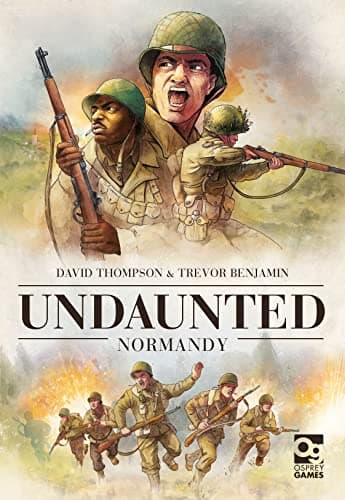
These are the two WWII games we cover and they solve opposite problems. Undaunted is published for exactly 2 players at 45-60 minutes, ages 14 and up, and its tension comes from a deck that thins as you take casualties -- every loss is permanent for that scenario. It is a deck-builder wearing khaki, and the skill is in managing an engine.
Memoir '44 is faster, lighter, lower-aged at 8 and up, and much more luck-driven. Its skill is in reading which section of the battlefield your hand lets you fight in, and in accepting that the dice get a vote. It also has far more stuff in the box, which matters more than it should: 144 miniatures on terrain tiles looks like a battle in a way that cards do not.
Buy Memoir '44 if you want the broadest possible appeal, a shorter game, or something a younger player can join. Buy Undaunted: Normandy if you want your decisions to be the thing that decides it and you do not mind a heavier teach. We would not call either the better game; they are different purchases.
06
Who this is genuinely for
Households where one person wants a war game and the other has always refused. This is the one that converts people, because the ten-minute teach removes the usual objection.
Pairs who like replaying the same situation from both sides rather than playing a different game every night.
Anyone who wants physical presence on the table. Miniatures on terrain tiles is a different experience from a hand of cards, and for some buyers that is most of the point.
Families with an older child who wants in. At a stated 8 and up it is the lowest-aged competitive game we cover apart from Patchwork.
07
Who should skip it
Skip it if you want a game built only for two. Days of Wonder lists 2-4 players, and the Overlord scenarios that people rave about require a second copy of the box -- a real cost that is easy to miss when you are reading about how good they are.
Skip it if swingy dice will spoil the evening. Combat can and will produce results that no amount of good play deserved. The two-games-with-sides-swapped format softens that, but it does not remove it, and if you want war gaming where skill dominates, this is the wrong shelf.
And skip it if setup time annoys you. Laying out terrain tiles and placing well over a hundred miniatures per scenario is part of every session. It is pleasant if you enjoy that sort of thing and a genuine chore if you do not.
08
What we did instead of playing it
We have not played this. What we did: took the player count, playing time, age, designer and the full box contents from Days of Wonder's own page for the game, and the 2004 release year, the three-section battlefield and the fact that Overlord needs two copies from the game's reference entry. Where the two sources disagree we used the publisher: Days of Wonder prints 30-45 minutes, the reference entry says 30-60, and the figure above is the publisher's. Neither source states an exact number of scenarios in the base box, so we do not give one. No price appears in this prose.
What we would buy
Picks drawn from the games covered on this site, chosen against the criteria above.
We earn a commission when you buy through links on this page, at no extra cost to you. It does not change which games we recommend or what we say about them. How this site is funded.
The most approachable historical war game in print, because a hand of command cards does the work a rulebook would otherwise do.
A supports-more historical war game that plays at two. You command Axis or Allied forces on a hex battlefield split into three sections, and the command cards in your hand decide which section you can give orders to each turn. 144 army miniatures, 44 double-sided terrain tiles, 60 command cards, 8 attack dice and a scenario book.
Players
2-4
Playing time
30-45 minutes
Age
8+
Designer
Richard Borg
Publisher
Days of Wonder
Published
2004
Who should skip it
Skip it if you want a game built only for two. Days of Wonder lists 2-4 players, and the famous Overlord scenarios need a second copy of the box.
The best two-player war game in print, and the only one on this list that teaches deck-building and squad tactics at the same time.
A two-player-only deck-building war game. Each side commands American or German forces across a campaign of World War II scenarios, with 108 cards, 18 large map tiles, dice and tokens. Your deck is your squad, and losses thin it permanently.
Players
2
Playing time
45-60 minutes
Age
14+
Designer
David Thompson and Trevor Benjamin
Publisher
Osprey Games
Published
2019
Who should skip it
Skip it if losing a unit permanently for the rest of a scenario will frustrate you. Casualties remove cards from your deck, so a bad turn keeps costing you.
Asymmetric, historical, and finished inside an hour -- the shortest route into serious card-driven games for two.
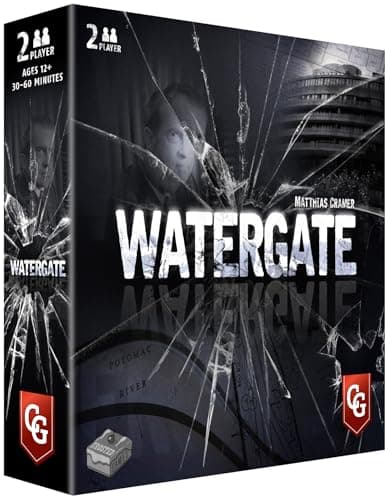
A two-player-only asymmetric card-driven game. One side is the Nixon administration, the other the Washington Post, and every card is both an action for you and a resource for the opponent.
Players
2
Playing time
30-60 minutes
Age
12+
Designer
Matthias Cramer
Publisher
Capstone Games
Published
2019
Who should skip it
Skip it if you both want the same experience. The two sides play very differently and one of you will prefer a side.
It is usually played by two, but Days of Wonder lists 2-4 players on its own page. At three or four you play in teams, and the large Overlord scenarios require two copies of the game. On this site that makes it Plays at two rather than Built for two.
+−Is Memoir '44 worth it?
Yes, if you want a historical war game that a reluctant partner will actually play. The command-card system teaches in about ten minutes and the box is unusually full. It is not worth it if swingy dice will spoil the evening for either of you.
+−Is Memoir '44 really a war game?
Yes, but at the accessible end. It uses command cards and dice rather than combat tables and supply rules, and the publisher rates it 8 and up. Treat it as a historical battle game rather than a simulation.
+−How long does Memoir '44 take?
Days of Wonder states 30-45 minutes per scenario. Add setup, which is substantial: terrain tiles plus well over a hundred miniatures placed per scenario diagram.
+−Do you need expansions to enjoy Memoir '44?
No. The base box includes a double-sided board, 144 miniatures, 44 terrain tiles and a scenario book, which is a complete game. Note that Overlord scenarios need a second copy of the core game, not an expansion.
+−Memoir '44 or Undaunted: Normandy?
Memoir '44 for a shorter, lighter game with broad appeal and a younger age rating. Undaunted: Normandy if you want exactly two players, a heavier teach, and a game where skill rather than dice decides it.