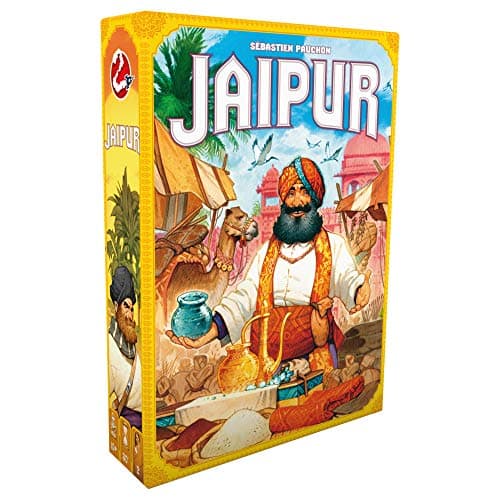
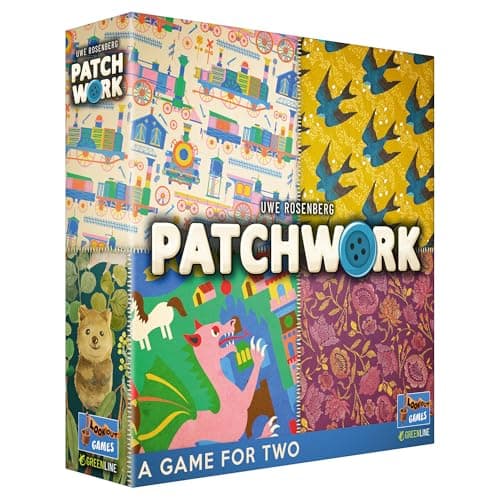
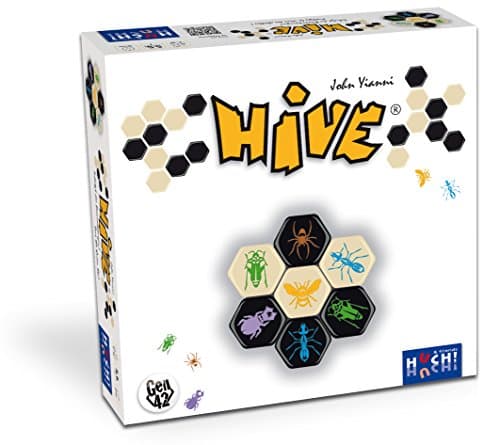
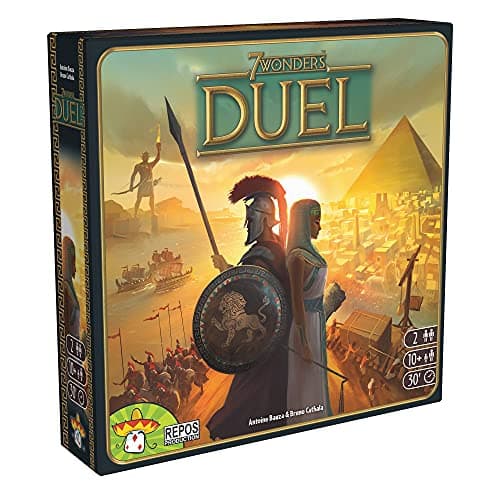
A game is Built for two when its publisher states a player count of exactly 2, and Plays at two when the publisher lists a range starting at 2. Of the 16 games we cover, 10 are built for exactly two, including 7 Wonders Duel, Jaipur, Hive, Patchwork and Sky Team.
We earn a commission when you buy through links on this page, at no extra cost to you. It does not change which games we recommend or what we say about them. How this site is funded.
Search for two-player board games and you will get lists that mix two completely different things without ever saying so. Some entries are games designed from the first sketch for exactly two people. Others are four- or five-player games that technically function at two, sometimes brilliantly and sometimes as a shadow of themselves.
That difference is not a detail if your household is two people. It is the difference between a box whose entire design budget went to your situation and a box where some of it went to player counts you will never use.
So every game on this site carries one of two labels, and the label is decided by the publisher's own stated player count -- not by our opinion, not by how it feels, and not by what other sites say.
Quick picks
#
Game
Players
Time
Price
1
7 Wonders Duel
The strongest all-round two-player game in print, and the one most couples settle on.
Player counts and playing times come from each publisher, cited on that game's review page. Tap a row to jump to the full write-up.
01
The two labels, defined exactly
There is no third label and no judgment call. If a publisher lists 2+, that is a range, and the game is Plays at two even if the entire internet describes it as a two-player game. Codenames: Duet is the case where this bites, and we cover it below.
Built for two -- the publisher states a player count of exactly 2. Not 2-4, not 2+. Exactly two. These games have no scaling rules, no dummy player, and no mechanism that exists to handle a third person.
Plays at two -- the publisher states a range that starts at 2. The game supports more players and can be played by a pair. Many of these are excellent at two; the label is not a criticism, it is a fact about the design brief.
02
Why the distinction is worth caring about
Three concrete consequences, none of which are about snobbery.
First, scaling artifacts. A game designed for four and played at two often needs a rule to replace the missing players -- a neutral third party, a modified setup, cards removed from the deck. Those rules are usually fine and they are always a patch. A two-player-only design has nothing to patch because nothing is missing.
Second, tuning. Balance in a multiplayer game frequently relies on players checking each other. Remove two of them and the check disappears, which is why some strategies that are risky at four are simply strong at two. Designers who only had to balance for two do not have this problem.
Third, and most practically: pacing. A game that supports five has a turn structure built to keep five people engaged. At two, that same structure can feel slow, or it can feel wonderfully fast, and there is no way to tell from the box which one you are getting.
03
The ten games we cover that are built for exactly two
Each verified against its publisher's own stated player count, with the source on that game's review page.
Lost Cities -- 2 players, 30 minutes. Reiner Knizia, Kosmos and Rio Grande Games.
The Fox in the Forest -- 2 players, 30 minutes. Foxtrot Games and Renegade Game Studios.
Watergate -- 2 players, 30 to 60 minutes. Capstone Games.
04
The six we cover that play at two
All are good at two and none is a two-player-only design. Where a game is widely believed to be two-player only and is not, we say so rather than going along with it.
Codenames: Duet -- listed 2+ by Czech Games Edition. This is the one everybody gets wrong. It is designed around two people, it is at its best at two, and its own publisher lists a range. Both facts are true and we print both.
Santorini -- 2-4 players, Roxley Games. Best at two, and the base rules are noticeably thin without the god powers.
Forbidden Island -- 2-4 players, Gamewright. Genuinely tighter at two than at four.
Forbidden Desert -- 2-5 players, Gamewright. Harder at two, because the storm runs on a fixed clock.
Love Letter -- 2-4 in the original, 2-6 in the second edition. Sharper at two than at six, where it becomes a deduction duel.
Gloomhaven: Jaws of the Lion -- 1-4 players, Cephalofair Games. Two is a common and comfortable count for it.
05
Does built for two mean better?
No, and we would be selling you something if we said otherwise. Santorini plays at two and is a better purchase for a household with an eight-year-old than several games on the built-for-two list. Forbidden Island plays at two and is the cheapest sensible way to find out whether cooperative games suit you at all.
What the label does is remove an ambiguity you would otherwise have to resolve yourself, usually by reading forum threads. When two games are close on everything else and one of them was made for exactly your situation, that is a real tiebreaker. When they are not close, buy the better game.
The one case where the label should be decisive: if you have been repeatedly disappointed by games that were recommended as two-player and turned out to be scaled-down group games, filter to Built for two and buy from that list. That specific disappointment is what this page exists to prevent.
06
How we check, and what we do when we cannot
Every player count on this site comes from the publisher's own product page where we can reach it, and from the game's Wikipedia infobox where we cannot. The source is printed on each game's review page with a link, so you can check any figure yourself in one click.
Where sources disagree, the publisher wins. Where a publisher states a range, we record the range even if convention says otherwise -- that is exactly the Codenames: Duet situation, and quietly rounding it to 2 would make every other label on the site worth less.
If we cannot verify a game's player count from a source we can cite, that game does not appear on this site at all. There is no category for probably.
The strongest all-round two-player game in print, and the one most couples settle on.
A two-player-only card drafting game where each side builds a civilization across three ages. Three ways to win -- civilian points, military supremacy and scientific dominance -- run at once, so every card you take is also a card denied.
Players
2
Playing time
30 minutes
Age
10+
Designer
Antoine Bauza and Bruno Cathala
Publisher
Repos Production
Published
2015
Who should skip it
Skip it if you want a relaxing evening. Three win conditions run at once, so you are always watching what the other person is about to do.
A fifteen-minute co-op you play in near silence, and the tension is extraordinary.
A two-player-only cooperative game. One of you is pilot, one is co-pilot, and you land an aircraft by placing dice on a shared cockpit board -- without discussing which dice you hold.
Players
2
Playing time
15 minutes
Age
12+
Designer
Luc Remond
Publisher
Le Scorpion Masque
Published
2023
Who should skip it
Skip it if you want to talk freely. The no-talking restriction is the whole game, and some pairs find that frustrating rather than thrilling.
The best first two-player card game there is: five minutes to teach, and it keeps giving for years.
A two-player-only trading card game. You collect and sell goods in sets, racing the other trader for bonus tokens that shrink as they are taken. Best of three rounds decides it.
Players
2
Playing time
30 minutes
Age
10+
Designer
Sebastien Pauchon
Publisher
Asmodee / GameWorks
Published
2009
Who should skip it
Skip it if you want a board on the table. This is cards and tokens, and it looks slight next to a game with a map.
The gentlest good game on this site. Two quilts, no attacking, and a surprisingly sharp puzzle underneath.
A two-player-only tile-laying game. You buy fabric patches on a shared time track and fit them onto a personal 9x9 quilt board, paying with buttons and with time.
Players
2
Playing time
about 30 minutes
Age
8+
Designer
Uwe Rosenberg
Publisher
Lookout Games
Published
2014
Who should skip it
Skip it if you want to interact. You are mostly solving your own board, and the only contact is who takes which patch first.
Chess without a board, in tactile tiles, and it survives the hundredth game better than most.
A two-player-only abstract strategy game with no board: 22 tactile tiles that build the playing surface as you place them. Surround the opposing queen bee to win.
Players
2
Playing time
20 minutes
Age
9 and up
Publisher
Gen42 Games
Box size
210mm x 210mm x 50mm
Who should skip it
Skip it if abstract games leave you cold. There is no theme here to carry you through a bad position.
A game whose publisher states a player count of exactly 2, with no rules for a third player. On this site those are labeled Built for two, as opposed to games listed 2-4 or 2+ which are labeled Plays at two.
+−Are two-player-only games better than games that scale down?
Not automatically. A two-player-only design has no scaling patches and is tuned for exactly your situation, which is a genuine tiebreaker between close games. It does not make a mediocre game good.
+−Is Codenames: Duet a two-player-only game?
No. Czech Games Edition lists it as 2+ on its own product page. It is designed around two players and best at two, but the publisher's stated count is a range, so we label it Plays at two.
+−What is the best board game built for exactly two players?
7 Wonders Duel for depth, Jaipur as a first purchase, and Sky Team if you want cooperative. All three are stated by their publishers at exactly 2 players.
+−How do you verify a game's player count?
From the publisher's own product page where reachable, and from the game's Wikipedia infobox otherwise. Each source is linked on the game's review page. If we cannot cite a count, the game does not go on the site.