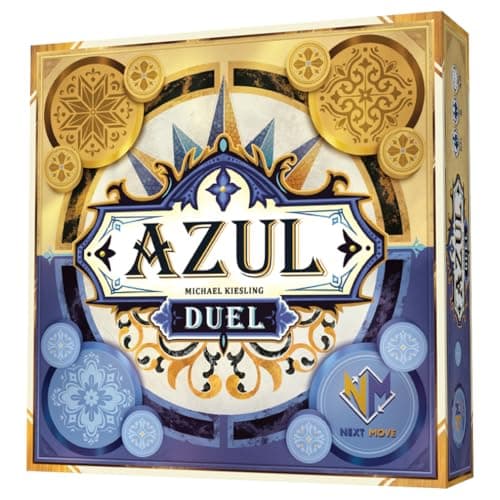
Azul Duel is the Azul built for exactly two: Next Move Games publishes it for 2 players at 45 minutes, ages 10+. Buy it instead of the 2017 Azul if the two of you are the only people who will ever play it, because here the tiles you reject are handed to your opponent in an order you choose. Buy the original if you want the famous award-winner that also seats four.
We earn a commission when you buy through links on this page, at no extra cost to you. It does not change which games we recommend or what we say about them. How this site is funded.
For nine years the honest answer to "is Azul good for two players?" was a shrug and a qualification. It worked at two, it was never designed for two, and the box seated four. In 2025 Next Move Games published a different answer: a standalone Azul for exactly two players, with a draft rebuilt around the fact that there is only ever one other person at the table.
This review exists because that changes a buying question rather than settling it. Azul Duel is not an expansion, does not need the 2017 box, and is not simply Azul with a two-player insert. It is a tighter, meaner, slightly heavier game that happens to be made of acrylic tiles, and for a household that will only ever play at two it is the better purchase. For a household that wants the game guests recognize, it is not.
One thing up front, as on every page here: we have not played it. What follows is built from the publisher's own product page, the game's reference entry, and a rules reproduction, each cited at the bottom. Where a source is silent, this page says so rather than filling the gap.
01
What you are actually buying
A tile-drafting game published by Next Move Games for exactly 2 players, at 45 minutes, rated 10 and up. Asmodee USA's store page states all three. It is standalone: you do not need the 2017 Azul, and this is not an expansion to it.
The publisher lists the contents in full, which is unusual enough in this niche to be worth reproducing: 2 player boards, 4 player tokens, 4 scoring markers, 75 acrylic tiles, 20 bonus chips, 1 scoreboard, 5 factories, 18 dome-plates, 4 scoring tablets, 1 bag and 1 tower. The tiles being acrylic rather than plastic is the one component note that matters to a buyer -- it is the quality everyone remarks on in the Azul family, and it survives the move to this box.
Two things the publisher's page does NOT state, and we are not going to pretend otherwise: the designer and the release year. Both come from secondary sources below -- the reference entry gives 2025, and the rules reproduction credits Michael Kiesling, who designed the original Azul. Neither figure is printed on the page we would most like to have it from. The box dimensions are not stated anywhere we could reach either, so this game is absent from our travel and small-table pages until they are.
02
The stacking twist is the whole reason this box exists
In the 2017 Azul, tiles sit on factory discs and you take every tile of one color from one disc. What you leave behind is just left behind. With three or four players that is already a sharp decision, because you cannot predict which of them will get to it first.
At two players that prediction problem disappears -- there is exactly one other person, and everything you leave is for them. Azul Duel's answer is to make that explicit and then make you responsible for it. Each factory has a sun side and a moon side. When you take all tiles of one color from a factory's sun side, you then choose the order in which the remaining tiles are placed onto that factory's moon space. On a later turn, a player can take one color from the top of the moon spaces.
Read those two rules together and the game appears. You are not only choosing what you want, you are building the pile your opponent will pick over, deciding which color sits on top and therefore which one is available and which is buried. That is a genuinely different decision from the original game, and it is the one that justifies a separate box rather than a two-player variant in the rulebook.
It is also the thing that makes this the sharper game of the two. In Azul you suffer from what is left on the table. In Azul Duel you suffer from what the other person deliberately left you.
03
How a turn works, and the four things you can do
On your turn you take one of four actions. You can take a face-up dome tile -- and you must do this twice each round. You can take all tiles of one color from a factory's sun side, then stack the leftovers on its moon space as described above. You can take one color from the top of the moon spaces. Or you can take a revealed bonus chip, which becomes available once the moon area is empty.
Every tile you gain in a turn goes into a single pattern line. Not spread across rows -- one line. Whatever does not fit is broken and costs you points, on a scale that bites for the first four tiles and ignores anything past that. This is the familiar Azul penalty, and it is still the rule that teaches new players the hardest lesson: greed is priced.
At the end of the round, each full pattern line pays out. You move one tile from it onto an open space on a dome tile and score immediately: one point if it touches nothing, otherwise one point for every tile in the row or column it joins -- and the new tile scores twice, once for its row and once for its column. Tiles from a full line that have nowhere to go yet stay put and can move later when a dome plate comes up; ones that can never move are broken.
There are two small penalties that are easy to miss when you are learning and easy to exploit once you are not. Drawing a dome tile from the face-down stack costs you a point per tile drawn. And taking from the large factory's moon side while you hold the first-player marker makes you first player next round at a cost of two points. Both are real decisions rather than fines; both are also exactly the sort of bookkeeping that the original Azul does not ask for.
04
Variable boards, and why that matters more at two than at four
The publisher's own description of the game leads on this: pattern plates let you build a player board with a different layout each game, so the setup varies and the scoring opportunities change with it. The original Azul has one fixed board and offers a basic mode where the board dictates where each color goes and an advanced mode where you place freely.
A variable board is worth more to a pair than to a group, and the reason is simple arithmetic. Two people who buy a two-player game play it far more times than four people who own a family game, because they never need to find a third. A fixed board that two people solve forty times is a board they have solved. Changing the layout every game is the cheapest honest defense against that, and it is a better answer than a difficulty toggle.
This is the strongest argument for Azul Duel over Azul for the specific buyer this site is written for, and it is also the hardest claim to verify from the outside -- we can tell you the mechanism is there because the publisher states it, but we cannot tell you how much variety it actually generates after thirty plays, because nobody honest can tell you that yet about a 2025 release.
05
The game ends when your board fills, not when a timer runs out
Five rounds, and the game also ends when your player board is full of dome tiles, at which point you stop taking them. Then three scoring tiles pay out. In the beginner setup those three are fixed and generous enough to steer a first game: three points for each completed row, seven for each completed column, and ten for a completed six-tile diagonal.
That diagonal is worth noticing. Ten points for one line is a large share of a close game, and it is the kind of target that makes an early tile placement matter four rounds later. Ties go to whoever holds the first-player token -- which retroactively prices that two-point first-player decision rather differently.
What we cannot give you is the non-beginner scoring conditions. The rules reproduction we used states that the beginner mode always uses those three and that other conditions vary, but it does not enumerate them, and the publisher's page does not either. So: the advanced game clearly has variable scoring goals, and we are not going to describe goals we have not seen.
06
Built for two, and this one actually is
Built for two, without qualification. Next Move Games states a minimum of 2 and a maximum of 2, and calls it a two-player challenge in its own copy. The reference entry says it was designed specifically for two players.
That matters on this site more than it would elsewhere, because it is the distinction the whole thing is organized around. Of the games we cover, this is one of the minority whose publisher states exactly two -- and it is the only one in the Azul family that does. If you arrived here because you want designs built for two rather than designs that tolerate two, this is the Azul for you and the 2017 box is not.
The flip side is equally plain and worth saying before you buy: it will never seat a third person. If a friend comes over, this box stays on the shelf and the family game comes out. That is the trade every two-player-only game asks you to make, and it is the right trade only if you are honest about how often you actually play with other people.
07
The honest downsides
It is new, and nobody has a long record with it. Published 2025. There is no award shelf, no decade of community consensus, and no thirty-plays verdict from us or anyone else. The 2017 Azul has all three.
It is more game to teach than Azul. Four actions, sun and moon sides, dome tiles you must take twice a round, dome-plates, bonus chips, scoring tablets, and two separate point penalties. Azul teaches in five minutes; this does not, and if your reason for buying is handing it to a non-gamer, that is a real mark against it.
Recognition is a genuine loss. Azul won the 2018 Spiel des Jahres and five other major awards, and people have heard of it. Nobody will recognize this box, which matters if you are buying it as a gift for someone who likes being given things they have heard of.
The publisher does not state the designer or the year. We filled both from secondary sources and told you which. The box dimensions are stated nowhere we could reach, so we cannot tell you whether it travels.
The small penalties are fiddly. A point for each face-down dome tile drawn and two points for the first-player grab are the kind of rules that get forgotten in a casual game and then argued about in a close one.
Ages 10+, where the original's age rating is unstated. If you are buying for a younger child, this is the one with a number on it -- and the number is 10.
08
Who each pick is for
Azul Duel -- best for the pair who are the only two people who will ever play it, and who want the draft to be a fight rather than a shared puzzle. Built for exactly two, variable board, and the leftovers are stacked for your opponent on purpose.
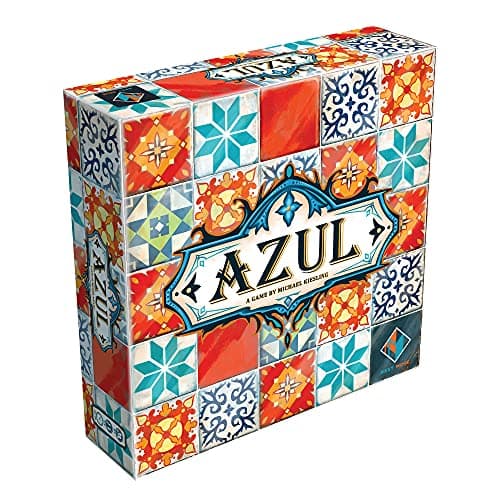
Azul -- best for the household that wants the famous one, needs the box to seat four when guests arrive, or is handing it to someone who does not play games. It is the gentler teach and the one with the award record, and it plays perfectly well at two even though it was not built for it.
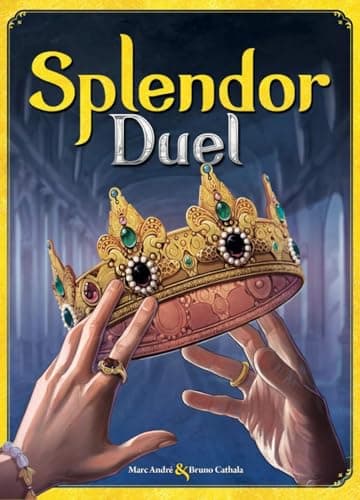
Splendor Duel -- best for the pair who like the two-player-only idea but want tension rather than tile-laying. Space Cowboys publishes it for exactly 2 at 30 minutes, three victory conditions run at once, and any of them can end the game on the spot.
What we would buy
Picks drawn from the games covered on this site, chosen against the criteria above.
We earn a commission when you buy through links on this page, at no extra cost to you. It does not change which games we recommend or what we say about them. How this site is funded.
The Azul family built for exactly two, and the first game here where you draft a tile and decide what the other person is allowed to reach next.
A two-player-only tile-drafting game in the Azul family. You take every tile of one color from a factory's sun side, then choose the order the leftovers are stacked onto its moon side for your opponent to pick over. Tiles fill a single pattern line at a time and move onto dome tiles that score by row and column, across five rounds. Published by Next Move Games for exactly 2 players at 45 minutes.
Players
2
Playing time
45 minutes
Age
10+
Designer
Michael Kiesling
Publisher
Next Move Games
Published
2025
Who should skip it
Skip it if you want the game everyone recognizes. This is the newer, sharper box; the 2017 Azul is the one your guests have heard of and the one that seats four.
Five major awards in 2018, and a draft where you must take every tile of the color you want -- including the ones you cannot use.
A tile-drafting game for 2-4 players. You take every tile of one color from a shared supply and arrange them in rows, then move one tile from each filled row onto a 5x5 board where it scores by where it sits relative to the others. Rounds continue until a player completes a row across their board, with bonuses for complete rows, columns and full color sets. Designed by Michael Kiesling, published by Plan B Games in 2017.
Players
2-4
Playing time
30-45 minutes
Designer
Michael Kiesling
Publisher
Plan B Games
Published
2017
Who should skip it
Skip it if you want a game built only for two. Plan B Games lists 2-4, and a two-player-only Azul exists separately as Azul Duel.
The gentler duel: an engine builder where you are racing rather than attacking, and the shared gem board is the whole game.
A two-player-only engine-building game in the Splendor universe. You draft gem tokens from a shared board to buy Jewel cards across three levels, chasing three separate victory conditions -- points, a color majority, or crowns. 67 Jewel cards, 25 tokens, 3 Privilege scrolls, 4 Royal cards.
Players
2
Playing time
30 minutes
Age
10+
Designer
Bruno Cathala and Marc Andre
Publisher
Space Cowboys
Published
2022
Who should skip it
Skip it if you want direct conflict. The tension is in what you take from the shared board before the other person can, never in anything you do to their cards.
Yes. Next Move Games states a minimum of 2 players and a maximum of 2, and describes it as a two-player challenge. It does not scale to three, and no solo mode is stated. It is the only game in the Azul family published for exactly two.
+−Do I need the original Azul to play Azul Duel?
No. It is a standalone game with its own 75 acrylic tiles, 5 factories, 2 player boards and 18 dome-plates. It is not an expansion and does not require the 2017 box.
+−Should I buy Azul or Azul Duel?
Buy Azul Duel if the two of you are the only people who will play it: it is built for exactly two and its draft makes you choose what order your leftovers are stacked for your opponent. Buy the 2017 Azul if you want the Spiel des Jahres winner, need to seat up to four, or are teaching someone who does not play games.
+−How long does Azul Duel take to play?
Next Move Games gives an average play time of 45 minutes across five rounds. That is longer than the 30-45 minutes listed for the original Azul and noticeably longer than a 30-minute two-player card game like Jaipur.
+−What age is Azul Duel for?
The publisher states a minimum recommended age of 10. Note that Amazon's listing copy says 8+; we use the publisher's figure. For comparison, no reachable source states an age rating for the 2017 Azul at all.
+−What is the stacking twist in Azul Duel?
Each factory has a sun side and a moon side. When you take all tiles of one color from the sun side, you choose the order the remaining tiles are stacked onto the moon space -- and a player can later take one color from the top of the moons. So you decide which color your opponent can reach and which is buried.
+−Is Azul Duel good for someone who has never played a board game?
Not as a first choice. It has four possible actions, two separate point penalties and several component types. Jaipur or the original Azul are the easier teaches; this is the better game once a pair already enjoys tile drafting.