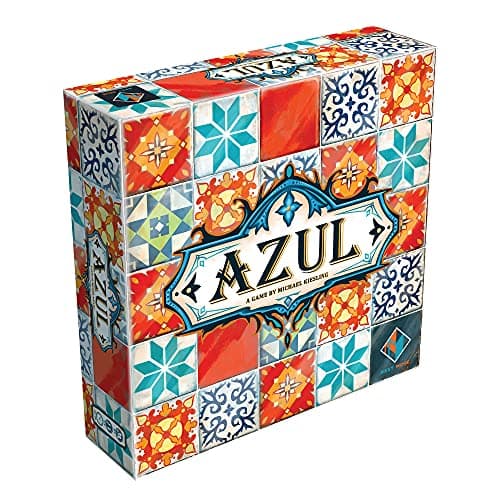
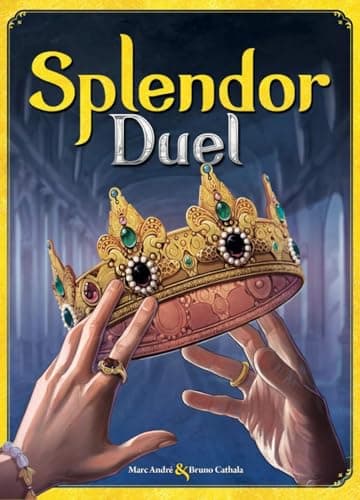
Buy Splendor Duel if you want tension and a game built for two: Space Cowboys publishes it for exactly 2 players at 30 minutes, three victory conditions run from the first turn and any of them can end it instantly. Buy Azul if you want the Spiel des Jahres winner that seats four, teaches in five minutes, and ends on a condition you can both watch approaching.
We earn a commission when you buy through links on this page, at no extra cost to you. It does not change which games we recommend or what we say about them. How this site is funded.
Both of these get recommended as the pretty, approachable, modern option, and both deserve it -- gems in a grid and acrylic tiles on a factory disc are two of the better-looking things you can put on a table for half an hour. That shared surface is why they end up compared.
Underneath, they differ on the one axis that decides how an evening feels: whether the game can stop before you were ready. Splendor Duel can, repeatedly, and that is the point of it. Azul cannot -- its ending is a condition both of you can see building for several rounds. Pick on that, not on the theme.
Quick picks
#
Game
Players
Time
Price
1
Splendor Duel
The gentler duel: an engine builder where you are racing rather than attacking, and the shared gem board is the whole game.
Player counts and playing times come from each publisher, cited on that game's review page. Tap a row to jump to the full write-up.
01
The verified specs
Splendor Duel -- 2 players, 30 minutes, ages 10+. Bruno Cathala and Marc Andre, Space Cowboys, 2022. 67 Jewel cards across 3 levels, 25 tokens, 3 Privilege scrolls, 4 Royal cards, 1 board.
Azul -- 2-4 players, 30-45 minutes, age rating not stated by any reachable source. Michael Kiesling, Plan B Games, 2017. Winner of the 2018 Spiel des Jahres plus five further major awards.
Splendor Duel is Built for two on this site's labeling; Azul is Plays at two. Neither has a publisher-stated solo mode, and neither needs another box to play.
02
How we judged it
Two things decide between these, and the first matters more than any amount of component quality.
Can the game end suddenly? A sudden-ending game creates urgency on every single turn and punishes a long-term plan that was one turn from paying off. Some pairs find that thrilling; others find it genuinely annoying, and it is the most common reason a well-reviewed game stops getting played in a particular house.
Second, how much does the shape of your turn change over the game? A game that builds -- where things you bought earlier make later things cheaper -- feels different from a game where every turn is structurally the same decision with different inputs.
03
Splendor Duel: three live win conditions and no final round
Twenty-five gem tokens sit on a grid, and you may only take up to three that form an uninterrupted line. Jewel cards sit in three levels above it. Cards you buy leave a permanent discount behind, so the game compounds: by the end you are buying things that would have been unreachable at the start.
Three victory conditions are live from the first turn -- 20 prestige points, 10 crowns, or 10 prestige points on cards of a single color -- and the instant anyone meets one at the end of their turn, the game stops. There is no final scoring round. Somebody buys a card and it is simply over.
Crowns do triple duty, which is the detail that makes the game good rather than merely tense: they are a win condition, they unlock Royal cards, and they are something you have to deny. Watching all three clocks at once while also building an engine is the whole skill, and it takes a game or two before you stop being surprised by the ending.
The design also prices greed directly. Taking three tokens of one color, or two pearls, hands your opponent a Privilege scroll in compensation. You are never simply taking -- you are choosing what to pay for taking.
04
Azul: the ending is visible for rounds
Azul's rule is that you take every tile of one color from one supply -- all of them, used or not -- and arrange them in rows. At the end of each round, one tile from each filled row moves to your 5x5 board, scoring by its position relative to tiles already there, and the surplus in that row is discarded at a cost in points.
Rounds continue until a player completes a row all the way across their board, which ends the game. Then the bonuses land: complete rows, complete columns, and full sets of a single color. That end condition is in the players' hands rather than on a timer, but crucially it is also on the table where both of you can count it. Nobody is ambushed.
At two players Azul has more bite than its family-game reputation suggests. With one opponent you know exactly what color they are building toward, so you can take it purely to deny, forcing them to pick up tiles that will be discarded at a penalty. That is real conflict -- it is simply conflict you can both see developing rather than conflict that resolves in one surprise turn.
The trade is that Azul's turn shape never changes. There is one kind of action from the first round to the last. It is a good action, and the advanced placement mode is effectively a harder second game, but there is no compounding engine the way Splendor Duel has one.
05
Seats, teaching and who else plays
Azul wins the practical comparison outright on two counts. It plays 2-4, so the box survives a friend arriving, while Splendor Duel does not scale at all. And its teach is under five minutes against Splendor Duel's two or three rounds of getting used to tracking three win conditions.
Splendor Duel's counter is that it was designed for exactly your situation. Space Cowboys lists 2 players and nothing else, and the token grid, the Privilege scrolls and the instant endings are all built around there being exactly one opponent. Nothing is scaled down or patched.
On age: Space Cowboys rates Splendor Duel 10 and up. No reachable source states an age rating for Azul -- Plan B Games' site redirects elsewhere and Asmodee's product page renders empty -- so if a specific child is going to play, read the box rather than trusting any page, this one included.
One more fact that matters if tiles are the draw: since 2025 Next Move Games publishes Azul Duel for exactly 2 players at 45 minutes, ages 10+. If you want the Azul drafting in a box built for two, that is the one, and it is a sharper game than either of these at the cost of a heavier teach.
06
Skill gap, and which one survives one
This is the question that decides whether a game stays on the table in a real household, and these two answer it differently.
Splendor Duel rewards experience heavily and the reason is structural rather than a matter of difficulty. Because cards you buy leave permanent discounts behind, a player who knows which early purchases compound is building a cheaper economy from turn three onward, and a player who does not will find that every card they want costs more than it should. On top of that, knowing which of the three win conditions is actually reachable -- and spotting when your opponent is one crown from ending the game -- is pure pattern recognition that only arrives with plays. Expect the more practised player to win most games for a while.
Azul flattens that curve, and not because it is shallower. Which tiles are available each round is shuffled, so a less practised player can have a genuinely strong round on supply alone. The deep skill in Azul is in denial and in sequencing placements so they score off each other, but the floor is high: a first-time player who simply takes what they can use will score respectably rather than being shut out.
So for a pair who both play a lot and want to improve at the same game together, Splendor Duel is the better long-term purchase. For a pair where one plays far more than the other and both want to enjoy the evening, Azul is the safer one, and that is a real reason to prefer a 2-4 family game over a game built for two.
07
Pick this if
Pick Splendor Duel if you want genuine tension, enjoy building an engine where early purchases make later ones cheaper, and like the feeling of watching three clocks at once. Built for exactly two, 30 minutes, 10+. It is the more competitive purchase by a wide margin.
Pick Azul if you want the award winner, need up to four seats, want a five-minute teach, or specifically do not want a game that can end before your plan pays off. Plays at two, 2-4, Spiel des Jahres winner.
Pick Azul Duel if the tile drafting is what you want but you want it built for two and adversarial. Pick Patchwork instead of all three if the real requirement is that neither player can interfere with the other at all -- both games on this page let the other person take what you needed.
The gentler duel: an engine builder where you are racing rather than attacking, and the shared gem board is the whole game.
A two-player-only engine-building game in the Splendor universe. You draft gem tokens from a shared board to buy Jewel cards across three levels, chasing three separate victory conditions -- points, a color majority, or crowns. 67 Jewel cards, 25 tokens, 3 Privilege scrolls, 4 Royal cards.
Players
2
Playing time
30 minutes
Age
10+
Designer
Bruno Cathala and Marc Andre
Publisher
Space Cowboys
Published
2022
Who should skip it
Skip it if you want direct conflict. The tension is in what you take from the shared board before the other person can, never in anything you do to their cards.
Five major awards in 2018, and a draft where you must take every tile of the color you want -- including the ones you cannot use.
A tile-drafting game for 2-4 players. You take every tile of one color from a shared supply and arrange them in rows, then move one tile from each filled row onto a 5x5 board where it scores by where it sits relative to the others. Rounds continue until a player completes a row across their board, with bonuses for complete rows, columns and full color sets. Designed by Michael Kiesling, published by Plan B Games in 2017.
Players
2-4
Playing time
30-45 minutes
Designer
Michael Kiesling
Publisher
Plan B Games
Published
2017
Who should skip it
Skip it if you want a game built only for two. Plan B Games lists 2-4, and a two-player-only Azul exists separately as Azul Duel.
+−Is Splendor Duel or Azul better for two players?
Splendor Duel, if you want a game designed for two: Space Cowboys publishes it for exactly 2 players and its three simultaneous win conditions only work with one opponent. Azul is excellent at two but was built as a 2-4 family game, and since 2025 there is a separate Azul Duel for exactly two.
+−Which is easier to learn?
Azul. Its core rule fits in two sentences and a first game starts in about five minutes. Splendor Duel's individual actions are simple, but tracking three live victory conditions at once takes a game or two to get comfortable with.
+−Which game is more relaxing?
Azul, clearly. Its ending is a condition both players can see building for several rounds. Splendor Duel can stop instantly the moment someone meets one of three win conditions, with no final scoring round, which is the opposite of relaxing by design.
+−Does Azul have an engine like Splendor Duel?
No. Azul's turn shape is the same from the first round to the last. In Splendor Duel, cards you buy leave permanent discounts behind, so the game compounds and late purchases become reachable that were not at the start.
+−Can you play Splendor Duel with more than 2 players?
No. Space Cowboys publishes it for exactly 2 players and it does not scale. The multiplayer Splendor is a separate game for 2-4 players, which we do not currently cover.
+−Which has the better components?
Both are strong, in different ways. Azul's heavy acrylic tiles are the reason people reach for the box, and Azul Duel uses the same 75 tiles. Splendor Duel's draw is its weighted tokens and the card art across three levels.