Buy Patchwork if you want a calm evening: it is a spatial puzzle with no race and no way to lose suddenly, rated 8+. Buy Splendor Duel if you want tension: three victory conditions run at once and any of them can end the game on the spot. Both are two-player-only at about 30 minutes.
We earn a commission when you buy through links on this page, at no extra cost to you. It does not change which games we recommend or what we say about them. How this site is funded.
These two land on the same shortlist more often than their themes suggest. Both are published for exactly two players, both run about half an hour, both sit in the same mid price bracket, and -- the thing that actually matters -- neither one lets you touch the other person's board. Nobody gets attacked, nothing gets destroyed, no card forces a discard. For a household that has been burned by a game where one person felt targeted, that shared property is why both keep coming up.
Underneath that, they are opposites. Patchwork is a quiet spatial puzzle you could almost play alone. Splendor Duel is a three-way race that can end before you were ready. The question is not which is better designed -- both are excellent -- but which kind of half hour the two of you actually want.
Quick picks
#
Game
Players
Time
Price
1
Patchwork
The gentlest good game on this site. Two quilts, no attacking, and a surprisingly sharp puzzle underneath.
Player counts and playing times come from each publisher, cited on that game's review page. Tap a row to jump to the full write-up.
01
The verified specs
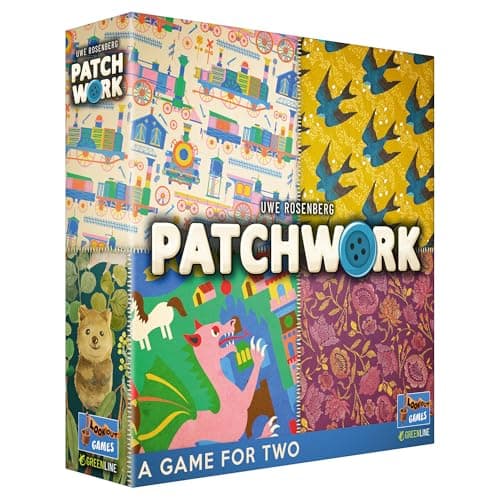
Patchwork -- 2 players, about 30 minutes, ages 8+. Uwe Rosenberg, Lookout Games, 2014. 33 patches plus 5 special patches, 1 time board, 2 player boards, 50 buttons, 1 bonus tile.
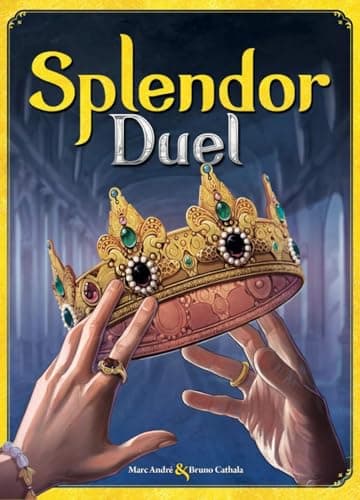
Splendor Duel -- 2 players, 30 minutes, ages 10+. Bruno Cathala and Marc Andre, Space Cowboys, 2022. 67 Jewel cards across 3 levels, 25 tokens, 3 Privilege scrolls, 4 Royal cards, 1 board.
Both are published for exactly two players. Neither scales up, and neither has a solo mode.
02
What they share, and why it matters
Both games run on a restricted shared supply, and both make that restriction the source of the tension. In Patchwork the 33 patches sit in a circle with a neutral token, and on your turn you may only choose from the three patches clockwise of it. In Splendor Duel the 25 gem tokens sit on a grid, and you may only take up to three that form an uninterrupted line. In both cases the thing you want is often not the thing you are allowed to have, and taking what you can reach changes what the other person can reach next.
Neither game has any direct attack. You never take an opponent's patch off their quilt or steal their cards. That makes both of them safe buys for a pair where one person dislikes confrontation, and it is the reason both appear in our date night picks rather than only in the competitive hub.
They are also both fast to explain. Patchwork has two possible actions on a turn; Splendor Duel has three. In neither case will the rules explanation be the hard part.
03
The real difference: a puzzle versus a race
Patchwork has no instant win and no race to a finish line. You buy fabric patches, pay for them in buttons and in time, and fit them onto your own quilt. At the end you count buttons and subtract two points for every empty space you failed to cover. There is a small bonus tile for the first player to fill a seven-by-seven square, and that is the only thing either of you is actively racing for.
Splendor Duel is the opposite shape. Three victory conditions are live from the first turn -- 20 prestige points, 10 crowns, or 10 prestige points on cards of a single color -- and the moment anyone meets one at the end of their turn, the game stops. There is no final scoring round. Somebody buys a card and it is simply over, sometimes before your own plan has paid off.
This is the whole decision, and it is worth being blunt about it. Patchwork cannot spring a loss on you. Splendor Duel can, and does. If what you want on a Tuesday night is something absorbing that will not spike your pulse, the difference is not a detail.
04
Turn order is stranger in Patchwork than people expect
Most two-player games alternate turns. Patchwork does not. Both players move along a shared time track, and whoever is furthest behind takes the next turn -- so a cheap patch that costs little time can buy you two or three turns in a row, while an expensive one hands a run of turns to the other person.
That single rule is what stops Patchwork from being two people doing a puzzle beside each other. Deciding to take a patch is also deciding how much of the near future you are giving away, and good players think about that before they think about the shape.
Splendor Duel alternates strictly, so the pressure there comes from the board rather than the clock. Every token you take opens a line for the other person, and taking three of one color or two pearls actually hands them a Privilege scroll in compensation. Both designs make you pay for greed. Patchwork charges you in turns; Splendor Duel charges you in tempo and privileges.
05
Spatial thinking versus economic thinking
Patchwork asks a spatial question over and over: will this shape fit, and what hole am I creating by placing it here? If one of you enjoys packing a suitcase or a car trunk well, they will enjoy this. If spatial puzzles make the other person feel slow, no amount of theme will rescue it -- that is the single most common reason a copy of Patchwork stops getting played.
Splendor Duel asks an economic one: which cards make later cards cheaper, and which of the three finish lines am I actually closest to? Cards you buy leave a permanent discount behind, so the game builds on itself, and crowns do triple duty as a win condition, a bonus engine and something you have to deny.
There is no ranking here, only a fit. Households usually discover within one game which of the two kinds of thinking they enjoy, and it is rarely the same for both people at the table.
06
Age, and who else might play
Lookout Games rates Patchwork 8 and up; Space Cowboys rates Splendor Duel 10 and up. If there is a younger child in the house who will eventually want in, Patchwork is the one that will take them, and the gentle scoring means a first game against an adult is not humiliating.
That said, neither is a children's game and we do not recommend them as such. The ratings matter here only because they widen who else in the household can join, which for some buyers is the deciding factor between two otherwise close games.
07
Pick this if
Pick Patchwork if you want a calm game, if either of you dislikes sudden endings, if spatial puzzles appeal, or if a child in the house might play too. It is the gentlest good game we cover.
Pick Splendor Duel if you want real tension, enjoy building an engine, and like the feeling of watching three clocks at once. It is the more competitive purchase by a wide margin.
Pick neither, and look at a co-op, if what you actually want is to be on the same side. Neither of these is cooperative, and no amount of indirectness changes that one of you loses.
The gentlest good game on this site. Two quilts, no attacking, and a surprisingly sharp puzzle underneath.
A two-player-only tile-laying game. You buy fabric patches on a shared time track and fit them onto a personal 9x9 quilt board, paying with buttons and with time.
Players
2
Playing time
about 30 minutes
Age
8+
Designer
Uwe Rosenberg
Publisher
Lookout Games
Published
2014
Who should skip it
Skip it if you want to interact. You are mostly solving your own board, and the only contact is who takes which patch first.
The gentler duel: an engine builder where you are racing rather than attacking, and the shared gem board is the whole game.
A two-player-only engine-building game in the Splendor universe. You draft gem tokens from a shared board to buy Jewel cards across three levels, chasing three separate victory conditions -- points, a color majority, or crowns. 67 Jewel cards, 25 tokens, 3 Privilege scrolls, 4 Royal cards.
Players
2
Playing time
30 minutes
Age
10+
Designer
Bruno Cathala and Marc Andre
Publisher
Space Cowboys
Published
2022
Who should skip it
Skip it if you want direct conflict. The tension is in what you take from the shared board before the other person can, never in anything you do to their cards.
+−Is Patchwork or Splendor Duel better for couples?
Patchwork, if you want a relaxed evening -- it has no race and cannot end suddenly. Splendor Duel is better if you both enjoy competing. Neither lets you attack the other player's board, which is why both appear in our date night picks.
+−Which is easier to learn?
Patchwork, slightly. It has two possible actions per turn and scores at the end. Splendor Duel's actions are simple too, but tracking three simultaneous victory conditions takes a game or two to get used to.
+−Are both games two-player only?
Yes. Lookout Games states 2 players for Patchwork and Space Cowboys states 2 players for Splendor Duel. Neither scales to three and neither has a solo mode.
+−Which has more interaction?
Splendor Duel. Both restrict what you can take from a shared supply, but Splendor Duel's three live win conditions mean you must constantly watch what the other player is close to. Patchwork's interaction is mostly the shared time track and which patches you leave behind.
+−Can you play Patchwork with a child?
Lookout Games rates it 8 and up, so an older child can play. It is not a children's game and we do not recommend it as one, but the gentle scoring makes a first game against an adult less discouraging than most.