Buy Patchwork if one of you does not want to be attacked; it has no conflict at all and teaches in one action. Buy 7 Wonders Duel if you both enjoy competing and want depth. Both are two-player-only and about 30 minutes; Patchwork is rated 8+, Duel 10+.
We earn a commission when you buy through links on this page, at no extra cost to you. It does not change which games we recommend or what we say about them. How this site is funded.
These two get compared because they are both the answer to "what is the best two-player game" -- from different people. 7 Wonders Duel is the answer from people who want a duel. Patchwork is the answer from people who want an evening.
Same length, same player count, and they sit at opposite ends of the conflict spectrum.
Conflict is the whole difference
7 Wonders Duel is directly confrontational by design. You draft from a shared pyramid, taking cards specifically to deny them is standard play, and the military track pushes toward the other player's capital. Two of its three win conditions end the game the instant they trigger.
Patchwork has no attacking of any kind. You each build your own quilt, and the only shared decision is which patch gets bought first. When you lose, it is because your quilt had holes in it -- not because of anything the other person chose to do to you.
For a lot of households that is the entire purchasing decision, and no amount of design quality routes around it.
03Depth and teach time
Duel is the deeper game and it is not close. Patchwork's central decision -- buy a patch, or move past your opponent for buttons -- is genuinely sharp every time, but its decision space is small and the patch set is the same every game.
Patchwork teaches in one action and is playable immediately. Duel's card symbols need a game before the turns flow, so its first session is the longest on this site. If you are introducing someone to two-player games, that difference matters more than depth does.
The picks in full
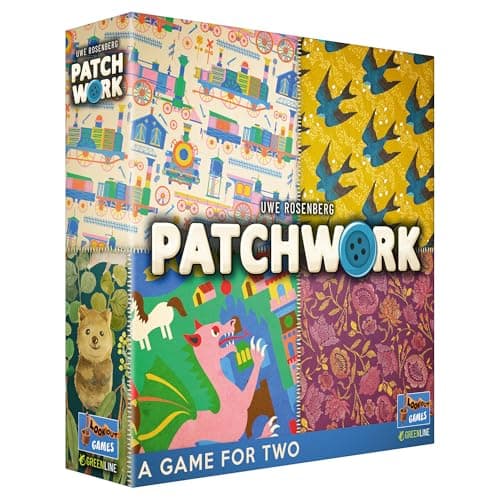
2 players · about 30 minutes · ages 8+
The gentlest good game on this site. Two quilts, no attacking, and a surprisingly sharp puzzle underneath.
A two-player-only tile-laying game. You buy fabric patches on a shared time track and fit them onto a personal 9x9 quilt board, paying with buttons and with time.
- 2
- about 30 minutes
- 8+
- Uwe Rosenberg
- Lookout Games
- 2014
Skip it if you want to interact. You are mostly solving your own board, and the only contact is who takes which patch first.
Specs from Patchwork - Lookout Games (publisher: players, time, age, designer, contents), Patchwork (board game) - Wikipedia infobox.
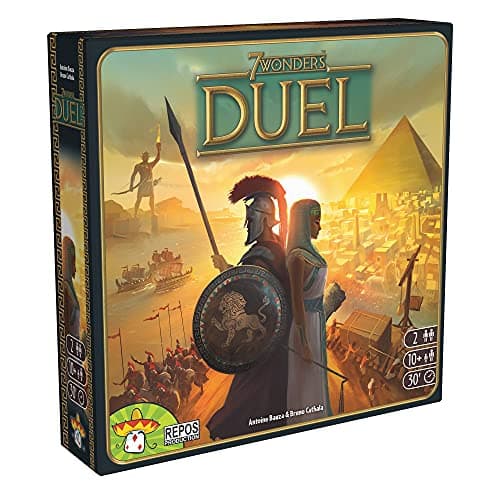
2 players · 30 minutes · ages 10+
The strongest all-round two-player game in print, and the one most couples settle on.
A two-player-only card drafting game where each side builds a civilization across three ages. Three ways to win -- civilian points, military supremacy and scientific dominance -- run at once, so every card you take is also a card denied.
- 2
- 30 minutes
- 10+
- Antoine Bauza and Bruno Cathala
- Repos Production
- 2015
Skip it if you want a relaxing evening. Three win conditions run at once, so you are always watching what the other person is about to do.
Specs from 7 Wonders Duel official site (Repos Production).