There are three fixes when losing to a partner sours the evening: cooperative games where you win or lose together, no-attack games where you never touch each other's position, and asymmetric games where the two sides are not directly comparable. Codenames: Duet, Patchwork and Watergate are the respective picks.
We earn a commission when you buy through links on this page, at no extra cost to you. It does not change which games we recommend or what we say about them. How this site is funded.
This is a common situation and it is not a character flaw. Losing repeatedly to the same person, in your own home, on a weeknight, is a different experience from losing to a stranger at a games club, and plenty of people who are perfectly relaxed about the second find the first grates.
The good news is that game design has three distinct structural answers, and picking the right one for your specific version of the problem works far better than resolving to be more gracious about it.
01
Fix one: cooperative -- remove the opponent
The most complete answer. In a cooperative game you win or lose together, so there is no record to accumulate and nobody to lose to.
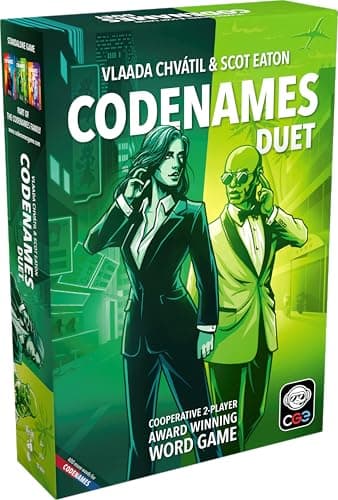
The caveat is the alpha player problem: if one of you is stronger, an open-information co-op just relocates the issue -- now one person is directing and the other is executing, which can be worse than losing. So buy a co-op with a structural communication limit. Codenames: Duet caps you at one word and a number. Sky Team goes further and forbids you from revealing your dice at all.
Best for: pairs where the problem is the competition itself, not the losing specifically.
02
Fix two: no-attack -- remove the targeting
Often the real complaint is not losing but being targeted -- having your plan dismantled by someone who chose to dismantle it. That is a different problem and it has a different fix.
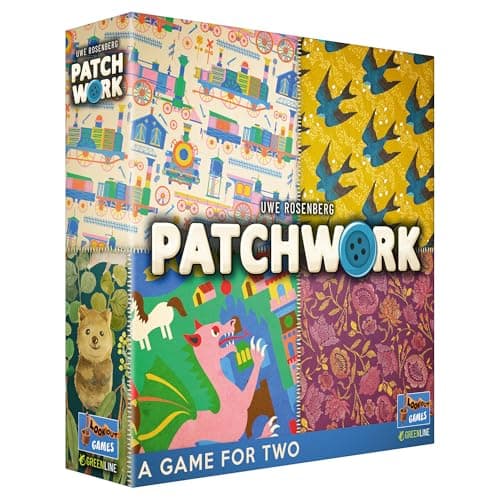
In a no-attack game you compete but never touch each other's position. Patchwork is the purest version: two separate quilts, and the only shared decision is who takes which patch first. Jaipur is nearly as clean -- you race for the same tokens but never reach across the table.
The loss still happens, but it is about your own board rather than about something the other person did to you, and for a lot of households that is the entire difference.
Best for: pairs where competing is fine but direct conflict is not.
03
Fix three: asymmetric -- remove the comparison
The subtlest and most underrated. If the two sides of a game have different tools and different win conditions, then a loss is not a clean statement that the other person played better -- you were doing different jobs.
Watergate is the clearest example we recommend: one side is the Nixon administration and the other the Washington Post, and their positions are not comparable in any straightforward way. It is a properly sharp game that produces much less legible results than a symmetric one.
Best for: pairs who both actively enjoy competing but find the ranking uncomfortable.
04
What not to do
Do not use a handicap. Everyone involved knows, and it makes the wins hollow and the losses worse.
Do not buy a luck-free abstract and hope. Hive and Onitama have no randomness at all, so the record is lopsided and there is nothing to attribute it to. They are excellent games and exactly wrong for this situation.
Do not play only long games. A 90-minute loss costs an evening; a 15-minute loss costs nothing and you can play again immediately. Short games are quietly one of the best fixes available.
05
If you want the deck to help
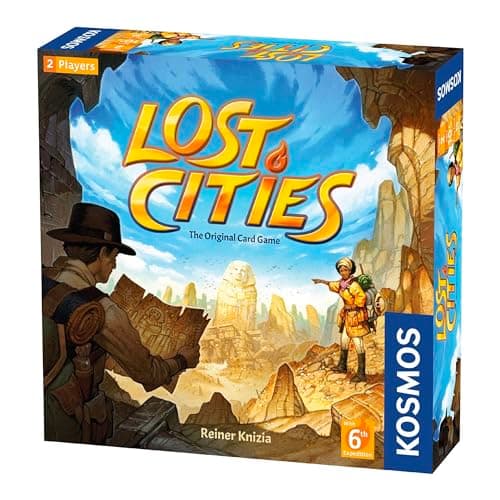
A fourth partial fix worth knowing: card games with a real draw give the weaker player genuine wins without anybody arranging it. Lost Cities is the strongest example, because committing to an expedition costs 20 points and whether the cards come is not up to you.
This is not the same as a handicap. The decisions are still entirely yours, so the wins are earned -- they just are not guaranteed to go to the stronger player every single time, which is all most households need.
What we would buy
Picks drawn from the games covered on this site, chosen against the criteria above.
We earn a commission when you buy through links on this page, at no extra cost to you. It does not change which games we recommend or what we say about them. How this site is funded.
The gentlest good game on this site. Two quilts, no attacking, and a surprisingly sharp puzzle underneath.
A two-player-only tile-laying game. You buy fabric patches on a shared time track and fit them onto a personal 9x9 quilt board, paying with buttons and with time.
Players
2
Playing time
about 30 minutes
Age
8+
Designer
Uwe Rosenberg
Publisher
Lookout Games
Published
2014
Who should skip it
Skip it if you want to interact. You are mostly solving your own board, and the only contact is who takes which patch first.
Built around two people and honest about it, though the publisher lists it as 2+ rather than two only.
A cooperative word-association game. You each see half of a shared key card and give one-word clues to guide the other to the right agents in a 5x5 grid, avoiding the assassin.
Players
2+
Playing time
15 minutes
Age
11+
Designer
Vlaada Chvatil and Scot Eaton
Publisher
Czech Games Edition
Who should skip it
Skip it if one of you thinks in wildly different associations from the other. That gap is funny once and exhausting by the fourth game.
Asymmetric, historical, and finished inside an hour -- the shortest route into serious card-driven games for two.
A two-player-only asymmetric card-driven game. One side is the Nixon administration, the other the Washington Post, and every card is both an action for you and a resource for the opponent.
Players
2
Playing time
30-60 minutes
Age
12+
Designer
Matthias Cramer
Publisher
Capstone Games
Published
2019
Who should skip it
Skip it if you both want the same experience. The two sides play very differently and one of you will prefer a side.
Built for two2 players · 30 minutes · ages 10 and up
Old enough to vote and still the cleanest press-your-luck card game for two.
A two-player-only card game about mounting expeditions. Every card you play must be higher than the last on that color, so committing early is how you score and also how you go negative.
Players
2
Playing time
30 minutes
Age
10 and up
Designer
Reiner Knizia
Publisher
Kosmos / Rio Grande Games
Published
1999
Who should skip it
Skip it if a run of bad draws will sour the evening. The cards decide more here than in anything else we recommend.
+−What board games are best when losing to your partner is a problem?
Cooperative games such as Codenames: Duet remove the opponent entirely. No-attack games such as Patchwork remove the targeting. Asymmetric games such as Watergate remove the direct comparison.
+−Should we use a handicap to even things out?
No. Handicaps make wins feel hollow and losses feel worse, because both players know the result was arranged. A game with genuine luck in it does the same job without anyone's involvement.
+−Are abstract games a bad idea in this situation?
Yes. Hive and Onitama have no luck at all, so the stronger player wins consistently and there is nothing to attribute the record to. They are great games and the wrong ones here.
+−Does game length matter?
A lot. A 15-minute loss costs nothing and you can play again straight away; a 90-minute loss costs the whole evening. Short games are one of the most effective and least discussed fixes.