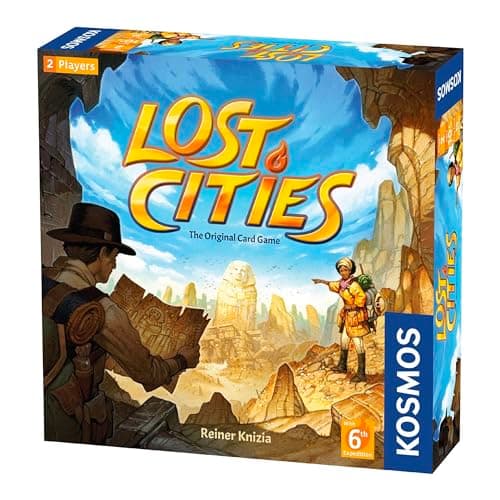
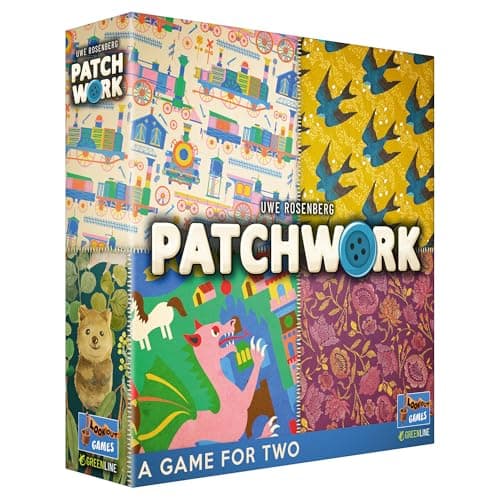
Buy Patchwork if you want a puzzle with no luck and a physical board; it is 2 players, about 30 minutes, ages 8+. Buy Lost Cities if you want a card game that packs small and gives the weaker player real wins; it is 2 players, 30 minutes, ages 10 and up.
We earn a commission when you buy through links on this page, at no extra cost to you. It does not change which games we recommend or what we say about them. How this site is funded.
Both of these are the answer to the same question -- what do we play when one of us does not want to be attacked -- and they answer it in completely different ways.
Patchwork removes conflict by giving you separate boards. Lost Cities removes it by making the deck the antagonist.
Luck is the real difference
Patchwork has almost none. The patch circle is shuffled at setup and after that everything is visible, so the better player wins consistently. It is a puzzle you get better at.
Lost Cities is substantially luck-driven within a hand. Commit to an expedition and the cards for it may never come, and no skill rescues that. Across three rounds skill wins out, but any individual round can go either way.
This is the deciding factor for most households, and it points opposite ways depending on your situation. Skill gap between you? Lost Cities, so the weaker player gets genuine wins. Evenly matched and want your decisions to be what decides it? Patchwork.
03Table footprint
Lost Cities is cards and a small shared area -- it works on a coffee table, a train seat, a lap. Patchwork wants a real surface: two personal boards plus a ring of tiles is a meaningfully larger footprint, and cramping it makes the puzzle harder to read.
If you play at a dining table, ignore this. If you play on a sofa, it decides the purchase.
The picks in full
2 players · about 30 minutes · ages 8+
The gentlest good game on this site. Two quilts, no attacking, and a surprisingly sharp puzzle underneath.
A two-player-only tile-laying game. You buy fabric patches on a shared time track and fit them onto a personal 9x9 quilt board, paying with buttons and with time.
- 2
- about 30 minutes
- 8+
- Uwe Rosenberg
- Lookout Games
- 2014
Skip it if you want to interact. You are mostly solving your own board, and the only contact is who takes which patch first.
Specs from Patchwork - Lookout Games (publisher: players, time, age, designer, contents), Patchwork (board game) - Wikipedia infobox.
2 players · 30 minutes · ages 10 and up
Old enough to vote and still the cleanest press-your-luck card game for two.
A two-player-only card game about mounting expeditions. Every card you play must be higher than the last on that color, so committing early is how you score and also how you go negative.
- 2
- 30 minutes
- 10 and up
- Reiner Knizia
- Kosmos / Rio Grande Games
- 1999
Skip it if a run of bad draws will sour the evening. The cards decide more here than in anything else we recommend.
Specs from Lost Cities - Wikipedia infobox.