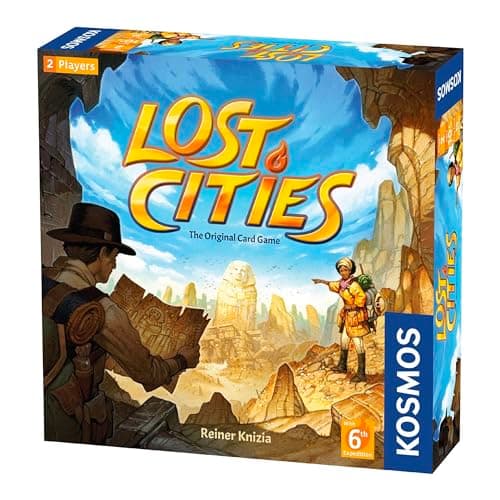
Lost Cities is a two-player-only card game by Reiner Knizia, published 1999 by Kosmos and Rio Grande Games, listed at 30 minutes for ages 10 and up. Each expedition you start costs 20 points before it scores, so committing is the entire decision.
We earn a commission when you buy through links on this page, at no extra cost to you. It does not change which games we recommend or what we say about them. How this site is funded.
Lost Cities was published in 1999 and remains one of the cleanest two-player card games ever designed. It survives because the central decision is genuinely hard and never gets easier with practice.
Every expedition you begin starts at minus twenty points. You have to get past that before you score anything at all, and the game will not let you know in advance whether you can.
01
The minus-twenty rule is the game
Playing a single card to an expedition commits you to it and to its twenty-point penalty. Two or three cards on that color and you are still losing money. Five or six and you are ahead.
So each turn asks the same question in a different costume: is this expedition going to develop, or am I about to sink twenty points into a color that never comes? Committing early is how you score and it is also how you lose badly, and the two are indistinguishable at the moment you decide.
The ascending-order rule sharpens it further. Cards on an expedition must be higher than the last one played there, so a low card played early keeps your options open and a high card played early forecloses them. There is no way to hedge.
02
The luck question, honestly
The draw matters here more than in anything else we recommend. A run where the colors you committed to never appear is a losing run, and there is no play that rescues it.
That is a real weakness and also a real feature depending on your household. In a pair with a skill gap it is exactly what you want -- the weaker player wins regularly, and the wins feel earned because the decisions were still theirs. In a pair of closely matched competitive players it can grate, and Hive or 7 Wonders Duel will suit better.
Playing three rounds rather than one, which is the standard way to play, takes most of the sting out without removing the tension.
03
Who should skip it
Skip it if a run of bad draws will sour the evening. The cards decide more here than in anything else on this site, and no amount of skill compensates within a single hand.
Skip it if you want your decisions to compound visibly across a game. This is a series of sharp isolated bets rather than an engine you build, and people who love the feeling of a plan coming together often find it flat.
What we would buy
Picks drawn from the games covered on this site, chosen against the criteria above.
We earn a commission when you buy through links on this page, at no extra cost to you. It does not change which games we recommend or what we say about them. How this site is funded.
Lost Cities
Built for two2 players · 30 minutes · ages 10 and up
Old enough to vote and still the cleanest press-your-luck card game for two.
A two-player-only card game about mounting expeditions. Every card you play must be higher than the last on that color, so committing early is how you score and also how you go negative.
Players
2
Playing time
30 minutes
Age
10 and up
Designer
Reiner Knizia
Publisher
Kosmos / Rio Grande Games
Published
1999
Who should skip it
Skip it if a run of bad draws will sour the evening. The cards decide more here than in anything else we recommend.
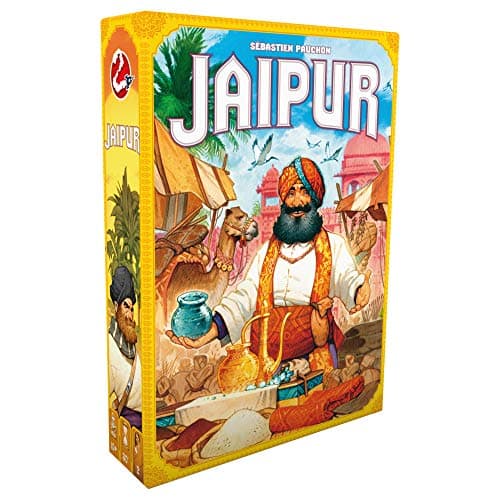
The best first two-player card game there is: five minutes to teach, and it keeps giving for years.
A two-player-only trading card game. You collect and sell goods in sets, racing the other trader for bonus tokens that shrink as they are taken. Best of three rounds decides it.
Players
2
Playing time
30 minutes
Age
10+
Designer
Sebastien Pauchon
Publisher
Asmodee / GameWorks
Published
2009
Who should skip it
Skip it if you want a board on the table. This is cards and tokens, and it looks slight next to a game with a map.
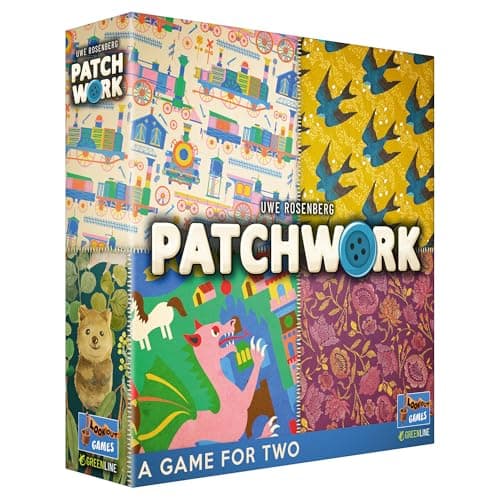
The gentlest good game on this site. Two quilts, no attacking, and a surprisingly sharp puzzle underneath.
A two-player-only tile-laying game. You buy fabric patches on a shared time track and fit them onto a personal 9x9 quilt board, paying with buttons and with time.
Players
2
Playing time
about 30 minutes
Age
8+
Designer
Uwe Rosenberg
Publisher
Lookout Games
Published
2014
Who should skip it
Skip it if you want to interact. You are mostly solving your own board, and the only contact is who takes which patch first.
Yes. The original card game is published for exactly 2 players, at 30 minutes for ages 10 and up.
+−Why does every expedition start at minus twenty?
It is the cost of committing. You must play enough cards on a color to clear the penalty before it scores anything, which makes every early commitment a genuine risk.
+−Is there too much luck in Lost Cities?
There is meaningful luck within a hand. Playing the standard three rounds spreads it out, and that balance is exactly what makes it work in households with a skill gap.
+−How old is Lost Cities?
It was published in 1999, designed by Reiner Knizia. It has been continuously available since, which is unusual for a two-player card game.