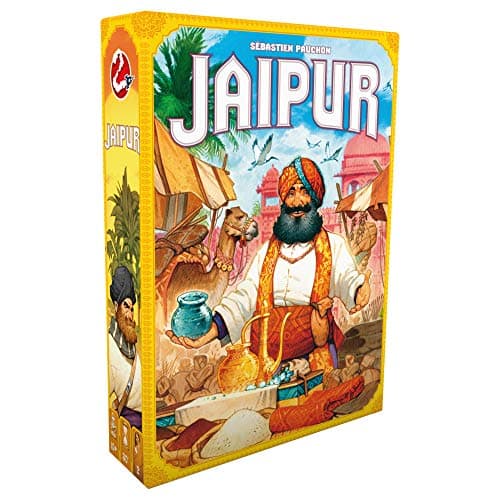
Jaipur is a two-player-only trading card game designed by Sebastien Pauchon, listed at 30 minutes for ages 10 and up. You collect and sell goods in sets while racing for bonus tokens that lose value as they are taken. It is the best single first purchase for a pair.
We earn a commission when you buy through links on this page, at no extra cost to you. It does not change which games we recommend or what we say about them. How this site is funded.
Jaipur is the game we would hand to anyone who has never bought a board game and wants one for two people. It teaches in about five minutes, it plays in about thirty, and people who own several hundred games still have it on the shelf.
What makes it work is that the core decision is always the same and always hard: sell now for a good token, or hold for a bigger set and risk the good tokens being gone.
01
The shrinking tokens are the whole design
Each type of good has a stack of tokens, and they are ordered highest first. Sell early and you take the top ones. Sell late and you take whatever is left.
This does something quietly clever. It makes the race real without any direct attacking. You never touch the other trader's hand or block their move, but every token they take is one you cannot have, and the pressure is constant. That is why the game suits households where one person dislikes confrontational games -- the competition is total and the aggression is zero.
The bonus tokens for selling three, four or five goods at once pull the other way, rewarding patience. Those two forces in tension are the entire game, and they never resolve into an obvious right answer.
02
Best of three, and why that matters
A match is two or three rounds rather than one, which quietly fixes the biggest problem with light card games. A single round can be decided by a lucky market flip. A best-of-three cannot, and the loser of round one gets to change approach knowing what the other person favors.
It also keeps the running time honest. Each round is roughly ten minutes, so you can stop after one on a short evening or play the full match on a long one, without either feeling like the wrong version of the game.
03
Who should skip it
Skip it if you want a board on the table. This is cards and tokens, and next to a game with a map it looks slight -- which matters more than it should when you are trying to persuade someone that board games are worth an evening.
Skip it also if you specifically want to interact directly. There is no attacking here at all. If what the two of you enjoy is the sharpness of taking something from each other, Hive or Onitama will scratch that and this will not.
What we would buy
Picks drawn from the games covered on this site, chosen against the criteria above.
We earn a commission when you buy through links on this page, at no extra cost to you. It does not change which games we recommend or what we say about them. How this site is funded.
The best first two-player card game there is: five minutes to teach, and it keeps giving for years.
A two-player-only trading card game. You collect and sell goods in sets, racing the other trader for bonus tokens that shrink as they are taken. Best of three rounds decides it.
Players
2
Playing time
30 minutes
Age
10+
Designer
Sebastien Pauchon
Publisher
Asmodee / GameWorks
Published
2009
Who should skip it
Skip it if you want a board on the table. This is cards and tokens, and it looks slight next to a game with a map.
Built for two2 players · 30 minutes · ages 10 and up
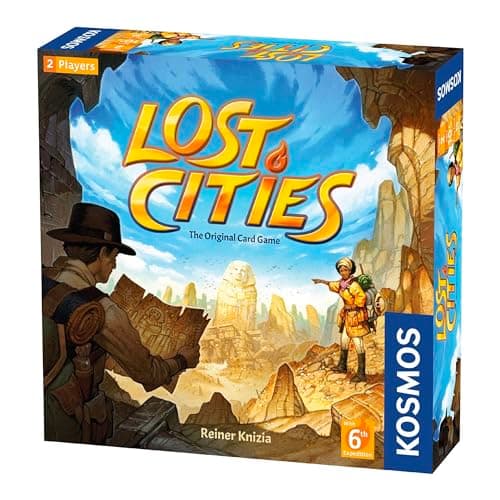
Old enough to vote and still the cleanest press-your-luck card game for two.
A two-player-only card game about mounting expeditions. Every card you play must be higher than the last on that color, so committing early is how you score and also how you go negative.
Players
2
Playing time
30 minutes
Age
10 and up
Designer
Reiner Knizia
Publisher
Kosmos / Rio Grande Games
Published
1999
Who should skip it
Skip it if a run of bad draws will sour the evening. The cards decide more here than in anything else we recommend.
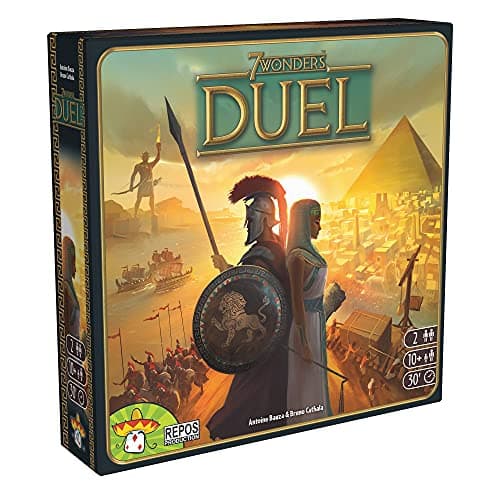
The strongest all-round two-player game in print, and the one most couples settle on.
A two-player-only card drafting game where each side builds a civilization across three ages. Three ways to win -- civilian points, military supremacy and scientific dominance -- run at once, so every card you take is also a card denied.
Players
2
Playing time
30 minutes
Age
10+
Designer
Antoine Bauza and Bruno Cathala
Publisher
Repos Production
Published
2015
Who should skip it
Skip it if you want a relaxing evening. Three win conditions run at once, so you are always watching what the other person is about to do.
Yes. It is published for exactly 2 players, at a stated 30 minutes for ages 10 and up.
+−Is Jaipur good for someone who has never played a board game?
It is the best option on this site for that. The rules explanation takes about five minutes and the core decision is intuitive from the first turn.
+−Is there much luck in Jaipur?
Enough that a weaker player wins individual rounds, not enough to decide a best-of-three match. That balance is exactly what makes it work in households with a skill gap.
+−How long does a game of Jaipur take?
The publisher states 30 minutes for the full match. Individual rounds run roughly ten minutes, so you can play one round on a short evening.