Buy Jaipur first if this is an early purchase or one of you is new to board games: it teaches in five minutes and its best-of-three structure forgives a bad round. Buy Splendor Duel if you want a deeper race with three ways to win. Both are Space Cowboys games for exactly two players at 30 minutes.
We earn a commission when you buy through links on this page, at no extra cost to you. It does not change which games we recommend or what we say about them. How this site is funded.
These two get compared constantly, and for once the comparison is fair. Both are published by Space Cowboys, both are stated for exactly two players at 30 minutes and ages 10 and up, and both are about taking goods from a shared market before the other person can. If you have already narrowed a first or second purchase down to this pair, you have narrowed it well.
What separates them is how much the game asks you to hold in your head at once. Jaipur asks one sharp question over and over. Splendor Duel asks three questions simultaneously and ends the moment any of them is answered. Which of those suits your household is the whole decision, and the rest of this page is about how to tell.
Quick picks
#
Game
Players
Time
Price
1
Jaipur
The best first two-player card game there is: five minutes to teach, and it keeps giving for years.
Player counts and playing times come from each publisher, cited on that game's review page. Tap a row to jump to the full write-up.
01
The verified specs
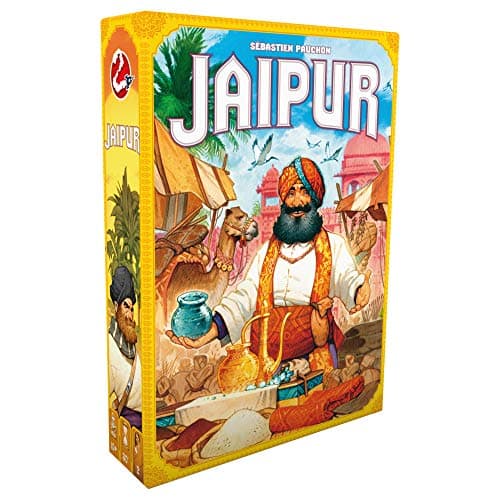
Jaipur -- 2 players, 30 minutes, ages 10+. Sebastien Pauchon, Space Cowboys. First published 2009. 55 goods cards, 38 goods tokens, 18 bonus tokens, 3 Seals of Excellence.
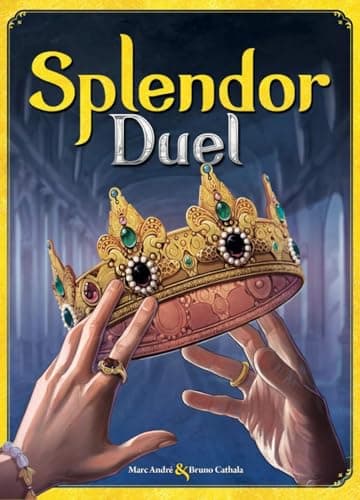
Splendor Duel -- 2 players, 30 minutes, ages 10+. Bruno Cathala and Marc Andre, Space Cowboys, 2022. 67 Jewel cards across 3 levels, 25 tokens, 3 Privilege scrolls, 4 Royal cards, 1 board.
Both are published for exactly two players. Neither scales up, and neither has a solo mode.
02
What they have in common
Both games run on a shared market. In Jaipur it is a row of five face-up cards that both traders draw from; in Splendor Duel it is a grid of 25 gem tokens that both players take from. Neither game lets you touch the other person's cards or tableau. The interaction is entirely about what you take before they can, and what you leave behind for them.
That makes them the same kind of competitive: indirect, and unlikely to produce a real argument. If one of you has been burned by a game with direct attacking and wants something where nobody gets targeted, either of these is a safe buy. That is not a small thing, and it is why both appear on our beginner picks.
They also share a publisher, an art style that leans warm rather than austere, and a box that fits a small table. The difference is not in the category. It is in the weight.
03
Teach time
Jaipur explains in about five minutes and it is not an exaggeration. On your turn you either take cards from the market or sell a set of goods for tokens. Camels help you trade and cannot be sold, though whoever holds the bigger herd when a round ends collects a small camel bonus. Sell three or more of one good at once and you get a bonus token on top. The richest trader at the end of a round takes a Seal of Excellence, and two Seals wins. You can start the first game while the explanation is still finishing.
Splendor Duel's turn is nearly as simple -- take up to three tokens in a line, or buy a card, or reserve one -- but the thing you are trying to do is not. Three victory conditions run at the same time: 20 prestige points, 10 crowns, or 10 prestige points in a single color. All three are live from the first turn, and reaching any one of them at the end of your turn ends the game immediately. Teaching the actions takes five minutes. Teaching a new player to watch all three clocks takes a game or two, and the first game usually ends before one of you has noticed which race they were losing.
If the person across the table is playing to spend time with you rather than to acquire a hobby, that gap decides it. Jaipur is the one you can put down in front of almost anyone.
04
How much the deck decides
Jaipur has real variance, and it is the good kind. The market refills from a face-down deck, so the goods you are waiting for may arrive at exactly the wrong moment or not at all. Within a round, luck matters. Across a best-of-three match, the better trader nearly always wins, because the bonus tokens that reward bigger sales are a skill lever the deck cannot take away.
Splendor Duel's luck is thinner and sits in one place: which Jewel cards happen to be revealed in the pyramid. Everything else -- the token grid, the privileges, the crowns -- is in plain view and under the two players' control. A stronger player will win consistently, and there is no shuffle between rounds to reset the score.
This points opposite ways depending on who is at the table. A skill gap between the two of you? Jaipur, because the weaker player gets genuine wins rather than consolation. Evenly matched and you want your decisions to be the thing that decides it? Splendor Duel.
05
Best of three versus a single race
The structural difference nobody mentions is how each game ends, and it changes how losing feels. Jaipur is played in rounds. Lose a round badly and you have lost one Seal, not the game, and the next round starts clean. It is hard to be crushed at Jaipur because the design keeps handing you a fresh start.
Splendor Duel is one continuous race with three finish lines. Get behind on all three and there is no reset coming -- you have to claw the position back in the same game, against an engine that is already ahead of yours. It can also end abruptly, sometimes a turn before your own plan was going to pay off, which some people find thrilling and others find genuinely irritating.
For a pair who plays to relax, the rounds structure is kinder. For a pair who plays to compete, the single race is the more satisfying shape, because a comeback in it is a real comeback.
06
Where the tension actually lives
Jaipur's entire tension is one decision: sell now, or hold for a bigger set. Goods tokens are stacked with the most valuable on top, so every sale the other trader makes lowers what your own goods will be worth. Wait too long and the value has gone; sell too early and you miss the bonus for a bigger set. That is the whole game, and it never gets easy.
Splendor Duel spreads its tension across the board. Because tokens must be taken in an uninterrupted line, taking the three you want almost always opens a line for the other person, and the best players are choosing which gems to take on the basis of what they leave. On top of that, taking three of one color or two pearls hands your opponent a Privilege scroll, so the greediest move is frequently the one that pays them back.
In practice: Jaipur is a game about timing, and Splendor Duel is a game about position. People who like the feel of a poker decision tend to prefer the first. People who like chess-shaped problems tend to prefer the second.
07
Pick this if
Pick Jaipur if this is a first or early purchase, if there is a skill gap, if either of you prefers a game that forgives a bad round, or if you want the smaller box -- it is cards and tokens and works on a train tray.
Pick Splendor Duel if you both already enjoy board games, want a proper engine to build and a race with more than one way to win, and can give the first game to learning which of the three clocks matters.
Own both, eventually. They scratch different itches from the same shelf: Jaipur gets played on a weeknight when you have twenty minutes, and Splendor Duel gets played when you want the evening to be about the game.
The best first two-player card game there is: five minutes to teach, and it keeps giving for years.
A two-player-only trading card game. You collect and sell goods in sets, racing the other trader for bonus tokens that shrink as they are taken. Best of three rounds decides it.
Players
2
Playing time
30 minutes
Age
10+
Designer
Sebastien Pauchon
Publisher
Asmodee / GameWorks
Published
2009
Who should skip it
Skip it if you want a board on the table. This is cards and tokens, and it looks slight next to a game with a map.
The gentler duel: an engine builder where you are racing rather than attacking, and the shared gem board is the whole game.
A two-player-only engine-building game in the Splendor universe. You draft gem tokens from a shared board to buy Jewel cards across three levels, chasing three separate victory conditions -- points, a color majority, or crowns. 67 Jewel cards, 25 tokens, 3 Privilege scrolls, 4 Royal cards.
Players
2
Playing time
30 minutes
Age
10+
Designer
Bruno Cathala and Marc Andre
Publisher
Space Cowboys
Published
2022
Who should skip it
Skip it if you want direct conflict. The tension is in what you take from the shared board before the other person can, never in anything you do to their cards.
+−Which should I buy first, Jaipur or Splendor Duel?
Jaipur, unless you are both already experienced with board games. It teaches in about five minutes and its best-of-three rounds forgive a bad start. Splendor Duel is the better game to grow into.
+−Is Splendor Duel harder than Jaipur?
Yes, noticeably. The turn actions are simple in both, but Splendor Duel makes you track three victory conditions at once and offers no reset between rounds. Jaipur asks one decision -- sell now or hold -- repeatedly.
+−Which has more luck?
Jaipur. Its market refills from a face-down deck, so within a round the cards can go against you. Across three rounds the better player usually wins. Splendor Duel's only luck is which cards are revealed, and everything else is in plain view.
+−Are both games two-player only?
Yes. Space Cowboys states 2 players for both Jaipur and Splendor Duel. Neither has a solo mode and neither scales to three.
+−Are Jaipur and Splendor Duel by the same designer?
No. Jaipur is by Sebastien Pauchon. Splendor Duel is by Bruno Cathala and Marc Andre. They share a publisher, Space Cowboys, and a market-trading theme, not a designer.