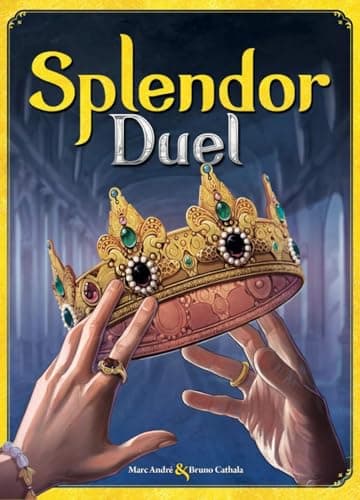
Splendor Duel is worth it for pairs who want a sharp competitive game that finishes in half an hour: Space Cowboys lists it at 30 minutes for exactly 2 players, ages 10 and up. It is not worth it if you want a calm evening, or if a skill gap between you already causes friction.
We earn a commission when you buy through links on this page, at no extra cost to you. It does not change which games we recommend or what we say about them. How this site is funded.
Splendor Duel gets recommended constantly and returned more often than its reputation suggests, and the reason is almost always the same: people buy it expecting the original Splendor for two, and it is a much sharper game than that.
This page is about deciding before you spend. The specs are not in question -- Space Cowboys publishes it for exactly 2 players at 30 minutes, ages 10 and up, by Bruno Cathala and Marc Andre. What is in question is whether the kind of half hour it produces is the one you want.
01
What you are actually paying for
A two-player-only engine builder that runs on one small contested board. Twenty-five gem tokens sit on a grid and you take up to three of them at a time, in an uninterrupted straight line. Those gems buy Jewel cards across three levels, and cards you buy leave a permanent discount behind, so the game compounds.
Three victory conditions are live from the first turn: 20 prestige points, 10 crowns, or 10 prestige points on cards of a single color. Meeting any one of them at the end of your turn ends the game immediately -- there is no final scoring round.
The box holds 67 Jewel cards, 25 tokens, 3 Privilege scrolls and 4 Royal cards. That is a small footprint for a game with this much going on, which is part of the appeal for a household without a dedicated table.
02
The line rule is the whole game, and it is why it is good
Tokens must be taken in an unbroken line, so what you can reach changes every single turn, and the three gems you want are frequently not a legal set. Good players stop asking which gems they need and start asking which legal set leaves the worst possible board for the other person.
That turns what looks like an economic game into a positional one. It is the strongest argument for buying it, and it is also why people who expected a relaxed gem-collecting game feel ambushed.
There is a brake built in. Take three tokens of one color, or two pearls, and your opponent receives a privilege scroll -- effectively paying them for your greed. So the most efficient-looking move is often the one that hands something back, and judging that trade is a real recurring decision rather than a formality.
03
The two households where it is not worth it
First: if you want a calm evening. Three simultaneous win conditions mean you are tracking what the other person is close to on every turn, and the game can stop abruptly -- an engine one turn from paying off scores nothing if they close a condition first. Some pairs find that thrilling. Others find it a waste of twenty minutes, and they are not wrong to. If that sounds like your household, Patchwork is the game we would point you at instead.
Second: if there is a skill gap between you that already causes friction. The luck here is thin and sits in one place -- which cards happen to be revealed. Everything else is in plain view and under the players' control, so a stronger player will win consistently and there is no shuffle between rounds to reset anything. A card game with a real draw, like Jaipur or Lost Cities, spreads wins far more evenly.
The stated reason to skip it that we print on every page is narrower and also true: there is no direct conflict. You never take the other person's cards or break their engine. If what you want is a game where you can do something to your opponent, this will feel oddly bloodless.
04
If you already own Splendor
Buy it anyway, if you mostly play at two. The original is a parallel game: players build gem engines beside each other and the interaction is polite. At two players that is pleasant and quiet. Duel replaces the generous common piles with one contested 25-token grid, adds two win conditions that can end the game without anybody reaching a points total, and hands you card abilities that fire the moment you buy.
It is a different game rather than a two-player patch, and pairs who own both generally keep this one. The exception is if what you liked about the original was precisely its calm -- in which case the original is still the better buy for you and this page is telling you not to spend.
05
If you already own 7 Wonders Duel
This is the more interesting case, because the two games are close in reputation and quite different in machinery. Both are two-player-only, both run 30 minutes by their publishers, and both keep several win conditions live at once.
They differ in what you are manipulating. 7 Wonders Duel gives you a drafting pyramid where taking a card uncovers something for the other person. Splendor Duel gives you a token grid where taking gems opens lines for them. The first is a game about card availability, the second about board position.
Owning one does not make the other redundant, and plenty of households keep both. If you can only justify one, buy 7 Wonders Duel first -- it is the deeper game and the one most pairs settle on. Buy Splendor Duel first if you want the shorter teach and the smaller table footprint.
06
What we did instead of playing it
We have not played this. What we did: took the player count, playing time, age, designers and box contents from Space Cowboys' own page for the game, and took the three victory thresholds and the token, privilege and crown rules from the published rulebook, because the product page states that three conditions exist without listing them. Both sources are linked below. No price appears in this prose -- the buy button carries live pricing, stamped with the date it was checked.
What we would buy
Picks drawn from the games covered on this site, chosen against the criteria above.
We earn a commission when you buy through links on this page, at no extra cost to you. It does not change which games we recommend or what we say about them. How this site is funded.
The gentler duel: an engine builder where you are racing rather than attacking, and the shared gem board is the whole game.
A two-player-only engine-building game in the Splendor universe. You draft gem tokens from a shared board to buy Jewel cards across three levels, chasing three separate victory conditions -- points, a color majority, or crowns. 67 Jewel cards, 25 tokens, 3 Privilege scrolls, 4 Royal cards.
Players
2
Playing time
30 minutes
Age
10+
Designer
Bruno Cathala and Marc Andre
Publisher
Space Cowboys
Published
2022
Who should skip it
Skip it if you want direct conflict. The tension is in what you take from the shared board before the other person can, never in anything you do to their cards.
The strongest all-round two-player game in print, and the one most couples settle on.
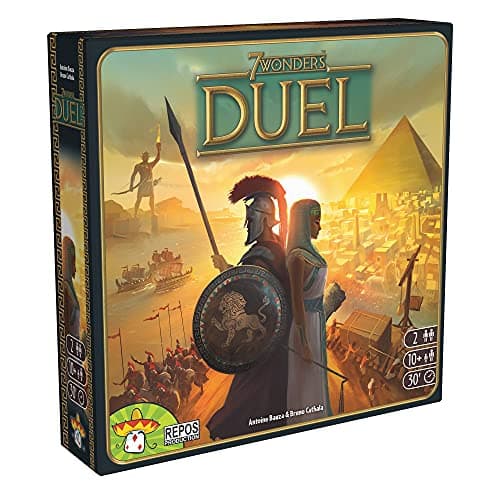
A two-player-only card drafting game where each side builds a civilization across three ages. Three ways to win -- civilian points, military supremacy and scientific dominance -- run at once, so every card you take is also a card denied.
Players
2
Playing time
30 minutes
Age
10+
Designer
Antoine Bauza and Bruno Cathala
Publisher
Repos Production
Published
2015
Who should skip it
Skip it if you want a relaxing evening. Three win conditions run at once, so you are always watching what the other person is about to do.
The best first two-player card game there is: five minutes to teach, and it keeps giving for years.
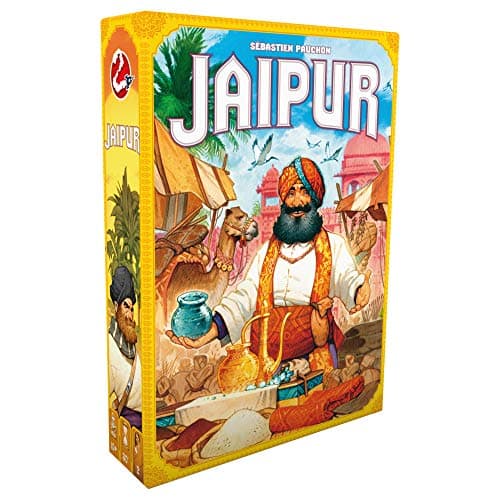
A two-player-only trading card game. You collect and sell goods in sets, racing the other trader for bonus tokens that shrink as they are taken. Best of three rounds decides it.
Players
2
Playing time
30 minutes
Age
10+
Designer
Sebastien Pauchon
Publisher
Asmodee / GameWorks
Published
2009
Who should skip it
Skip it if you want a board on the table. This is cards and tokens, and it looks slight next to a game with a map.
Yes, for a competitive pair who want a sharp 30-minute game. Space Cowboys publishes it for exactly 2 players, ages 10 and up. It is not worth it if you want a relaxed evening or if one of you wins consistently already.
+−Is Splendor Duel better than Splendor?
At two players, almost certainly. The original is a parallel game that is pleasant but quiet with two; Duel rebuilds it around one contested board and two extra ways to win. If you mainly play at three or four, keep the original.
+−Is Splendor Duel harder than Splendor?
Yes. The turn actions are simple in both, but Duel asks you to track three victory conditions at once and gives you no reset between rounds. Expect the first game or two to end before a new player has noticed which race they were losing.
+−Is Splendor Duel good for beginners?
It is a reasonable second purchase rather than a first one. The actions are readable immediately, but the simultaneous win conditions are a genuine cognitive load. Jaipur is the better opening buy for a household new to modern board games.
+−How long does Splendor Duel actually take?
The publisher states 30 minutes, and that is realistic from the second game onward. The teach does not blow out the way a symbol-heavy game does, because there are only three things you can do on a turn.