Buy Splendor Duel if you want the tighter, cleaner game: Space Cowboys publishes it for exactly 2 players at 30 minutes, with a compounding engine and three live win conditions. Buy The Lord of the Rings: Duel for Middle-earth if the theme matters to you -- Repos Production publishes it for exactly 2 at 30 minutes, with three instant-win routes and a Tolkien map doing real mechanical work.
We earn a commission when you buy through links on this page, at no extra cost to you. It does not change which games we recommend or what we say about them. How this site is funded.
This is a closer comparison than most on this site, because the two games agree on almost everything that usually separates two-player games. Both are published for exactly two players. Both run 30 minutes. Both are rated 10+. Both are built on drafting from a visible layout, and both can end the instant one player meets a condition, with no final scoring round to save you.
So the usual deciding questions -- does it scale, how long is it, can it end suddenly -- all come back the same answer twice. What is left is a genuine choice between an abstract economic puzzle and a licensed game where the theme is load-bearing, and that is a preference rather than a verdict.
Quick picks
#
Game
Players
Time
Price
1
Splendor Duel
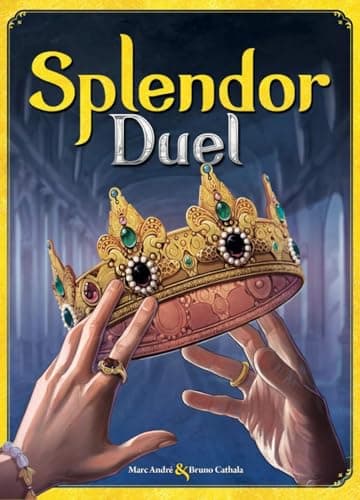
The gentler duel: an engine builder where you are racing rather than attacking, and the shared gem board is the whole game.
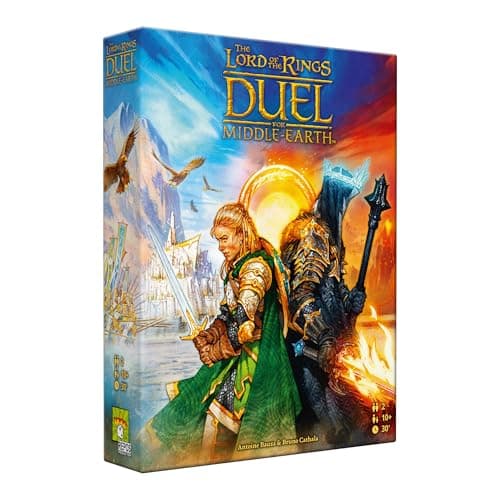
7 Wonders Duel's designers, 7 Wonders Duel's structure, and a theme that does real work -- the asymmetric Fellowship-versus-Sauron split is the reason to own both.
Player counts and playing times come from each publisher, cited on that game's review page. Tap a row to jump to the full write-up.
01
The verified specs
Splendor Duel -- 2 players, 30 minutes, ages 10+. Bruno Cathala and Marc Andre, Space Cowboys, 2022. 67 Jewel cards across 3 levels, 25 tokens, 3 Privilege scrolls, 4 Royal cards, 1 board. Three win conditions: 20 prestige points, 10 crowns, or 10 prestige on one color.
The Lord of the Rings: Duel for Middle-earth -- 2 players, 30 minutes, ages 10+. Antoine Bauza and Bruno Cathala, Repos Production, retail release October 2024. Three win conditions: the Quest of the Ring, presence in all 7 regions, or 6 different alliance symbols.
Both are published for exactly two players. Neither scales up, neither has a publisher-stated solo mode, and neither needs another box.
Bruno Cathala co-designed both, which is not a coincidence and shows in how each handles tempo.
02
How we judged it
When two games match this closely on specs, the comparison has to be about texture rather than facts, and three things actually differ.
First, does the game compound? A game where early purchases make later ones cheaper feels completely different from a game where you are claiming territory on a map, even when both last half an hour.
Second, how much does the theme do? For some buyers a licensed theme is the reason to buy and for others it is noise. Being honest about which this is matters more than pretending theme is irrelevant.
Third, where does the tension actually come from -- the board, or the clock? Both games can end abruptly, but they make you watch different things.
03
Splendor Duel is the tighter machine
Twenty-five gem tokens sit on a grid and you may only take up to three that form an uninterrupted line. Jewel cards sit above in three levels. The crucial rule is that cards you buy leave a permanent discount behind, so the game builds on itself: by the last few turns you are buying things that were unreachable at the start.
Three victory conditions run from the first turn -- 20 prestige points, 10 crowns, or 10 prestige points on cards of a single color -- and the moment anyone meets one at the end of their turn the game stops. Crowns do triple duty as a win condition, a route to Royal cards, and something you must deny, which is the detail that makes the game deep rather than merely fast.
The design also charges you for greed explicitly. Taking three tokens of one color, or two pearls, hands your opponent a Privilege scroll in compensation. You are never simply taking; you are deciding what to pay.
Its weakness is the flip side of being a machine: it is abstract. Gems and nobles, with no fiction worth describing. If what you want from a half-hour game is to feel like you were somewhere, Splendor Duel will not do that for you, and the next game will.
04
Duel for Middle-earth puts the pressure on a map
The skeleton is the 7 Wonders Duel skeleton, which Bauza and Cathala also designed: three successive chapters, a card layout you draft from where taking one card uncovers others, and three separate ways to win that each end the game the instant they trigger.
What is different is where the game happens. Two of the three win routes are spatial: presence in all seven regions of the map, or the Quest of the Ring advancing across it. So your drafting decisions resolve into position on a board you can both look at, and you spend the game watching a physical front line rather than tracking three numeric thresholds.
The alliance win -- six different symbols -- is functionally the science win from 7 Wonders Duel wearing different art, and anyone who has played that game will recognize the shape within a turn. That is worth knowing in both directions: it is a reassuring recommendation if you loved 7 Wonders Duel, and a reason to hesitate if you already own it, because the two boxes overlap more than their covers suggest.
The theme is doing real work rather than being a skin. If Tolkien means something to you, this is a 30-minute game that delivers a recognizable Middle-earth, and that is a legitimate reason to buy it over a mechanically cleaner abstract.
05
The question that should actually decide it
Do you already own 7 Wonders Duel?
If yes, lean Splendor Duel. Duel for Middle-earth is the closest thing on this site to a reskin of a game you have -- same designers, same three-chapter structure, same drafting layout, same instant-win architecture. It is excellent and it is also familiar, and a second copy of a shape you own is a weaker purchase than a genuinely different game. Splendor Duel's compounding engine and token grid are not something 7 Wonders Duel does.
If no, and the theme appeals, Duel for Middle-earth is a strong first purchase precisely because that architecture is so good. You would be getting the structure that makes 7 Wonders Duel the best two-player game we cover, with a map and a license attached.
And if neither theme moves you either way, buy Splendor Duel. It is the tighter design of the two, it is two years older with a correspondingly longer record, and it is the cheaper box at the time of writing -- live prices for both are in the table above with the date we read them.
06
What neither of these is
Neither is a relaxing evening. Both can stop before your plan pays off, with no final round to rescue it, and both are directly competitive -- you are denying the other person things they need, on purpose, repeatedly.
Neither is a first board game either, and that is worth saying because both get recommended as one on the strength of being short. Thirty minutes of playing time is not the same as thirty minutes of learning, and in both cases a first game is slower than the box suggests while you work out what the three win conditions actually mean. Both are rated 10+ by their publishers, and that rating is about comprehension rather than content. If one of you is genuinely new to modern board games, start with something where the first play teaches itself -- Jaipur is the usual answer here, published for exactly two at 30 minutes -- and come back to these once a half-hour game feels short rather than dense.
And neither is the pick if what you want is a game that scales. Both are hard-capped at two players, which is the point of them, but it does mean the box stays shut when a third person is in the room. If you want one purchase to cover both situations, a 2-4 game that is genuinely good at two -- Azul is the clearest example we cover -- is the more useful thing to own, even though it is the weaker two-player game.
If that is the wrong shape for your household, the honest answer is a different kind of game rather than a different duel. Patchwork is published by Lookout Games for exactly 2 players at about 30 minutes, rated 8+, and nothing in it lets either player touch the other's board. Codenames: Duet is cooperative, so you win or lose together. Both are covered here and either is a better purchase than talking yourself into a duel you will not enjoy.
07
Pick this if
Pick Splendor Duel if you want the tighter and more original design, if you enjoy building an engine where early buys make later ones cheaper, or if you already own 7 Wonders Duel and want something structurally different. Built for exactly two, 30 minutes, 10+.
Pick Duel for Middle-earth if Tolkien matters to you, if you want your decisions to resolve into position on a map rather than into numbers, or if you do not own 7 Wonders Duel and want that excellent architecture with a theme attached. Built for exactly two, 30 minutes, 10+.
Pick neither if one of you dislikes competing. Both of these end with a loser and both are built on denial; Patchwork or Codenames: Duet is the honest alternative.
The gentler duel: an engine builder where you are racing rather than attacking, and the shared gem board is the whole game.
A two-player-only engine-building game in the Splendor universe. You draft gem tokens from a shared board to buy Jewel cards across three levels, chasing three separate victory conditions -- points, a color majority, or crowns. 67 Jewel cards, 25 tokens, 3 Privilege scrolls, 4 Royal cards.
Players
2
Playing time
30 minutes
Age
10+
Designer
Bruno Cathala and Marc Andre
Publisher
Space Cowboys
Published
2022
Who should skip it
Skip it if you want direct conflict. The tension is in what you take from the shared board before the other person can, never in anything you do to their cards.
7 Wonders Duel's designers, 7 Wonders Duel's structure, and a theme that does real work -- the asymmetric Fellowship-versus-Sauron split is the reason to own both.
A two-player-only asymmetric card game from the designers of 7 Wonders Duel. One side is the Fellowship, one is Sauron, played across three chapters with three instant-win conditions: the Quest of the Ring, presence in all 7 regions, or gathering 6 different alliance symbols.
Players
2
Playing time
30 minutes
Age
10+
Designer
Antoine Bauza and Bruno Cathala
Publisher
Repos Production
Published
2024
Who should skip it
Skip it if you already own 7 Wonders Duel and want something structurally different. This is the same three-stage, race-to-an-instant-win skeleton wearing Middle-earth, and the overlap is large.
+−Is Splendor Duel or Duel for Middle-earth better?
Splendor Duel is the tighter and more original design, and the better buy if you already own 7 Wonders Duel, whose structure Duel for Middle-earth closely shares. Duel for Middle-earth is the better buy if the Tolkien theme matters to you or if you want your drafting to resolve into position on a map.
+−Are both games two-player only?
Yes. Space Cowboys publishes Splendor Duel for exactly 2 players and Repos Production publishes Duel for Middle-earth for exactly 2. Neither scales to three and neither has a publisher-stated solo mode.
+−Is Duel for Middle-earth just 7 Wonders Duel with a Tolkien theme?
Not just, but the overlap is real: same designers, three chapters, the same kind of drafting layout, and three instant-win routes. The alliance win is functionally the science win with different art. The genuine difference is that two of its three win conditions are spatial and resolve on a map.
+−Which is easier to learn?
They are close. Splendor Duel's actions are simpler but tracking three live victory conditions takes a game or two. Duel for Middle-earth has more to explain up front -- regions, the Ring quest and alliances -- but anyone who has played 7 Wonders Duel will pick it up within a turn.
+−Which is better for a couple who do not play many games?
Neither is ideal. Both can end suddenly and both are built on denying your opponent. Jaipur is the easier competitive game for a pair new to this, and Patchwork is the calm one at the same 30-minute length.
+−Do either need an expansion to be good?
No. Both are complete games as sold by their publishers, and nothing in either box depends on buying anything else. We do not cover an expansion for either game, so we are not in a position to tell you whether one is worth adding.