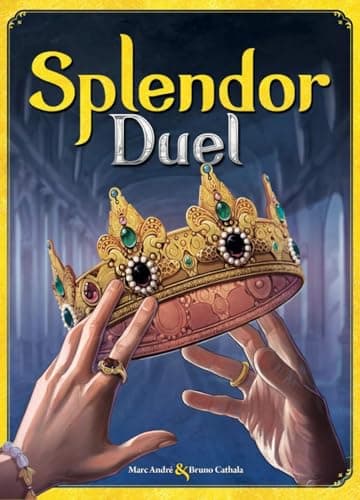
Splendor Duel is a two-player-only engine builder published by Space Cowboys, stated at 30 minutes for ages 10 and up. Three victory conditions run at once -- 20 prestige points, 10 crowns, or 10 points in a single color -- and reaching any one of them ends the game immediately.
We earn a commission when you buy through links on this page, at no extra cost to you. It does not change which games we recommend or what we say about them. How this site is funded.
Splendor Duel is what happens when a designer takes a famous family game, throws out the part that made it work at four players, and rebuilds the rest for two. The original Splendor is a quiet, parallel game: four people build gem engines beside each other and the interaction is mostly polite. This is not that. Everything here runs through one small shared board, and there is no way to take what you need without changing what the other person can reach.
It is also the most approachable of the serious two-player-only games we cover. The turn is genuinely simple -- take tokens, or buy a card, or reserve one -- and the depth sits in the ordering rather than in a wall of rules. That combination is rare, and it is why this ends up recommended for households that found 7 Wonders Duel a step too far but still want something with teeth.
01
The three finish lines, and why they change every turn
The publisher states three victory conditions, and unlike most games with multiple paths, all three are live from the first turn. You win the moment you hold 20 or more prestige points, or 10 or more crowns, or 10 or more prestige points on cards of a single color. Fulfilling any one of them at the end of your turn stops the game on the spot.
That structure does something specific to how you play. You cannot look at the other person's card tally, decide they are behind on points, and relax. A player sitting on six points can be two cards from a color win, and a player with no obvious engine at all can be quietly stacking crowns. Working out which of the three races your opponent is actually in is most of the skill, and it is a read you have to take every single turn.
It also means the game ends abruptly, and often earlier than new players expect. There is no final scoring round and no last turn for everybody. Somebody buys a card and it is simply over. First games frequently end with one player mid-sentence about what they were going to do next, which is either delightful or infuriating depending on the person.
02
The shared board is the actual game
Twenty-five tokens sit on one small grid, filled from the center outward along a printed spiral. On your turn you take up to three of them, and they must be adjacent in an uninterrupted straight line -- horizontal, vertical or diagonal. That single restriction is the whole design.
Because the line has to be unbroken, the board constantly rearranges what is possible. Taking the three tokens you want almost always opens a line for the other person, so the strong players are not really asking which gems they need. They are asking which gems they can take that leave the worst possible board behind. It is a positional game wearing the costume of an economic one.
There is a brake on greed, too. Take three tokens of the same color, or take two pearls, and your opponent receives a privilege scroll for the trouble. The most efficient-looking move on the board is frequently the one that hands something back, and judging when that trade is worth it is a real decision rather than a formality.
03
Privileges, gold and the economy around the edges
Privilege scrolls are the compensation currency. There are three in the box, the player going second starts with one, and they move back and forth across the table all game. Spending one lets you simply take a gem or pearl of your choice off the board, ignoring the line rule entirely -- exactly the escape hatch you want when the board has been left hostile.
Gold works differently from the original game. You cannot scoop gold up with the ordinary token action at all. The only way to get it is to reserve a card: you take a gold token, then either take a card from the visible pyramid or draw blind from the top of one of the three level decks. You may hold three reserved cards at most and they stay secret, which is the only hidden information in the game and the one place a bluff exists.
Crowns sit on top of all of it. Reach your third crown and you take a royal card and resolve its ability; reach your sixth and you take another. So crowns are simultaneously a win condition, a bonus engine and a thing you have to deny -- three jobs for one symbol, which is efficient design and also the single most common thing new players forget to watch.
04
What actually changed from Splendor
If you already own Splendor, the honest question is whether this is a different game or a two-player patch. It is a different game. Cards still cost gems and still leave a permanent discount behind, and the pyramid is still three levels deep -- 67 jewel cards across levels one, two and three. Almost everything else has been rebuilt.
The four-player version gives each player a private reserve drawn from generous common piles, and the nobles at the end reward steady long-term planning. Duel replaces the piles with one contested 25-token grid, adds two win conditions that can end the game without anybody reaching a points total, and hands you card abilities that fire the moment you buy. The result is shorter, sharper and considerably meaner.
Which is the right way round for a two-player site to put it: Splendor at two players is a perfectly pleasant parallel puzzle, and Splendor Duel is an argument. If the thing you liked about the original was its calm, you may genuinely prefer the original. Most pairs who play both keep this one.
05
Who this is genuinely for
Pairs who want a real competitive game but bounced off the symbol-heavy teach of 7 Wonders Duel. The actions here are readable on turn one.
Anyone who likes a game where the board state matters more than the card text, and who enjoys being forced to choose between two good moves.
Households that want a 30-minute game that still ends in a conversation about what just happened.
Owners of the original Splendor who mostly play at two and have quietly stopped getting it off the shelf.
06
Who should skip it
Skip it if you want direct conflict. Nothing here lets you attack the other person's board -- you never take their cards, never break their engine, never force a discard. The entire fight is over the shared tokens, and if what you want is a game where you can do something to your opponent, this will feel oddly bloodless.
Skip it if abrupt endings annoy you. Three simultaneous conditions mean the game can stop before your plan has paid off, and a carefully built engine that was one turn from firing scores exactly nothing. Some people find that thrilling. Others find it a waste of twenty minutes, and it is worth knowing which one you are before buying.
And skip it if the two of you have a skill gap that already causes friction. The luck here is real but thin -- it is in which cards happen to appear, not in a hand you were dealt -- so a stronger player will win consistently. A card game with a proper draw, like Jaipur or Lost Cities, spreads the wins far more evenly.
07
What we did instead of playing it
We have not played this. What we did: took the player count, playing time, age, designers and full box contents from Space Cowboys' own page for the game, confirmed the publisher states exactly two players rather than a range, checked the release year against the Splendor reference entry, and took the three victory conditions and the token, privilege and crown rules from the published rulebook rather than from memory. Every figure above links to where it came from. Where the publisher does not state something -- the specific victory thresholds are not on the product page -- we have named the source that does.
What we would buy
Picks drawn from the games covered on this site, chosen against the criteria above.
We earn a commission when you buy through links on this page, at no extra cost to you. It does not change which games we recommend or what we say about them. How this site is funded.
The gentler duel: an engine builder where you are racing rather than attacking, and the shared gem board is the whole game.
A two-player-only engine-building game in the Splendor universe. You draft gem tokens from a shared board to buy Jewel cards across three levels, chasing three separate victory conditions -- points, a color majority, or crowns. 67 Jewel cards, 25 tokens, 3 Privilege scrolls, 4 Royal cards.
Players
2
Playing time
30 minutes
Age
10+
Designer
Bruno Cathala and Marc Andre
Publisher
Space Cowboys
Published
2022
Who should skip it
Skip it if you want direct conflict. The tension is in what you take from the shared board before the other person can, never in anything you do to their cards.
The strongest all-round two-player game in print, and the one most couples settle on.
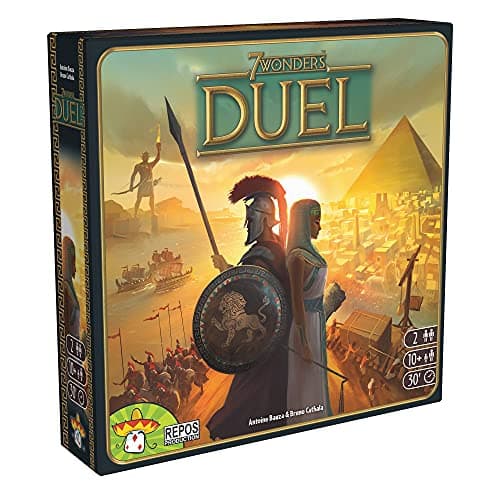
A two-player-only card drafting game where each side builds a civilization across three ages. Three ways to win -- civilian points, military supremacy and scientific dominance -- run at once, so every card you take is also a card denied.
Players
2
Playing time
30 minutes
Age
10+
Designer
Antoine Bauza and Bruno Cathala
Publisher
Repos Production
Published
2015
Who should skip it
Skip it if you want a relaxing evening. Three win conditions run at once, so you are always watching what the other person is about to do.
The best first two-player card game there is: five minutes to teach, and it keeps giving for years.
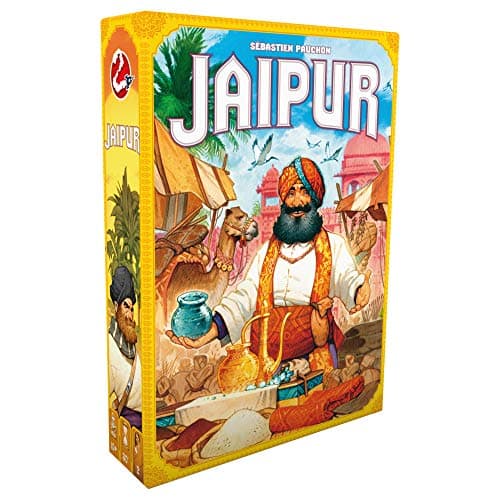
A two-player-only trading card game. You collect and sell goods in sets, racing the other trader for bonus tokens that shrink as they are taken. Best of three rounds decides it.
Players
2
Playing time
30 minutes
Age
10+
Designer
Sebastien Pauchon
Publisher
Asmodee / GameWorks
Published
2009
Who should skip it
Skip it if you want a board on the table. This is cards and tokens, and it looks slight next to a game with a map.
Yes. Space Cowboys states 2 players on its official page for the game. It is a standalone two-player-only design, not the four-player Splendor with a variant bolted on.
+−Do I need to own Splendor to play Splendor Duel?
No. It is completely standalone and shares no components with the original. Owning Splendor gives you no advantage beyond recognizing that cards cost gems and leave a discount behind.
+−How do you win Splendor Duel?
Three ways, any one of which ends the game immediately at the end of your turn: 20 or more prestige points, 10 or more crowns, or 10 or more prestige points on cards of a single color.
+−Is Splendor Duel better than Splendor?
At two players, almost certainly. The original is pleasant but quiet with two; Duel rebuilds it around one contested board and two extra win conditions. If you mainly play at three or four, keep the original.
+−How long does Splendor Duel take?
The publisher states 30 minutes. That is realistic from the second game onward, because the turn options are simple enough that the teach does not blow out the way a symbol-heavy game does.
+−Is Splendor Duel good for beginners?
It is a reasonable second purchase rather than a first one. The actions are simple, but tracking three victory conditions at once is a genuine cognitive load. Jaipur is the better opening buy.