Yes, and the setup genuinely scales: at two players you remove three tokens of each gem color, leaving four of each, and reveal three nobles instead of five. But the card market does not shrink at all, so Splendor gets looser at two rather than tighter. If the two of you are the only people who will ever play it, buy Splendor Duel instead -- Space Cowboys built that one for exactly two.
We earn a commission when you buy through links on this page, at no extra cost to you. It does not change which games we recommend or what we say about them. How this site is funded.
This question gets asked constantly and answered badly, usually in one of two ways: a flat "yes, it's fine at two!" that never looks at the setup, or a dismissal that ignores the fact that Space Cowboys lists the game at 2-4 and means it. Both skip the interesting part, which is that Splendor's two-player setup scales one half of the game and leaves the other half alone.
There is also a second question hiding inside the first, and it is the one that actually decides a purchase: since 2022 there has been a Splendor built for exactly two players. So "is Splendor good at two?" and "should I buy Splendor at two?" have different answers, and this page gives both.
We have not played either game. The specifications come from Space Cowboys' own product pages, the game's reference entry and a rules reproduction, all cited at the bottom. Where a figure is not in any of those, this page does not print one.
01
The short answer, and the verified specs
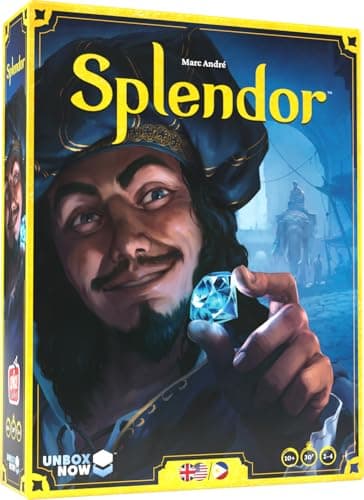
Splendor -- 2-4 players, 30 minutes, 10+. Marc Andre, Space Cowboys, first released 2014. 90 Development cards, 10 Noble tiles, 7 tokens in each of five gem colors plus 5 gold.
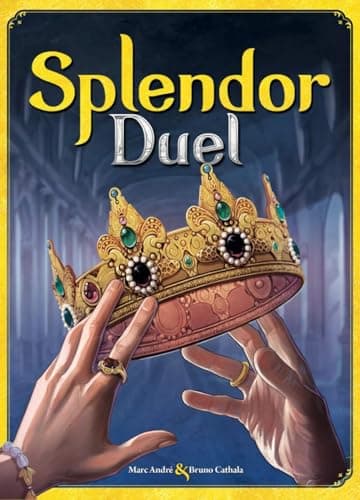
Splendor Duel -- exactly 2 players, 30 minutes, ages 10+. Bruno Cathala and Marc Andre, Space Cowboys, 2022. Standalone; it does not need the base game.
At two players, Splendor's setup removes three tokens of each gem color, leaving four of each. Gold is untouched. Three noble tiles are revealed instead of five.
The 90 Development cards and the face-up card market do NOT change with the player count. Only tokens and nobles scale.
So: Splendor is Plays at two on this site's labeling, Splendor Duel is Built for two, and neither has a publisher-stated solo mode.
02
How we judged this before answering it
Three criteria, in this order. They are the same three we apply to every game here that scales down rather than being built for two.
First, does the publisher actually state that two players is supported, or is two a fan variant? A surprising number of "great at two!" recommendations turn out to rest on a house rule. Splendor passes cleanly and completely: Space Cowboys lists 2-4, and the rulebook contains a specific two-player setup rather than a note saying it works anyway.
Second, does the game lose something at two? This is where most multiplayer games quietly fail, because their tension came from not knowing which of three opponents would act before you. Splendor is the unusual case where the designers scaled part of the game and left the rest, and the next two sections are about what that does.
Third -- and this is the criterion that decides the purchase rather than the question -- is there a game by the same publisher that was actually built for two? If there is, "does this work at two" stops being the useful question and "why would I buy the compromise" takes over. For Splendor there is, and it is from the same publisher and shares a designer.
03
What actually changes at two players
The token supply shrinks, and by a lot. The full game has seven tokens in each of five gem colors; at two players you remove three of each, leaving four of each on the table. The five gold jokers are untouched. You also reveal three noble tiles rather than five, following the general rule of one more noble than there are players.
That is a real adjustment rather than a token gesture, and it is aimed at the right thing. Splendor's economy runs on gem tokens, and with only two people drawing from the pool a full seven-of-each supply would mean nobody ever ran short. Cutting it to four keeps the tokens scarce enough to fight over.
The ten-token hand limit does not change, and that matters more at two than it looks. You may never finish a turn holding more than ten tokens, gold included, and with only four of each color in the supply a single opponent hoarding one color can take a serious bite out of what is available. Watching what the other person is stockpiling is most of the two-player game.
04
The part most answers miss: the cards do not scale
Here is the asymmetry, and it is the honest core of this page. The tokens scale down at two. The 90 Development cards and the face-up market you buy them from do not.
Think about what that means for contention. At four players, four people are reaching for the same face-up cards, so the card you were saving toward is frequently gone before your turn comes back. At two, the same market is picked over by half as many hands, which means the card you want is far more likely to still be there, and long-range plans survive in a way they do not at a full table.
So the two games pull in opposite directions. Token competition stays sharp because the supply was deliberately cut. Card competition drops because the supply was not. The result is that Splendor at two is a more buildable, more plannable, slightly gentler game than Splendor at four -- and whether that is a feature depends entirely on what you wanted.
If you wanted a tight duel where every decision is contested, that loosening is the thing to know before buying, and it is the strongest argument for the other box. If you wanted a calm half-hour of building an engine without being constantly disrupted, Splendor at two delivers exactly that, and the people who tell you it is broken at two are describing a different preference rather than a defect.
05
One rule quietly stops working the way you expect
A specific consequence worth its own section, because it changes how a turn feels and almost nobody mentions it.
One of Splendor's four actions is to take two gem tokens of the same color, and that action is only legal if at least four of that color remain in the supply. At a four-player table there are seven of each, so the double-take is available most of the time and is a normal part of your toolkit.
At two players there are only four of each to begin with. So the double-take is legal when a color is sitting at its full four, and the moment anyone takes from that color it drops below the threshold and the action closes until spent tokens come back. The option is not gone, but it goes from routine to occasional, and it means the single-color rush that works at four is a much less reliable plan at two.
This is the kind of detail that decides whether a scaled-down game still feels like itself. We would not call it a flaw -- it follows from a setup rule doing its job -- but it is a genuine change in how the game plays, and a buyer who loves the double-take should know it becomes situational.
06
Built for two, or plays at two?
Plays at two, and comfortably so. That is this site's label for a game whose publisher states support for three or more players, and Splendor earns it: Space Cowboys lists 2-4, and the design brief was plainly a gateway game for a table rather than a duel.
The label is not a criticism. Several of the best games covered here are Plays at two -- Azul, Santorini, Memoir '44 and War Chest among them -- and Splendor's dedicated two-player setup puts it at the better end of that category rather than the worse. A game that bothered to write a different setup for two is a game whose designers thought about you.
The practical consequence is the usual one and it is worth stating plainly: Splendor seats four when someone comes over, and a two-player-only game does not. For plenty of households that single fact outweighs everything else on this page, and it has nothing to do with which is the better game for a pair.
07
If you only ever play at two, buy Splendor Duel
Space Cowboys published Splendor Duel in 2022 for exactly 2 players at 30 minutes, ages 10+, designed by Bruno Cathala and Marc Andre -- the same designer as the base game. It is standalone and does not need your copy of Splendor.
It is not a cut-down Splendor, and the difference is structural rather than cosmetic. The tokens sit on a shared grid and you may only take up to three that form an uninterrupted line, so what you want is frequently not what you are allowed to have, and every take changes what the other person can reach next. That is the contested-every-turn feeling the base game loses at two, rebuilt as a rule instead of relying on a crowded table to supply it.
It also replaces the single 15-point finish line with three live victory conditions -- 20 prestige points, 10 crowns, or 10 prestige on cards of a single color -- any of which ends the game the instant it is met, with no final round. And taking greedily hands your opponent a Privilege scroll in compensation, so the design charges you for the thing the base game lets you do freely.
So the recommendation splits cleanly. If two is all you will ever play, Splendor Duel is the better game and we would not talk you into the family box. If the box needs to seat three or four sometimes, or you want the gentler gateway teach, buy Splendor and enjoy a game that scales down more honestly than most.
Two things not to get wrong while shopping, because the names invite it. Splendor Duel has exactly one expansion, The Counterfeiters, which we cover separately. And Splendor's own expansions are not Splendor Duel expansions -- they require the 2-4 base game, which is a mistake that costs the same as the right box.
08
When neither is the right answer
Two cases worth naming, because a page that only offers its own subject is not advising.
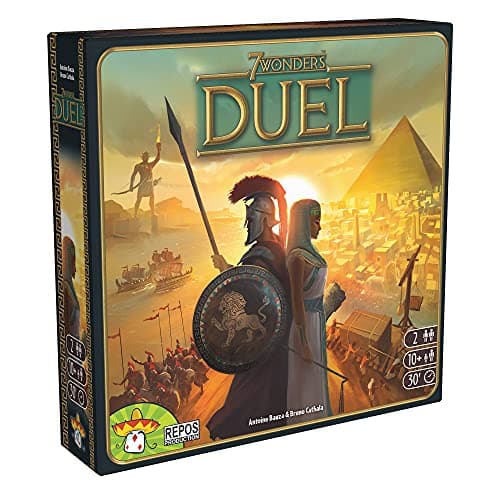
If what you actually want is the best two-player game of this general shape rather than specifically a gem game, 7 Wonders Duel is the stronger purchase. Repos Production publishes it for exactly 2 players at 30 minutes, ages 10+, it has almost no luck, and three win conditions run at once. It is the game this site most often ends up recommending outright, and it is a deeper game than either Splendor.
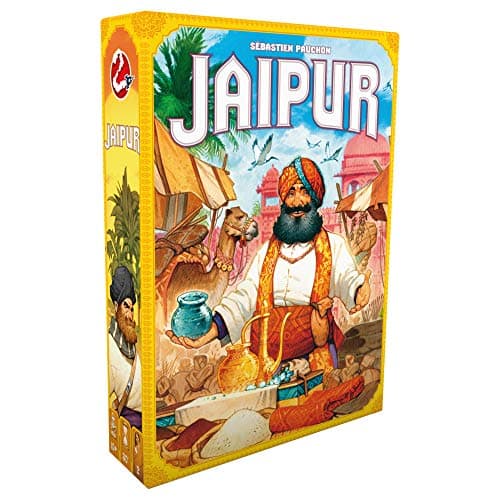
If the appeal was that Splendor is light, quick and easy to agree to, Jaipur does that better and cheaper. It is published for exactly 2 players at 30 minutes, teaches in about five minutes, and the economy is the same species -- collect, hold, cash in at the right moment -- with none of the setup. It is our usual first recommendation for a pair buying their first game together.
09
Who each pick is for
Splendor -- best for the household that plays at two most of the time but needs the box to seat three or four, and for anyone who wants the gateway teach. 2-4 players, 30 minutes, 10+, with a real two-player setup. Downside: only the tokens scale, so card competition drops at two and the game gets looser rather than tighter, and the double-take action becomes situational.
Splendor Duel -- best for the pair who are the only two people who will ever play, and who want every turn contested. Built for exactly two, 30 minutes, 10+, with a shared token grid, three live win conditions and no final round. Downside: it will never seat a third, it punishes inexperience more than the base game, and the sudden endings annoy some pairs.
7 Wonders Duel -- best for the pair who want the best two-player game here rather than specifically a gem game. Built for exactly two, 30 minutes, 10+, almost no luck. Downside: a denser teach than either Splendor, and with so little luck a stronger player wins consistently.
Jaipur -- best for the pair who liked that Splendor is light and want lighter and cheaper still. Built for exactly two, 30 minutes, 10+, five-minute teach. Downside: cards and tokens with no board, so it looks slight next to a box of gem chips.
What we would buy
Picks drawn from the games covered on this site, chosen against the criteria above.
We earn a commission when you buy through links on this page, at no extra cost to you. It does not change which games we recommend or what we say about them. How this site is funded.
The gateway engine builder, and it does scale down honestly -- but only the tokens shrink at two, not the card market, so it loosens where Splendor Duel tightens.
A gem-trading engine builder for 2-4 players. One action per turn: take gem tokens, reserve a development card and take a gold joker, or buy a card. Cards grant permanent gem bonuses that make later cards cheaper, and the first player to reach 15 prestige points triggers the final round. 90 Development cards, 10 Noble tiles, 7 tokens in each of five gem colors plus 5 gold. At two players three tokens of each gem color are removed, leaving four of each.
Players
2-4
Playing time
30 minutes
Age
10+
Designer
Marc Andre
Publisher
Space Cowboys
Published
2014
Who should skip it
Skip it if the two of you are the only people who will ever play. Space Cowboys publishes Splendor Duel for exactly two, and it is the better two-player game by a clear margin.
The gentler duel: an engine builder where you are racing rather than attacking, and the shared gem board is the whole game.
A two-player-only engine-building game in the Splendor universe. You draft gem tokens from a shared board to buy Jewel cards across three levels, chasing three separate victory conditions -- points, a color majority, or crowns. 67 Jewel cards, 25 tokens, 3 Privilege scrolls, 4 Royal cards.
Players
2
Playing time
30 minutes
Age
10+
Designer
Bruno Cathala and Marc Andre
Publisher
Space Cowboys
Published
2022
Who should skip it
Skip it if you want direct conflict. The tension is in what you take from the shared board before the other person can, never in anything you do to their cards.
The strongest all-round two-player game in print, and the one most couples settle on.
A two-player-only card drafting game where each side builds a civilization across three ages. Three ways to win -- civilian points, military supremacy and scientific dominance -- run at once, so every card you take is also a card denied.
Players
2
Playing time
30 minutes
Age
10+
Designer
Antoine Bauza and Bruno Cathala
Publisher
Repos Production
Published
2015
Who should skip it
Skip it if you want a relaxing evening. Three win conditions run at once, so you are always watching what the other person is about to do.
The best first two-player card game there is: five minutes to teach, and it keeps giving for years.
A two-player-only trading card game. You collect and sell goods in sets, racing the other trader for bonus tokens that shrink as they are taken. Best of three rounds decides it.
Players
2
Playing time
30 minutes
Age
10+
Designer
Sebastien Pauchon
Publisher
Asmodee / GameWorks
Published
2009
Who should skip it
Skip it if you want a board on the table. This is cards and tokens, and it looks slight next to a game with a map.
Yes. Space Cowboys publishes it for 2-4 and the rulebook has a dedicated two-player setup: remove three tokens of each gem color, leaving four of each, keep all five gold, and reveal three nobles. The caveat is that the card market does not scale, so there is less competition for cards at two and the game plays looser than it does at four.
+−Can you play Splendor with 2 players?
Yes, with no house rules needed. Two players is an officially supported count with its own setup instructions, which is a stronger position than many 3+ games that merely tolerate a pair.
+−Is Splendor or Splendor Duel better for two players?
Splendor Duel, if two is all you will ever play. Space Cowboys built it for exactly two, and its shared token grid -- you may only take up to three tokens forming an uninterrupted line -- restores the contested-every-turn feeling the base game loses when only two people are picking over an unchanged card market. Buy the base Splendor instead if you need three or four seats or want the gentler teach.
+−How does the Splendor setup change for 2 players?
Three tokens of each gem color are removed, leaving four of each. The five gold jokers stay in. Three noble tiles are revealed rather than five, following the rule of one more noble than there are players. The 90 Development cards and the card market are unchanged.
+−Does Splendor Duel need the base game?
No. Splendor Duel is a standalone game with its own board, tokens and cards. It is not an expansion to Splendor.
+−Do Splendor expansions work with Splendor Duel?
No. Splendor's expansions require the 2-4 player base game, and Space Cowboys files them under Splendor rather than under Splendor Duel. The only expansion for Splendor Duel is The Counterfeiters, which we cover separately.
+−Does Splendor have a solo mode?
No solo mode is stated by the publisher for either Splendor or Splendor Duel. Of the games covered here, only Gloomhaven: Jaws of the Lion has a publisher-stated minimum of one player.