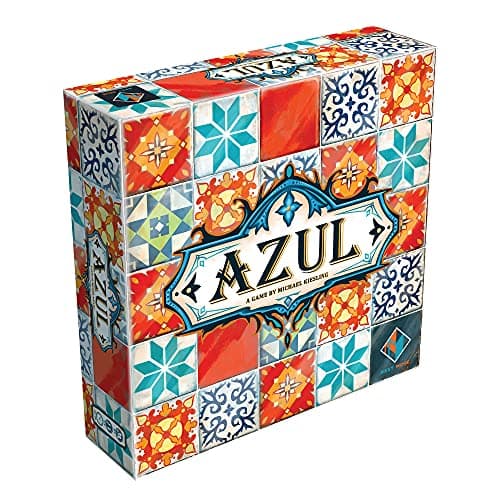
Azul is a tile-drafting game published by Plan B Games for 2-4 players at 30-45 minutes, designed by Michael Kiesling and first published in 2017. It won the 2018 Spiel des Jahres. You take every tile of one color from a shared supply, and whatever you cannot place is discarded.
We earn a commission when you buy through links on this page, at no extra cost to you. It does not change which games we recommend or what we say about them. How this site is funded.
Azul is the most decorated family game of the last decade and the one most often handed to people who say they do not play board games. It is also, on this site's terms, a game that plays at two rather than a game built for two -- and since 2025 there has been a separate Azul designed specifically for two players, which changes the buying question rather than settling it.
This review is unusually explicit about its sources, because Azul's own publisher has become hard to cite. Plan B Games' site now redirects to an unrelated domain and Asmodee's product page renders empty, so the specifications below come from the game's reference entry rather than a publisher page. Where that entry is silent -- the age rating and the box contents -- this page prints nothing at all.
01
What you are actually buying
A tile-drafting game for 2-4 players at 30-45 minutes, designed by Michael Kiesling, published by Plan B Games and first released in 2017. Philippe Guerin and Chris Quilliams are credited as illustrators, which matters more than usual here: the look is a large part of why this game gets agreed to.
What we cannot tell you is the age rating or the component counts. The reference entry gives neither, and no publisher page was reachable to confirm them. If you are buying this for a specific child, read the box rather than this page. We would rather leave a hole than fill it with a number we cannot cite.
What is beyond doubt is the award record, and it is the strongest of any game covered here: the 2018 Spiel des Jahres, the 2018 As d'Or Jeu de l'Annee, the 2018 Origins Award for Best Family Game plus the Origins Fan Favorite, the 2018 Dice Tower Award for Best Family Game, and a 2018 Mensa Select certification. It was also Golden Geek Best Family Game for 2017 and runner-up for Board Game of the Year.
02
The draft is the game
The core rule is the one that makes Azul interesting and it is easy to state. Tiles sit on cardboard discs around the table and in a pile in the center, and when you take tiles you take every tile of the one color you have chosen from the one place you have chosen. You do not take three of five. You take all of them.
Those tiles go into a row in front of you. Turns continue until the round's tiles are gone, and then one tile from every row you have filled moves onto your 5x5 board -- and the rest of the tiles in that filled row are discarded.
Read those two sentences together and the whole tension appears. Taking what you need often means taking more than you can use, and the surplus is not stored for later: it is gone. So a turn that solves this round can be the turn that wastes half of what you picked up, and the better player is the one who keeps asking what the other person is about to be forced to take.
03
Where the points come from
Each tile scores based on where it sits in relation to the other tiles already on your board, so the order you place things in matters as much as what you collect. A tile placed next to existing work is worth more than the same tile placed in isolation.
Rounds continue until at least one player has completed a row all the way across their 5x5 board, which is what ends the game. Then the end-of-game bonuses land: points for each complete row, points for each complete column, and points for each instance of having collected all five tiles of a single color.
That structure is why the game does not drift. The end condition is in the players' hands rather than on a timer, and the bonuses reward long-range commitments made four rounds before they pay out. It is a puzzle with a clock that one of you controls.
04
Two ways to play, and the second one is the real game
There are two placement modes. In the basic game, the board dictates where each color goes -- the layout tells you which square a blue tile occupies in which row. In the advanced version, players may place colors anywhere.
That is a genuinely different game rather than a difficulty slider. With fixed positions you are solving a puzzle the board hands you; with free placement you are designing the puzzle and then solving it, and a bad early commitment can block you out of a column for the rest of the game.
For a pair who will play this more than twice, the advanced mode is the version worth learning, and it is the reason this box does not get exhausted the way its reputation as a family game suggests.
05
Built for two, or plays at two?
Plays at two, on this site's labeling, and the distinction has an unusually concrete consequence here.
Plan B Games lists 2-4 players. Nothing in the design is patched or scaled down for a pair, and two is a completely normal way to play it -- but the design brief was a family game, and the box seats four. On a site organized around exactly this distinction that gets stated rather than rounded away.
The concrete consequence: since 2025 there is a separate game called Azul Duel, designed specifically for two players, built on similar pattern building with additional tactical options during the draft. We do not cover it yet -- we could not reach a publisher page to confirm its specifications, and this site does not feature a product it cannot source -- but if your reason for being here is that you want designs built only for two, you should know it exists before you buy this box.
06
What the award record does and does not tell you
Five major awards in a single year is not an accident, and the Spiel des Jahres in particular is the most reliable signal in this hobby that a game is teachable, attractive and genuinely replayable. If you want one safe gift for a household that does not play games, the jury has already done your work.
What none of those awards tell you is how the game behaves at two players. The Spiel des Jahres rewards accessibility across a family table; the Origins and Dice Tower family-game awards are the same category. None of them is a two-player award, and we are not going to translate a family-game prize into a claim about a pair's hundredth play, because that is not what the jury was measuring.
So treat the award record as what it is: very strong evidence that the game is good and easy to get to the table, and no evidence either way about whether it is the best use of your money if you only ever play with one other person.
07
Azul or Patchwork?
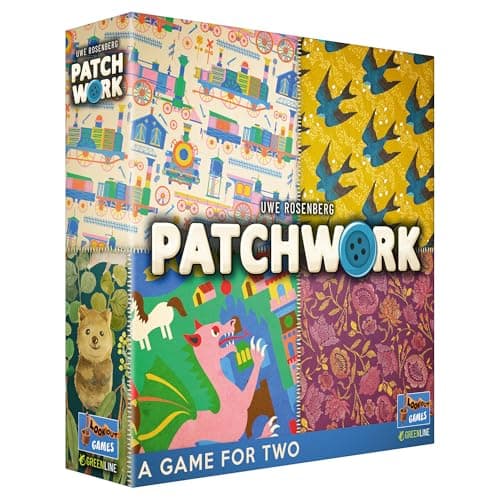
This is the comparison worth making on this site, because Patchwork occupies the same shelf -- quiet, puzzly, no direct attack -- and Lookout Games publishes it for exactly 2 players.
Patchwork is the one to buy if the two-player-only guarantee is why you are here, and it is the shorter, smaller, cheaper box. Azul is the one to buy if you want the famous one, if other people will sometimes join you, or if the visual appeal is doing real work in getting a reluctant partner to sit down. Both are games where you compete for shared supply rather than attacking each other, which is the quality that makes either of them survive a long evening with the same person.
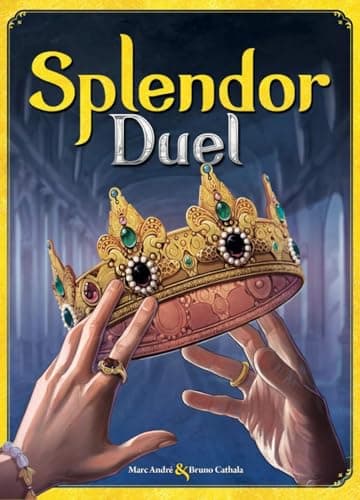
If you want the same calm but with a two-player-only design and more bite, Splendor Duel is the third option here, published by Space Cowboys for exactly 2 players.
08
Who should skip it
Skip it if you want a game published for exactly two. Plan B Games lists 2-4, and Azul Duel exists for precisely this reason. If you have been repeatedly sold scaled-down group games as two-player games, that distinction is the whole purpose of this site.
Skip it if you want to interact with the other player directly. There is no attacking and no taking from another person's board: the entire contest runs through a shared supply, which some players find elegant and others find cold.
Skip it if you need to know the age rating before buying and cannot check a box -- we genuinely cannot cite one here, and we are not going to guess at a number that parents use to make decisions.
And skip the basic mode if you are buying it for the two of you. Learn it once, then play the advanced placement rules; the fixed-position version is the teaching tool, not the destination.
09
What we did instead of playing it
We have not played this. What we did: took the player count, playing time, designer, publisher, first publication year, illustrators, the drafting and scoring rules, the end condition, the end-of-game bonuses, the two placement modes and the full award record from the game's reference entry, and checked the retailer listing for current availability before featuring it. The listing's own title independently states 2-4 players and 30-45 minutes, which matches.
Why a reference entry rather than the publisher: Plan B Games' own domain now redirects to an unrelated site, and Asmodee's product page for the game returns an empty document. We tried both before falling back, and the source is named at the bottom of this page like every other figure on this site.
What we deliberately do not state: the age rating, the number of tiles, the number of cardboard discs, or any component count, because the entry gives none of them. We also make no claim about how the draft feels at two players specifically, because no source we can cite measures that and we have not played it. No price appears in this prose; the buy button carries the live price with the date it was checked.
What we would buy
Picks drawn from the games covered on this site, chosen against the criteria above.
We earn a commission when you buy through links on this page, at no extra cost to you. It does not change which games we recommend or what we say about them. How this site is funded.
Five major awards in 2018, and a draft where you must take every tile of the color you want -- including the ones you cannot use.
A tile-drafting game for 2-4 players. You take every tile of one color from a shared supply and arrange them in rows, then move one tile from each filled row onto a 5x5 board where it scores by where it sits relative to the others. Rounds continue until a player completes a row across their board, with bonuses for complete rows, columns and full color sets. Designed by Michael Kiesling, published by Plan B Games in 2017.
Players
2-4
Playing time
30-45 minutes
Designer
Michael Kiesling
Publisher
Plan B Games
Published
2017
Who should skip it
Skip it if you want a game built only for two. Plan B Games lists 2-4, and a two-player-only Azul exists separately as Azul Duel.
The gentlest good game on this site. Two quilts, no attacking, and a surprisingly sharp puzzle underneath.
A two-player-only tile-laying game. You buy fabric patches on a shared time track and fit them onto a personal 9x9 quilt board, paying with buttons and with time.
Players
2
Playing time
about 30 minutes
Age
8+
Designer
Uwe Rosenberg
Publisher
Lookout Games
Published
2014
Who should skip it
Skip it if you want to interact. You are mostly solving your own board, and the only contact is who takes which patch first.
The gentler duel: an engine builder where you are racing rather than attacking, and the shared gem board is the whole game.
A two-player-only engine-building game in the Splendor universe. You draft gem tokens from a shared board to buy Jewel cards across three levels, chasing three separate victory conditions -- points, a color majority, or crowns. 67 Jewel cards, 25 tokens, 3 Privilege scrolls, 4 Royal cards.
Players
2
Playing time
30 minutes
Age
10+
Designer
Bruno Cathala and Marc Andre
Publisher
Space Cowboys
Published
2022
Who should skip it
Skip it if you want direct conflict. The tension is in what you take from the shared board before the other person can, never in anything you do to their cards.
It is routinely played by two, but Plan B Games lists 2-4 players, so on this site it is Plays at two rather than Built for two. Nothing is scaled down for a pair, and the box also seats four.
+−Is there a two-player-only version of Azul?
Yes. A separate game called Azul Duel, released in 2025, is designed specifically for two players and uses similar pattern building with extra tactical options in the draft. We do not cover it yet because no publisher page was reachable to confirm its specifications.
+−What makes the Azul draft interesting?
You must take every tile of the color you choose from the place you choose, and at the end of the round any surplus in a filled row is discarded rather than kept. So taking what you need frequently means taking more than you can use.
+−How long does a game of Azul take?
30-45 minutes per the game's reference entry, and the retailer listing states the same. The game ends when one player completes a row all the way across their 5x5 board, so the length is in the players' hands rather than fixed.
+−Did Azul win the Spiel des Jahres?
Yes, in 2018. It also won the 2018 As d'Or Jeu de l'Annee, the 2018 Origins Award for Best Family Game and the Origins Fan Favorite, the 2018 Dice Tower Award for Best Family Game, and a Mensa Select certification.
+−Azul or Patchwork for two people?
Patchwork if you want a game published for exactly two players, in a smaller and cheaper box. Azul if you want the award winner, if others will sometimes join, or if the look is what gets a reluctant partner to the table. Neither has direct attacking.