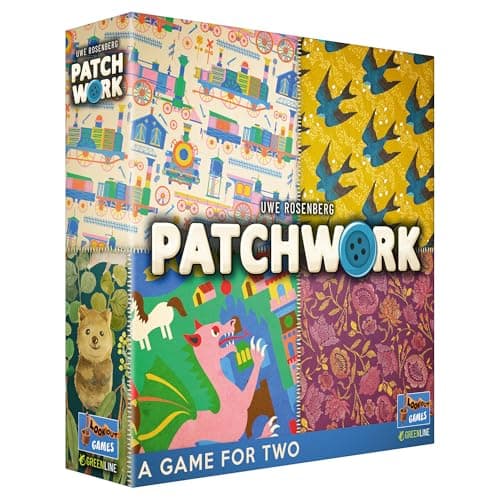
Patchwork is a two-player-only tile-laying game by Uwe Rosenberg, published 2014, listed at about 30 minutes for ages 8 and up. You buy fabric patches from a shared circle and fit them onto a personal quilt board, paying with buttons and with time.
We earn a commission when you buy through links on this page, at no extra cost to you. It does not change which games we recommend or what we say about them. How this site is funded.
Patchwork is what you buy when one of you does not want to be attacked. There is no combat, no blocking, no taking anything off anyone's board. You are each building a quilt, and the only contact between you is which patch gets bought first.
It is also considerably sharper than that description suggests, which is the reason it has stayed in print since 2014 rather than being filed under pleasant.
01
Paying with time is the idea worth the money
There is no turn order in the usual sense. Both players have a marker on a shared time track, and whoever is behind goes next -- which means a player can take several turns in a row if they keep buying cheap, fast patches.
Every patch costs buttons and time. A large efficient piece might cost five time, handing your opponent three turns while you sit. That single mechanism turns a pleasant tile puzzle into a genuine decision on every action, and it is why the game does not go stale.
The scoring closes it neatly: empty squares on your quilt cost you points at the end, so the puzzle is not just about filling space efficiently but about filling it before you run out of track.
02
Why it works when one of you is not a gamer
Three reasons, and they compound. The rules are one action long -- buy a patch or advance past your opponent. The theme is legible without explanation. And critically, nothing bad happens to you because of something the other person chose to do to you.
That last one is the reason it works in households where competitive games have failed. The loss, when it comes, is about your own quilt having holes in it. Nobody did that to you.
03
Who should skip it
Skip it if you want interaction. You are mostly solving your own board and the only shared decision is patch order, which reads as parallel solitaire to plenty of people. That is a legitimate objection and not a matter of taste to be argued out of.
Skip it too if you want variety inside the box. The patch set is the patch set. It is the same puzzle every time, distinguished by the order things come out, and after thirty games some pairs find that thin.
What we would buy
Picks drawn from the games covered on this site, chosen against the criteria above.
We earn a commission when you buy through links on this page, at no extra cost to you. It does not change which games we recommend or what we say about them. How this site is funded.
The gentlest good game on this site. Two quilts, no attacking, and a surprisingly sharp puzzle underneath.
A two-player-only tile-laying game. You buy fabric patches on a shared time track and fit them onto a personal 9x9 quilt board, paying with buttons and with time.
Players
2
Playing time
about 30 minutes
Age
8+
Designer
Uwe Rosenberg
Publisher
Lookout Games
Published
2014
Who should skip it
Skip it if you want to interact. You are mostly solving your own board, and the only contact is who takes which patch first.
Built for two2 players · 30 minutes · ages 10 and up
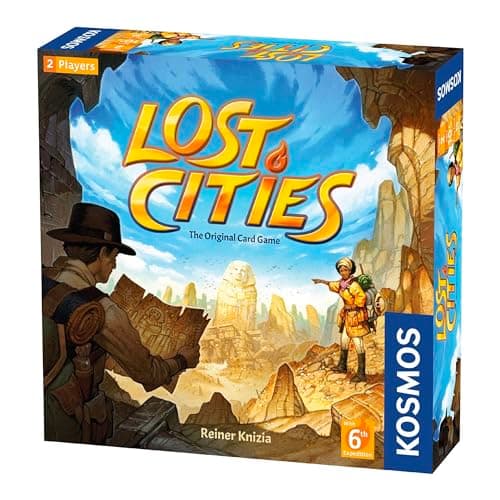
Old enough to vote and still the cleanest press-your-luck card game for two.
A two-player-only card game about mounting expeditions. Every card you play must be higher than the last on that color, so committing early is how you score and also how you go negative.
Players
2
Playing time
30 minutes
Age
10 and up
Designer
Reiner Knizia
Publisher
Kosmos / Rio Grande Games
Published
1999
Who should skip it
Skip it if a run of bad draws will sour the evening. The cards decide more here than in anything else we recommend.
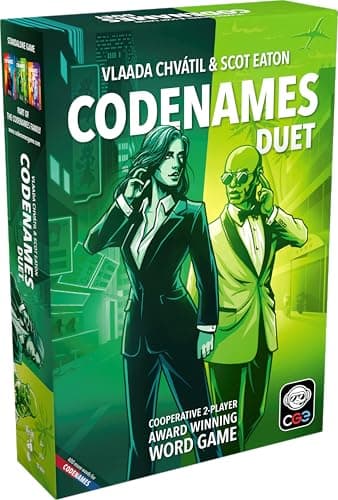
Built around two people and honest about it, though the publisher lists it as 2+ rather than two only.
A cooperative word-association game. You each see half of a shared key card and give one-word clues to guide the other to the right agents in a 5x5 grid, avoiding the assassin.
Players
2+
Playing time
15 minutes
Age
11+
Designer
Vlaada Chvatil and Scot Eaton
Publisher
Czech Games Edition
Who should skip it
Skip it if one of you thinks in wildly different associations from the other. That gap is funny once and exhausting by the fourth game.
Yes. Its infobox lists 2 players, at about 30 minutes for ages 8 and up. It was designed for exactly two.
+−Is Patchwork good for non-gamers?
It is one of the best options here. The rules are a single action, the theme needs no explanation, and nothing the other player does can damage your board.
+−Is there any conflict in Patchwork?
Only over which patch is bought first. There is no attacking, blocking or taking. That is exactly why it works for some households and feels like parallel solitaire to others.
+−How does the time track work?
Both players move on a shared track and whoever is behind takes the next turn, so cheap patches can buy you several consecutive turns while an expensive one hands turns to your opponent.