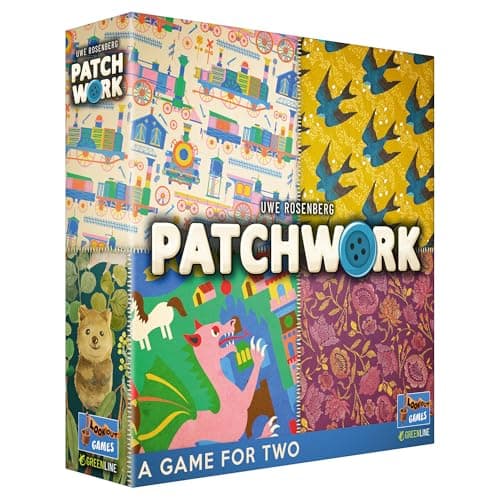
Patchwork is worth it for pairs who want a calm, low-conflict game: Lookout Games lists it for exactly 2 players at about 30 minutes, ages 8 and up. It is not worth it if you want interaction -- you are mostly solving your own quilt, and the only contact is which patch you take first.
We earn a commission when you buy through links on this page, at no extra cost to you. It does not change which games we recommend or what we say about them. How this site is funded.
Patchwork is the game we recommend to households that have been burned by a competitive evening, and the honest framing is that its greatest strength and its most common complaint are the same fact: almost nothing the other person does can hurt you.
So the question is not whether Patchwork is a good design -- it is, and it has stayed in print since 2014 on the strength of it. The question is whether a game with that little friction is the game you want on your table.
01
What you are actually paying for
A two-player-only tile game published by Lookout Games, designed by Uwe Rosenberg, at about 30 minutes for ages 8 and up. You buy fabric patches and fit them onto your own quilt board, paying for each one in buttons and in time.
The box holds 33 patches plus 5 special patches, a time board, two player boards, 50 buttons and a bonus tile. The patches sit in a circle with a neutral token, and on your turn you may take only one of the three patches clockwise of it -- so the supply is shared and restricted even though your board is private.
At the end you count your buttons, add the bonus tile if you earned it, and subtract two points for every empty space you failed to cover. There is no instant win and nothing that ends the game early.
02
The turn order is the clever part
This is the thing most buyers do not know in advance, and it is what stops Patchwork from being two people doing puzzles beside each other. Turns do not alternate. Both players move along a shared time track, and whoever is furthest behind takes the next turn.
So a cheap patch that costs little time can buy you two or three turns in a row, and an expensive one hands a run of turns to the other person. Taking a patch is simultaneously a decision about shape, about cost, and about how much of the near future you are giving away.
There is one thing worth racing for: a bonus tile goes to the first player to completely fill a seven-by-seven square on their board. It is the only part of the game where you are directly competing for something, and good players plan toward it from early on.
03
The household where it is not worth it
If you want to interact, this is the wrong purchase, and we would rather say that before you spend than after. You never take anything off the other person's quilt, never block them, never force them to do anything. The only contact is which of the three available patches you take before they can, and that is a thin thread to hang an evening on for a pair who like to feel the other player.
The second case is more specific: if spatial puzzles make one of you feel slow, no amount of gentle theme rescues that. Patchwork asks the same question repeatedly -- will this shape fit, and what hole am I creating -- and enjoying it is close to a personality trait. It is the single most common reason a copy stops getting played.
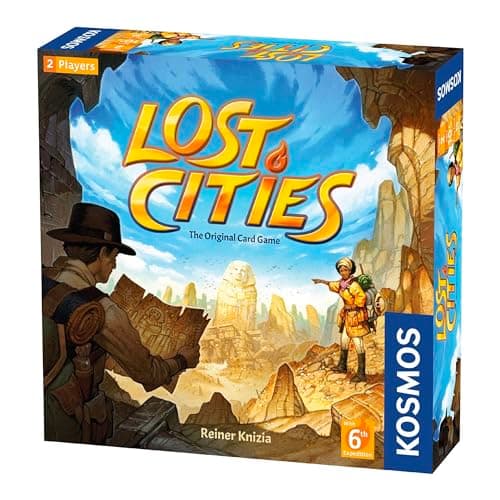
If either of those is you, the useful alternative from the same calm end of the shelf is Lost Cities: also two-player-only, also short, but with a real shared tension because you are both drafting from one deck and committing to expeditions in public.
04
The case for buying it anyway
Two things make Patchwork worth the money even for households that normally want more bite. The first is that it cannot spring a loss on you. There is no instant win and no final-turn reversal, so a bad position is a slow, visible thing rather than an ambush. For a pair where one person has quietly stopped enjoying competitive games, that matters more than any mechanism.
The second is the age rating. Lookout Games rates it 8 and up -- the lowest of any game we cover -- so a household with an older child has a game that genuinely works for all three of them, and the gentle scoring means a first game against an adult is not humiliating. It is not a children's game and we do not recommend it as one, but it widens who can sit down.
It is also physically small and quick to set up, which is why it survives on shelves where heavier games do not.
05
Patchwork or Splendor Duel
This is the comparison buyers most often land on, because both are two-player-only games around half an hour where neither player can attack the other. They are opposites in temperament.
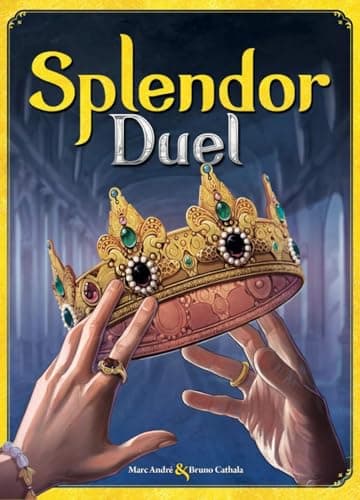
Patchwork has no race and cannot end suddenly. Splendor Duel has three victory conditions live from the first turn and stops the moment anyone meets one. If what you want from a weeknight is something absorbing that will not spike your pulse, that difference is the entire decision, and it points at Patchwork.
06
What we did instead of playing it
We have not played this. What we did: took the player count, playing time, age, designer and box contents from Lookout Games' own page for the game, and took the turn-order rule, the three-patch restriction, the seven-by-seven bonus and the end-of-game scoring from published reproductions of the rulebook, because the publisher page does not describe the mechanics. Sources are linked below. No price appears in this prose.
What we would buy
Picks drawn from the games covered on this site, chosen against the criteria above.
We earn a commission when you buy through links on this page, at no extra cost to you. It does not change which games we recommend or what we say about them. How this site is funded.
The gentlest good game on this site. Two quilts, no attacking, and a surprisingly sharp puzzle underneath.
A two-player-only tile-laying game. You buy fabric patches on a shared time track and fit them onto a personal 9x9 quilt board, paying with buttons and with time.
Players
2
Playing time
about 30 minutes
Age
8+
Designer
Uwe Rosenberg
Publisher
Lookout Games
Published
2014
Who should skip it
Skip it if you want to interact. You are mostly solving your own board, and the only contact is who takes which patch first.
Built for two2 players · 30 minutes · ages 10 and up
Old enough to vote and still the cleanest press-your-luck card game for two.
A two-player-only card game about mounting expeditions. Every card you play must be higher than the last on that color, so committing early is how you score and also how you go negative.
Players
2
Playing time
30 minutes
Age
10 and up
Designer
Reiner Knizia
Publisher
Kosmos / Rio Grande Games
Published
1999
Who should skip it
Skip it if a run of bad draws will sour the evening. The cards decide more here than in anything else we recommend.
The gentler duel: an engine builder where you are racing rather than attacking, and the shared gem board is the whole game.
A two-player-only engine-building game in the Splendor universe. You draft gem tokens from a shared board to buy Jewel cards across three levels, chasing three separate victory conditions -- points, a color majority, or crowns. 67 Jewel cards, 25 tokens, 3 Privilege scrolls, 4 Royal cards.
Players
2
Playing time
30 minutes
Age
10+
Designer
Bruno Cathala and Marc Andre
Publisher
Space Cowboys
Published
2022
Who should skip it
Skip it if you want direct conflict. The tension is in what you take from the shared board before the other person can, never in anything you do to their cards.
Yes, if you want a calm game with no attacking and no sudden endings. Lookout Games publishes it for exactly 2 players at about 30 minutes, ages 8 and up. It is not worth it if you want real interaction across the table.
+−Is Patchwork too simple?
The rules are simple -- two possible actions on a turn -- but the decisions are not. The shared time track means taking a cheap patch can buy you consecutive turns, so every purchase is also a decision about tempo.
+−Is Patchwork good for couples?
It is one of the best we cover for a pair who want a relaxed evening, precisely because neither player can do anything to the other. If you want to feel competed with, it will read as two people playing solitaire side by side.
+−Can you play Patchwork with a child?
Lookout Games rates it 8 and up, so an older child can play. It is not a children's game and we do not recommend it as one, but the scoring is gentle enough that a first game against an adult is not discouraging.
+−Patchwork or Splendor Duel?
Patchwork for a calm evening -- no race, no sudden ending. Splendor Duel if you want tension: three victory conditions run at once and any of them can end the game on the spot.