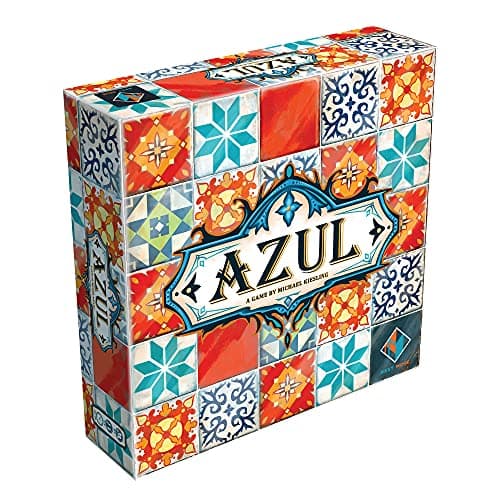
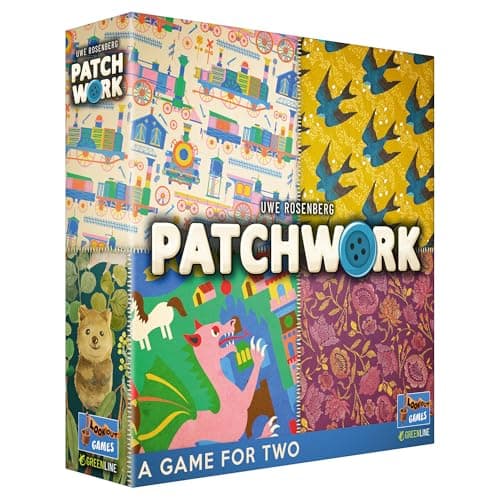
Buy Patchwork if you want the genuinely calm game: Lookout Games publishes it for exactly 2 players at about 30 minutes, rated 8+, and nothing in it lets either player touch the other's board. Buy Azul if you want the award winner that also seats four and a draft with real conflict in it -- you must take every tile of a color, including the ones you cannot use.
We earn a commission when you buy through links on this page, at no extra cost to you. It does not change which games we recommend or what we say about them. How this site is funded.
These two end up on the same shortlist constantly, and for a reasonable surface reason: both are tile games, both are beautiful on a table, both run about half an hour, and both get recommended to people who want something gentler than a war game. If you have been looking for a quiet game for two, you have almost certainly been shown both.
They are not, though, the same kind of quiet. One of them has no way for either player to interfere with the other at all. The other hands you a rule that forces you to take tiles you cannot use, and lets you strip the supply of exactly the color the other person was building toward. That difference is not a nuance -- it is the whole decision, and it is the one most comparisons skip.
Quick picks
#
Game
Players
Time
Price
1
Patchwork
The gentlest good game on this site. Two quilts, no attacking, and a surprisingly sharp puzzle underneath.
Player counts and playing times come from each publisher, cited on that game's review page. Tap a row to jump to the full write-up.
01
The verified specs
Patchwork -- 2 players, about 30 minutes, ages 8+. Uwe Rosenberg, Lookout Games, 2014. 33 patches plus 5 special patches, 1 time board, 2 player boards, 50 buttons, 1 bonus tile.
Azul -- 2-4 players, 30-45 minutes, age rating not stated by any reachable source. Michael Kiesling, Plan B Games, 2017. Winner of the 2018 Spiel des Jahres plus five further major awards.
Patchwork is published for exactly two and is Built for two on this site's labeling. Azul is published for 2-4 and is Plays at two. Neither has a publisher-stated solo mode.
02
How we judged it
Three questions, and they are the ones that actually decide between two games that look alike.
First: can one player spoil the other's plan? This sorts calm games from games that merely look calm, and it is the single most useful thing to know before buying for a household where one person dislikes confrontation.
Second: what kind of thinking does it ask for? Spatial and economic thinking feel completely different to do, and people are rarely equally good at both. A pair usually discovers within one game which of the two they enjoy, and it is often not the same for both of them.
Third: who else in the house might play it? A player count and an age rating are not trivia here -- they decide whether a box gets used twice a year or twice a week.
03
Patchwork has no interference at all. Azul does.
In Patchwork you buy fabric patches from a shared circle, pay for them in buttons and in time, and fit them onto your own quilt. At the end you count buttons and lose two points for every empty square you failed to cover. You never take a patch off the other person's quilt, never force a discard, and never attack anything. The only contact between you is which patches you take from the circle before they can.
Azul's central rule is the opposite of gentle, and it is easy to miss because the game is so pretty. When you take tiles, you take every tile of the one color you have chosen from the one place you have chosen -- all of them, whether or not you can use them. Tiles that do not fit are discarded and cost you points.
That rule has a sharp consequence at two players, and it gets sharper the better you both get. You can take a color you do not need in order to deny it, and because there is exactly one opponent you can see precisely what they are building toward and precisely what they will be forced to pick up next. Good Azul at two is substantially about making the other person take tiles they will have to throw away.
So if the reason you are looking for a tile game is that you want an evening with no conflict in it, those are different answers. Patchwork delivers that. Azul is a game about pressure that happens to be decorated with ceramic tiles.
04
Spatial thinking versus a drafting puzzle
Patchwork asks one question over and over: will this shape fit, and what hole am I creating by putting it here? It is the board game equivalent of packing a car trunk well. People who enjoy that enjoy Patchwork enormously, and people who find spatial puzzles make them feel slow do not come back to it -- that is the most common reason a copy stops being played, and no amount of theme fixes it.
Azul asks a drafting and sequencing question instead: which color can I take the most of without wasting any, and in what order do I place tiles so they score off each other? Each tile scores by where it sits relative to tiles already on your board, so the order you commit things in matters as much as what you collect. There is still a spatial element, but the board tells you where colors go in the basic mode, so the pressure is on timing rather than fit.
Neither is harder than the other, and there is no ranking here. But they exercise genuinely different muscles, and the thing to know is that enjoying one does not predict enjoying the other.
05
Turn order in Patchwork is the stranger rule
Patchwork does not alternate turns. Both players move along a shared time track, and whoever is furthest behind takes the next turn -- so a cheap patch that costs little time can buy you two or three turns in a row, while an expensive one hands a run of turns to the other person.
That one rule is what stops Patchwork from being two people doing jigsaws beside each other. Taking a patch is also deciding how much of the near future you are giving away, and that is where the game lives once you have played a few times.
Azul alternates strictly, so its pressure comes from the supply rather than from the clock. Both designs charge you for greed; Patchwork charges you in turns, Azul charges you in discarded tiles and lost points.
06
Who else will be playing
This is where Azul wins on a fact that has nothing to do with the design. Plan B Games publishes it for 2-4. The moment a friend or a family member turns up, Azul is still playable and Patchwork is not. For a household that hosts even occasionally, that is frequently the whole argument.
Patchwork's counter is its age rating. Lookout Games rates it 8 and up -- the lowest of any game we cover -- and the gentle end-of-game scoring means a first game against an adult is not humiliating for a child. No reachable source states an age rating for Azul at all: Plan B Games' own site now redirects elsewhere and Asmodee's product page renders empty, so if you are buying for a specific child, read the box rather than trusting any page including this one.
There is a third option worth knowing before you choose either. Since 2025 there is an Azul built for exactly two players -- Azul Duel, from Next Move Games, 45 minutes, ages 10+. If what draws you to Azul is the tile drafting rather than the four seats, that is the box designed for your table.
One last difference that only shows up after a month of ownership: these two age differently for a pair. Patchwork's variety comes from its shuffled supply -- 33 patches plus 5 special ones in a circle, so the order you meet them changes every game while the puzzle itself stays the same shape. Azul's comes from its advanced placement mode, where you may put colors anywhere rather than in the positions the board dictates, and that is effectively a second and harder game sitting inside the box. The practical upshot is that Patchwork is consistent from the first play to the fiftieth, and Azul has a step change in it that you have to choose to take. A pair who will play one game forty times is better served by Azul's second mode than by Patchwork's reshuffle.
07
Pick this if
Pick Patchwork if you want a genuinely conflict-free evening, if either of you dislikes being targeted, if spatial puzzles appeal, or if a child as young as eight might join. Built for exactly two, about 30 minutes, and the gentlest good game we cover.
Pick Azul if you want the famous award winner, need the box to seat up to four, like a draft with real denial in it, or are buying a gift for someone who likes receiving things they have heard of. Plays at two, 2-4, five major awards.
Pick Azul Duel instead of either if the two of you are the only players and you specifically want the tile draft. It is the Azul built for exactly two, and its rule that you choose the order your leftovers are stacked for your opponent is the sharpest version of what Azul is already doing.
The gentlest good game on this site. Two quilts, no attacking, and a surprisingly sharp puzzle underneath.
A two-player-only tile-laying game. You buy fabric patches on a shared time track and fit them onto a personal 9x9 quilt board, paying with buttons and with time.
Players
2
Playing time
about 30 minutes
Age
8+
Designer
Uwe Rosenberg
Publisher
Lookout Games
Published
2014
Who should skip it
Skip it if you want to interact. You are mostly solving your own board, and the only contact is who takes which patch first.
Five major awards in 2018, and a draft where you must take every tile of the color you want -- including the ones you cannot use.
A tile-drafting game for 2-4 players. You take every tile of one color from a shared supply and arrange them in rows, then move one tile from each filled row onto a 5x5 board where it scores by where it sits relative to the others. Rounds continue until a player completes a row across their board, with bonuses for complete rows, columns and full color sets. Designed by Michael Kiesling, published by Plan B Games in 2017.
Players
2-4
Playing time
30-45 minutes
Designer
Michael Kiesling
Publisher
Plan B Games
Published
2017
Who should skip it
Skip it if you want a game built only for two. Plan B Games lists 2-4, and a two-player-only Azul exists separately as Azul Duel.
Patchwork, if you want calm: neither player can interfere with the other's board at all. Azul is better if you both enjoy pressure -- its rule that you must take every tile of a color lets you deliberately leave the other person with tiles they cannot use.
+−Which is easier to learn?
Both are light, and Azul is marginally lighter. Patchwork has two possible actions per turn plus an unusual shared time track that decides turn order. Azul has essentially one kind of action, though its scoring takes a round to click.
+−Is Azul a two-player game?
Azul is published by Plan B Games for 2-4 players, so it plays at two rather than being built for two. It is genuinely good at two, and since 2025 there is also Azul Duel, published for exactly 2 players.
+−Which one can a child play?
Patchwork. Lookout Games rates it 8 and up, the lowest rating of any game we cover. No reachable source states an age rating for Azul, so we cannot tell you -- read the box if that matters.
+−Which has more replay value for two people?
Patchwork has 33 patches plus 5 special ones in a shuffled circle, so the supply order changes every game. Azul's variety comes from its advanced placement mode, where you may place colors anywhere rather than in fixed positions, which is effectively a second and harder game.
+−Do either of these work as a gift?
Azul is the better gift: it has an award record people recognize, a five-minute teach, and it seats four. Patchwork is the better gift when you know the recipients want something calm, or when there is a young child in the house.