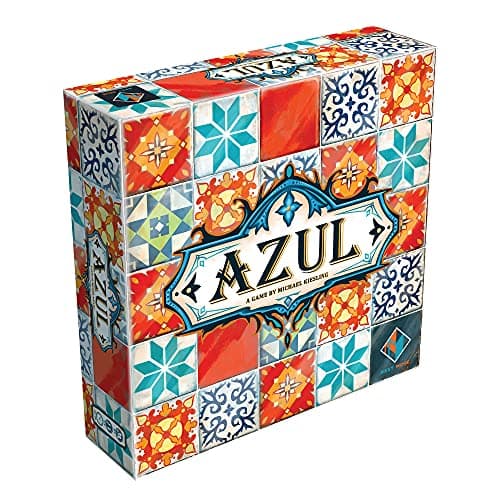
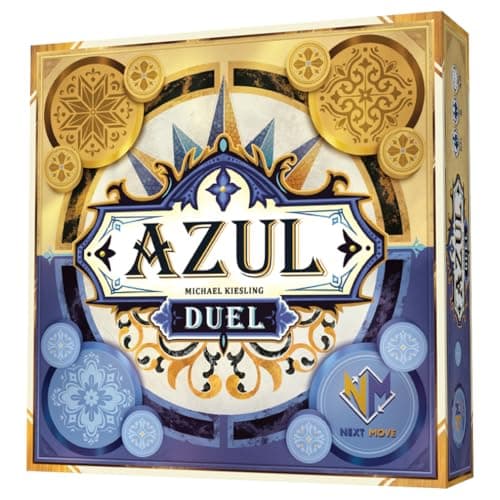
Buy Azul Duel if the two of you are the only people who will ever play it: Next Move Games publishes it for exactly 2 players at 45 minutes, and its draft makes you choose the order your leftover tiles are stacked for your opponent. Buy the 2017 Azul if you need the box to seat up to four, want the gentler teach, or want the Spiel des Jahres winner everyone recognizes.
We earn a commission when you buy through links on this page, at no extra cost to you. It does not change which games we recommend or what we say about them. How this site is funded.
Until 2025 this comparison did not exist. Azul was the tile-drafting game everyone recommended, it was published for 2-4 players, and a pair who wanted it simply played the family game at two and enjoyed it. Then Next Move Games published a standalone Azul designed specifically for two, and the recommendation stopped being automatic.
This is a genuinely close call, which is why it deserves a page rather than a sentence. Both are tile-drafting games by the same designer in the same family, both use the heavy acrylic tiles that are the reason people reach for these boxes, and neither needs the other. The decision comes down to two things: how many people will ever sit at your table, and how much rules overhead you want.
Quick picks
#
Game
Players
Time
Price
1
Azul Duel
The Azul family built for exactly two, and the first game here where you draft a tile and decide what the other person is allowed to reach next.
Player counts and playing times come from each publisher, cited on that game's review page. Tap a row to jump to the full write-up.
01
The verified specs
Azul -- 2-4 players, 30-45 minutes, age rating not stated by any reachable source. Michael Kiesling, Plan B Games, 2017. Winner of the 2018 Spiel des Jahres, the 2018 As d'Or, Origins Best Family Game, a Dice Tower award and Mensa Select.
Both are standalone. Azul Duel is not an expansion and does not need the 2017 box. Neither game has a publisher-stated solo mode.
On this site's labeling: Azul is Plays at two, Azul Duel is Built for two. It is the only game in the Azul family published for exactly two.
02
The rule that separates them
In Azul, tiles sit on factory discs and you take every tile of one color from one disc. Whatever you leave is simply left. With three or four players that is a sharp decision because you cannot predict which opponent reaches it first.
Azul Duel starts from the fact that at two players there is nothing to predict -- everything you leave goes to one specific person. Each factory has a sun side and a moon side. When you take all tiles of one color from the sun side, you then choose the order in which the remaining tiles are stacked onto that factory's moon space, and a player can later take one color from the top of the moons.
So in Azul you suffer from what happens to be left on the table. In Azul Duel you suffer from what the other person deliberately left you, in the order they chose, with the color they wanted buried at the bottom. That is a different game, and it is a rule that would be meaningless with a third player at the table.
If you want one sentence for the difference: Azul at two is a shared puzzle you are both solving faster than the other, and Azul Duel is a fight over a supply you each take turns rationing.
03
Azul Duel is the heavier teach, and it is not close
Azul is close to the lightest good game we cover. You take tiles, you put them in rows, filled rows move a tile onto your board, and surplus tiles are discarded at a cost. That is nearly all of it, and a first game starts inside five minutes.
Azul Duel asks for more on every front. There are four possible actions rather than one basic take: take a face-up dome tile (which you must do twice each round), take a color from a factory's sun side and stack the leftovers, take a color from the top of the moon spaces, or take a revealed bonus chip. On top of that sit dome-plates, bonus chips that can substitute for missing tiles, scoring tablets, and two separate point penalties -- one point for each dome tile drawn face-down from the stack, and two points for grabbing the first-player position from the large factory's moon side.
None of that is complicated once learned, and none of it is padding. But it is a real step up, and it matters enormously for one specific buyer: if the plan is to hand this to someone who says they do not play board games, Azul is the one that works and Azul Duel is the one that stalls.
04
Replay value points the other way
Azul has one fixed player board, with two placement modes. In the basic mode the board dictates where each color goes; in the advanced mode you may place colors anywhere, which is a genuinely different and much harder game rather than a difficulty slider.
Azul Duel's boards vary. Next Move Games' own description leads on this: pattern plates let you build a player board with a different layout each game, so the setup and the scoring opportunities change with it.
That difference is worth more to a pair than it looks, for a reason that is pure arithmetic. Two people who own a two-player game play it far more often than four people who own a family game, because they never have to find a third. A fixed board that the two of you have solved forty times is a solved board, and Azul's advanced placement mode is the only answer the 2017 box has. Changing the layout every game is the better answer.
The honest qualification: Azul's advanced mode is a known quantity with nine years of players behind it, and Azul Duel's variable boards are a 2025 mechanism nobody has a long record with. We can tell you the mechanism exists because the publisher states it. We cannot tell you how much variety it actually generates after thirty plays, and neither can anyone else yet.
05
What Azul has that Azul Duel cannot get
Recognition and a shelf of awards. Azul won the 2018 Spiel des Jahres -- the most meaningful prize in the hobby -- plus the As d'Or, Origins Best Family Game and Fan Favorite, a Dice Tower award and a Mensa Select certification, and it was Golden Geek Best Family Game for 2017.
That record does two concrete things for a buyer. It is a guarantee of quality that no new release can match, because the award is partly a measure of how well the game held up in front of juries and crowds. And it makes Azul a far better gift, because the recipients will have heard of it, and anything they look up will agree with you.
It also seats four. That sounds obvious and it is the most frequently decisive fact on this page: the moment a friend comes over, a two-player-only box stays on the shelf. A household that hosts even occasionally is often better served by the family game that is excellent at two than by the two-player game that is slightly better at two.
What the award record does NOT tell you is anything about two-player play. The Spiel des Jahres measures accessibility at a family table. It is not a two-player award, and we are not going to launder it into one.
06
Price, and the thing that is actually at stake
Both games sit in the same mid price bracket, and at the time of writing Azul Duel is the cheaper of the two boxes -- live prices for both are in the table above, each stamped with the date we read it. Price is not the deciding factor here and we would not pretend otherwise.
What is actually at stake is whether you buy a game designed around your situation or a better-known game that accommodates it. That framing is this entire site's reason for existing, and it cuts cleanly here for once: Azul Duel is the two-player game, Azul is the famous game that is also good at two, and both of those are real reasons to buy.
07
Pick this if
Pick Azul Duel if two of you are the only people who will ever play it, you want the draft to be confrontational rather than parallel, and you want a board layout that changes every game. Built for exactly two, 45 minutes, 10+.
Pick Azul if the box needs to seat up to four, if you are teaching someone who does not play games, if it is a gift for someone who likes receiving things they have heard of, or if you want the five-minute teach. Plays at two, 2-4, Spiel des Jahres winner.
Pick neither, and look at Patchwork, if what you want from a tile game is calm. Lookout Games publishes it for exactly 2 at about 30 minutes, rated 8+, and nothing in it lets either player touch the other's board. Both Azuls let you take the tiles the other person needed.
The Azul family built for exactly two, and the first game here where you draft a tile and decide what the other person is allowed to reach next.
A two-player-only tile-drafting game in the Azul family. You take every tile of one color from a factory's sun side, then choose the order the leftovers are stacked onto its moon side for your opponent to pick over. Tiles fill a single pattern line at a time and move onto dome tiles that score by row and column, across five rounds. Published by Next Move Games for exactly 2 players at 45 minutes.
Players
2
Playing time
45 minutes
Age
10+
Designer
Michael Kiesling
Publisher
Next Move Games
Published
2025
Who should skip it
Skip it if you want the game everyone recognizes. This is the newer, sharper box; the 2017 Azul is the one your guests have heard of and the one that seats four.
Five major awards in 2018, and a draft where you must take every tile of the color you want -- including the ones you cannot use.
A tile-drafting game for 2-4 players. You take every tile of one color from a shared supply and arrange them in rows, then move one tile from each filled row onto a 5x5 board where it scores by where it sits relative to the others. Rounds continue until a player completes a row across their board, with bonuses for complete rows, columns and full color sets. Designed by Michael Kiesling, published by Plan B Games in 2017.
Players
2-4
Playing time
30-45 minutes
Designer
Michael Kiesling
Publisher
Plan B Games
Published
2017
Who should skip it
Skip it if you want a game built only for two. Plan B Games lists 2-4, and a two-player-only Azul exists separately as Azul Duel.
For a pair who will only ever play at two, yes. It is published for exactly 2 players and its central rule -- choosing the order your leftover tiles are stacked for your opponent -- only works with one other person. Azul remains the better buy if you need four seats, want the lighter teach, or want the award winner.
+−Do I need Azul to play Azul Duel?
No. Azul Duel is standalone, with its own 75 acrylic tiles, 5 factories, 2 player boards and 18 dome-plates. It is not an expansion to the 2017 game.
+−Which is easier to learn, Azul or Azul Duel?
Azul, clearly. It has essentially one kind of action and a first game begins within five minutes. Azul Duel has four possible actions, dome tiles you must take twice a round, bonus chips, scoring tablets and two separate point penalties.
+−Is Azul Duel two players only?
Yes. Next Move Games states a minimum of 2 and a maximum of 2 players and calls it a two-player challenge. Azul, by contrast, is published by Plan B Games for 2-4.
+−Which has better replay value for a couple?
Azul Duel on paper, because its pattern plates give a different board layout each game while Azul has one fixed board. The qualification is that Azul Duel is a 2025 release with no long-term record, whereas Azul's advanced placement mode has nine years of players behind it.
+−Which is the better gift?
Azul. It has an award record people recognize, the lightest possible teach, and it seats four if the recipients have guests. Azul Duel is the better gift only for a couple you know already plays games together at two.