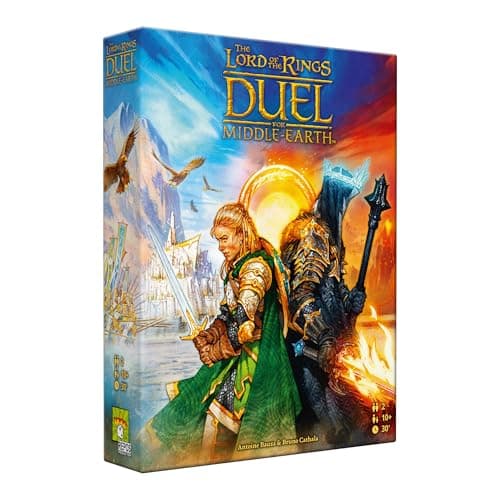
The Lord of the Rings: Duel for Middle-earth is a two-player-only card game from Repos Production, stated at 30 minutes for ages 10 and up. One player is the Fellowship, the other Sauron, across three chapters, and three instant wins -- the Ring quest, all 7 regions, or 6 Races -- can end it early.
We earn a commission when you buy through links on this page, at no extra cost to you. It does not change which games we recommend or what we say about them. How this site is funded.
This is the game 7 Wonders Duel owners get asked about most, and the question is always the same: is it a new game, or the same game with Frodo on the box? The honest answer is that it is both, in proportions worth understanding before you spend the money. The designers are the same two people, Antoine Bauza and Bruno Cathala. The shape is the same -- three stages, a partly hidden card display, several ways to end the game before the last card. What is new is a map of Middle-earth, a quest track with two figures racing toward each other, and a theme that is doing mechanical work rather than decoration.
It arrived at US retail in October 2024, which makes it one of the newest games we cover. That matters for one practical reason: recent releases go out of print between print runs more often than established ones, so it is worth checking the buy button below rather than assuming it will always be there.
01
Three instant wins, and one fallback
Repos Production states three victory conditions, and each one ends the game the moment it is met. That is one more instant win than 7 Wonders Duel, where the third route is a points count at the end. Here, even the fallback when nobody wins outright is decided by territory rather than by a points total.
The quest is the one that carries the theme. Blue cards advance your figure along the Quest of the Ring track. If Frodo and Sam reach Mount Doom and destroy the One Ring, the Fellowship wins on the spot; if the Nazgul catch them first and seize the Ring, Sauron does. The two sides are running at each other along the same line, which is a much more direct race than anything in the original.
The military route is territorial. Middle-earth is split into seven regions, and if you are present in all seven -- with a Fortress, at least one Unit, or both -- you win immediately. The alliance route is a collection goal: gather six different symbols on your green Race cards and the Races rally to you, which also ends the game.
If nobody has managed any of that by the end of the third chapter, the published rules fall back to the map: whoever is present in the most regions wins. If that is tied, the victory is shared. That last clause is worth knowing about in advance, because a draw is a genuinely possible result, and some competitive pairs dislike it intensely.
02
How asymmetric it actually is
The marketing leads with Fellowship versus Sauron, and it is fair to ask how different the two sides really are. On the evidence of the publisher's own description, the asymmetry is concentrated in one place, and it is the right place: the quest. The Fellowship is trying to get the Ring to Mount Doom, Sauron is trying to catch the hobbits, and those are opposite goals on a shared track.
The other two routes are the same for both players. Both of you draft from the same chapter display, both of you can race to occupy all seven regions, and both of you can chase six Race symbols. So this is not the kind of asymmetric game where the two sides have separate rulebooks and you have to learn two games. It is one game with a lopsided finish line, which is much easier to teach and also much less different between sides than the box art suggests.
That is not a criticism. Fully asymmetric games are slow to learn precisely because each player has to understand the other side too. Duel for Middle-earth gets most of the flavor of opposing forces for a fraction of the teaching cost. Just do not buy it expecting Watergate-style asymmetry, where the two sides really are playing different jobs.
03
What a turn looks like
Each chapter starts with a display of chapter cards laid out in a set pattern, some face up and some face down. On your turn you do one of two things. You take an available chapter card and either play it or discard it, or you take a Landmark tile.
Playing a card means meeting its cost. Most cards and Landmarks require Skills already present in your play area, and for each Skill symbol you are missing you can pay one coin to the reserve instead. So early cards that give you Skills make later cards cheaper, which is the engine-building layer underneath everything else.
The card colors tell you what each one is for. Blue cards move you along the quest track. Green cards are the Races that count toward the alliance win. Red cards are Units that put you into regions. Purple cards are Maneuvers. Landmark tiles let you place a Fortress pawn into the region shown on the tile, which counts toward regional presence, and they give an immediate benefit printed on the tile itself.
Turns strictly alternate, including across chapters, so the player who ends one chapter does not start the next unless a card granted an extra turn. It is a small rule, but it means taking the last card of a chapter is a real decision rather than a formality.
04
How much it overlaps 7 Wonders Duel
A lot, and it is better to say so plainly than to let you discover it. Same designers, same three-stage structure, same partly hidden card display, same idea that the game can end before the final card through more than one route. If you own 7 Wonders Duel and play it regularly, much of the decision-making here will feel familiar within a game.
The differences are real, though, and they point in a consistent direction: toward the board. 7 Wonders Duel is about the cards you build in front of you and two tracks you watch. Duel for Middle-earth adds a seven-region map you are physically contesting, Fortresses and Units that sit in those regions, and a quest track where the two players' pieces are moving toward each other. There is more on the table and more of it is shared ground.
Our practical advice: if you own neither, choose on theme and on whether a map appeals to you, because both are strong buys. If you already own 7 Wonders Duel and love it, this is a sidegrade you would buy for the setting rather than for a new kind of game. If you own 7 Wonders Duel and it has gone stale, the change here is probably not large enough to fix that -- look at something structurally different like Watergate or Undaunted instead.
05
Who this is genuinely for
Pairs who both care about The Lord of the Rings. The theme is not a skin here -- the quest win is the most memorable thing in the box, and it only lands if the Ring means something to both of you.
People who own neither 7 Wonders Duel nor this, and prefer a map and territory to a tableau of cards.
Households that want a competitive game with a strong sense of opposing sides without the teaching cost of a fully asymmetric design.
Anyone whose 7 Wonders Duel copy is loved rather than tired, and who would enjoy a second game on the same bones in a different world.
06
Who should skip it
Skip it if you already own 7 Wonders Duel and want something structurally different. The overlap is large, and the money is better spent on a game that asks different questions of you.
Skip it if neither of you has any attachment to the setting. Without the theme, what remains is a very good game that sits close to one you could already buy, and the stronger case for this box over the original disappears.
And skip it if a shared victory would ruin the evening. A tie on regions at the end of chapter 3 is a draw by the rules, and a pair who plays competitive games specifically to have a winner will find that outcome deflating, however rarely it happens.
07
What we did instead of playing it
We have not played this. What we did: took the player count, playing time, age, designers, three-chapter structure, the two sides, all three instant-win conditions and the four card colors from Repos Production's own page for the game; took the box contents from Asmodee USA's product page; took the end-of-chapter-3 fallback, the tie rule, the turn actions, the Skill and coin costs and the Landmark rules from a published reproduction of the rulebook, and confirmed the fallback and tie rule against a second, independent write-up because the publisher's page does not state them. Every source is linked below.
What we would buy
Picks drawn from the games covered on this site, chosen against the criteria above.
We earn a commission when you buy through links on this page, at no extra cost to you. It does not change which games we recommend or what we say about them. How this site is funded.
7 Wonders Duel's designers, 7 Wonders Duel's structure, and a theme that does real work -- the asymmetric Fellowship-versus-Sauron split is the reason to own both.
A two-player-only asymmetric card game from the designers of 7 Wonders Duel. One side is the Fellowship, one is Sauron, played across three chapters with three instant-win conditions: the Quest of the Ring, presence in all 7 regions, or gathering 6 different alliance symbols.
Players
2
Playing time
30 minutes
Age
10+
Designer
Antoine Bauza and Bruno Cathala
Publisher
Repos Production
Published
2024
Who should skip it
Skip it if you already own 7 Wonders Duel and want something structurally different. This is the same three-stage, race-to-an-instant-win skeleton wearing Middle-earth, and the overlap is large.
The strongest all-round two-player game in print, and the one most couples settle on.
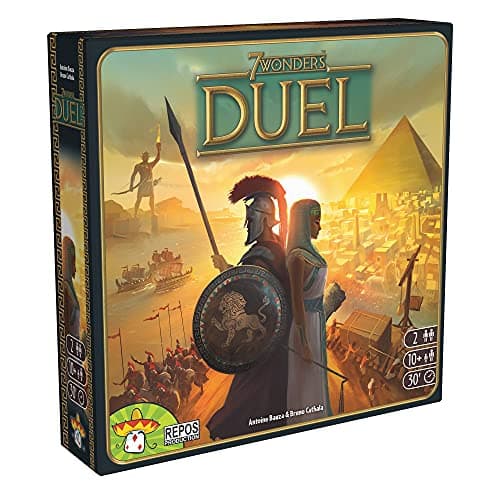
A two-player-only card drafting game where each side builds a civilization across three ages. Three ways to win -- civilian points, military supremacy and scientific dominance -- run at once, so every card you take is also a card denied.
Players
2
Playing time
30 minutes
Age
10+
Designer
Antoine Bauza and Bruno Cathala
Publisher
Repos Production
Published
2015
Who should skip it
Skip it if you want a relaxing evening. Three win conditions run at once, so you are always watching what the other person is about to do.
Asymmetric, historical, and finished inside an hour -- the shortest route into serious card-driven games for two.
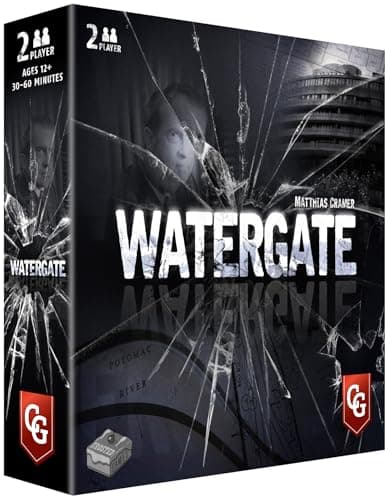
A two-player-only asymmetric card-driven game. One side is the Nixon administration, the other the Washington Post, and every card is both an action for you and a resource for the opponent.
Players
2
Playing time
30-60 minutes
Age
12+
Designer
Matthias Cramer
Publisher
Capstone Games
Published
2019
Who should skip it
Skip it if you both want the same experience. The two sides play very differently and one of you will prefer a side.
Yes. Repos Production states 2 players on its official page, and Asmodee USA lists a minimum and maximum of 2. It is a two-player-only design.
+−Do I need 7 Wonders Duel to play Duel for Middle-earth?
No. It is a complete, separate game with its own components -- Asmodee USA lists 69 cards, 44 pawns, 18 tokens, 30 coins, 7 tiles and 2 boards -- not an expansion. Knowing 7 Wonders Duel just makes it quicker to learn.
+−How do you win Duel for Middle-earth?
Three ways, each ending the game immediately: complete the Quest of the Ring for your side, be present in all 7 regions, or gather 6 different symbols on your green Race cards. If none happens by the end of chapter 3, most regions wins, and a tie is shared.
+−Is Duel for Middle-earth better than 7 Wonders Duel?
Not better -- a different trade. It adds a contested map and a quest race and loses some of the original's clean card focus. If you own neither, pick on theme. If you own 7 Wonders Duel, the overlap is large.
+−Is there an expansion for Duel for Middle-earth?
Yes. Repos Production publishes one called Allies, which it describes as 14 illustrated cards with Power tokens. We have not covered it, so it has no buy link on this site.
+−How long does Duel for Middle-earth take?
The publisher states 30 minutes. Expect the first game to run longer: there are four card colors, Landmarks, a map and a quest track to learn, which is more to take in than the original.