Buy Pantheon first. It changes Age III rather than adding a layer on top, and Repos Production lists both expansions at 2 players, 30 minutes, ages 10+. Agora adds a fourth instant-win condition and suits players who already track the base game's three comfortably.
We earn a commission when you buy through links on this page, at no extra cost to you. It does not change which games we recommend or what we say about them. How this site is funded.
If you own 7 Wonders Duel and play it often enough to be asking this question, you are the ideal buyer for an expansion: you already know the card symbols, the three victory tracks are second nature, and the base game has stopped surprising you.
There are two expansions, they cost the same as each other, and Repos Production states both at 2 players, 30 minutes, ages 10 and up. Neither adds playing time on paper. Both require the base game.
The short answer is Pantheon first, and the rest of this page is why -- plus an honest section on when the right move is to buy neither.
01
What each one actually adds
The distinction that matters is where in the game they intervene.
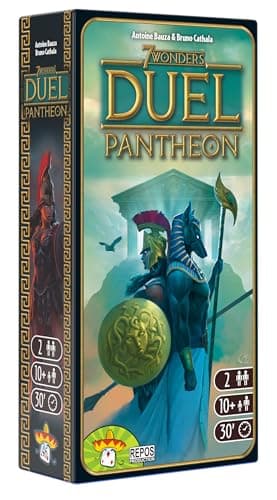
Pantheon adds a Pantheon board and Divinity cards drawn from five mythologies -- Greek, Phoenician, Mesopotamian, Egyptian and Roman -- plus two new Wonders and three progress tokens. Critically, its Grand Temple cards replace the Guilds in Age III. It modifies a phase you already play rather than sitting alongside it.
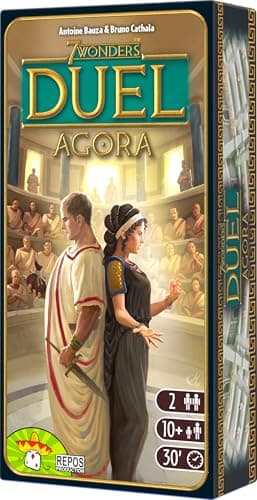
Agora adds a Senate board with six controllable Chambers, Senator cards split into Politicians and Conspirators, Conspiracy cards, two new Wonders and two progress tokens. It also adds a new instant-win condition, Political Supremacy, which sits alongside the military and scientific ones.
Both are compatible with each other, so running both at once is supported rather than a house rule.
02
Why Pantheon is the one to buy first
Three reasons, in order of how much they should weigh on the decision.
First, it replaces rather than accumulates. The base game's Age III already has Guild cards, and Pantheon swaps them for Grand Temples. You are not tracking a new subsystem on top of everything else -- you are playing a familiar phase with different cards in it. That keeps the mental load close to where it was.
Second, divinities give you a reason to look up. The most common complaint about 7 Wonders Duel from experienced pairs is that both players settle into optimizing their own tableau and the drafting becomes routine. Invoking a divinity is a discrete, timed decision that cuts across that routine.
Third, it does not change how the game ends. The three victory conditions you already watch are the same three. That matters more than it sounds, and the next section is about why.
03
What a fourth victory condition does to the game
Agora's Political Supremacy is a genuine addition to how the game can end, and whether that appeals depends entirely on how you experience the base game.
7 Wonders Duel is already a game about watching clocks that belong to your opponent. You can be comfortably ahead on points and lose instantly to a sixth science symbol or a military marker reaching your capital. For a lot of players that tension is the whole appeal.
For others it is the stressful part, and Agora makes it more so: now there is a third thing that can end the game without warning, and it has its own board to read. If the moment you enjoy least is looking up to discover you missed something, adding a fourth track is the wrong purchase.
The flip side is real too. If you and your opponent have both got good enough that games reliably go to points, a fourth instant-win condition reopens the game. It rewards the pair who have solved the base game rather than the pair still learning it.
04
Should you run both at once
The publisher supports it, and there is a reasonable case for eventually getting there. But not at first, and not together.
Add one, play it a dozen times, and let it become as automatic as the base game is now. Then decide whether you want the other. Adding both simultaneously means two new subsystems arriving at once, and you will not be able to tell which one you are enjoying or which one is causing the friction.
The other practical point is setup and table space. The base game already spreads wide in Age III -- it is one of the largest footprints of anything we cover. Both expansion boards on the table at once is a real consideration if you play anywhere other than a full dining table.
05
When the honest answer is to buy neither
This is the section most expansion guides skip, so it goes here rather than at the bottom.
The base game is complete. It is not a stripped-down release waiting to be fixed by a purchase, and there is no missing piece that an expansion restores. If you have played it twenty times and still find the three-track tension gripping, an expansion adds variety you have not run out of yet.
The clearest signal that you are ready is boredom with a specific thing: if Age III has become rote, buy Pantheon, because that is precisely the phase it changes. If instead you find the games are all ending on points and the instant-win conditions have stopped threatening, Agora is the one that addresses that.
If neither of those describes your last few games, the money is better spent on a different game entirely. A second two-player design gives you a genuinely different evening; an expansion gives you a variation on one you already have.
06
What an expansion does to teach time
Worth planning for if you ever play with someone who is not your regular opponent.
Neither expansion is hard for an existing player, but both make the game meaningfully worse as an introduction. 7 Wonders Duel is already the game on this site with the longest first-game explanation, because the card symbols are a small visual language. Adding a Senate board or a Pantheon on top of that first session is how a good game gets a bad first impression.
The practical rule: keep the base game boxed separately in your head. Teach it clean, play a few games, and only introduce an expansion once the symbols have stopped being work. Both expansions are easy to leave out for a session, which is a genuine advantage of the modular design.
07
What we did instead of playing these
We have not played these. What we did: took the player count, playing time, age and full contents for both expansions from Repos Production's own pages, confirmed both are currently sold and that each requires the base game, and confirmed from the publisher that the two are compatible with each other.
Every figure links to its source at the bottom of this page. No prices appear in this prose -- the buy buttons carry live pricing, stamped with the date checked, and the two prices move independently, so compare them on the buttons below rather than assuming they match.
What we would buy
Picks drawn from the games covered on this site, chosen against the criteria above.
We earn a commission when you buy through links on this page, at no extra cost to you. It does not change which games we recommend or what we say about them. How this site is funded.
The expansion to buy first: divinities give you a reason to look up from your own tableau, and it changes Age III rather than bolting a layer on top.
An expansion for 7 Wonders Duel requiring the base game. Adds a Pantheon board and Divinity cards drawn from five mythologies, two new Wonders, three progress tokens, and Grand Temple cards that replace the Guilds in Age III.
Players
2
Playing time
30 minutes
Age
10+
Publisher
Repos Production
Who should skip it
Skip it if you like Age III as it is. Grand Temple cards replace the Guilds, so the endgame you already know is the part that changes most.
Adds a fourth way to win. That is a bigger change than it sounds, because the base game is already about watching three clocks at once.
An expansion for 7 Wonders Duel requiring the base game. Adds a Senate board with six controllable Chambers, Senator and Conspiracy cards, two new Wonders, two progress tokens, and a new instant-win condition called Political Supremacy.
Players
2
Playing time
30 minutes
Age
10+
Publisher
Repos Production
Who should skip it
Skip it if tracking the existing three victory conditions is already the part you find stressful. Political Supremacy is a fourth thing that can end the game without warning.
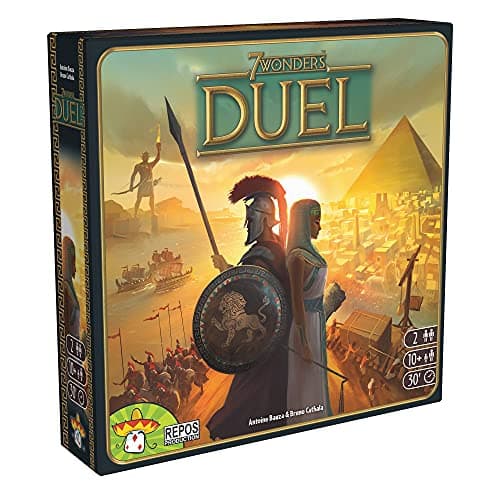
The strongest all-round two-player game in print, and the one most couples settle on.
A two-player-only card drafting game where each side builds a civilization across three ages. Three ways to win -- civilian points, military supremacy and scientific dominance -- run at once, so every card you take is also a card denied.
Players
2
Playing time
30 minutes
Age
10+
Designer
Antoine Bauza and Bruno Cathala
Publisher
Repos Production
Published
2015
Who should skip it
Skip it if you want a relaxing evening. Three win conditions run at once, so you are always watching what the other person is about to do.
+−Which 7 Wonders Duel expansion should I buy first?
Pantheon. It changes Age III by replacing the Guilds with Grand Temple cards rather than adding a separate subsystem, and it leaves the three victory conditions you already track unchanged.
+−What is the difference between Pantheon and Agora?
Pantheon adds Divinity cards from five mythologies and replaces the Age III Guilds with Grand Temples. Agora adds a Senate board, Senator and Conspiracy cards, and a fourth instant-win condition called Political Supremacy.
+−Can you play Pantheon and Agora together?
Yes, Repos Production states they are compatible. We would still add one at a time, play it a dozen games, and only then decide on the other -- two new subsystems at once makes it impossible to tell which you are enjoying.
+−Do the expansions make the game longer?
Not on paper. Repos Production lists both expansions at 30 minutes for 2 players, ages 10+, the same as the base game. In practice any new subsystem costs some time until it becomes automatic.
+−Do I need the base game to play an expansion?
Yes. Both Pantheon and Agora require 7 Wonders Duel and are not standalone games.
+−Are the expansions worth it?
Only if something specific has gone stale. If Age III has become rote, Pantheon fixes exactly that. If your games all end on points and the instant-win conditions no longer threaten, Agora reopens them. Otherwise a different game is better value than a variation on one you own.