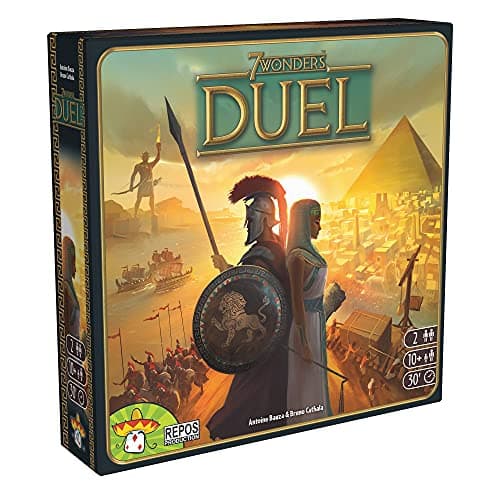
The core skill in 7 Wonders Duel is denial: because the card layout is shared, taking a card your opponent needs is often worth more than taking the one you want. Watch the military and science tracks constantly, since either can end the game instantly regardless of points.
We earn a commission when you buy through links on this page, at no extra cost to you. It does not change which games we recommend or what we say about them. How this site is funded.
7 Wonders Duel rewards a specific mental shift, and most players take a dozen games to make it. Beginners play their own civilization. Better players play the shared layout.
This is not a strategy list of best cards. It is the four principles that change how you look at the table.
01
1. Every card you take is also a card you deny
The pyramid layout means only certain cards are available, and taking one uncovers others. That makes each turn two decisions at once: what do I gain, and what am I preventing.
The consequence is that a card which does very little for you can be the strongest play on the board, if the alternative is handing your opponent their third science symbol or the resource that completes their chain. Beginners agonize over which card helps them most. The better question is which card, left on the table, hurts them most.
This also means discarding for coins is not a fallback. Taking a card purely to remove it from the layout, and being paid for it, is a legitimate and frequently correct play.
02
2. Two of the three victory conditions end the game immediately
Points are counted at the end. Military and science are not -- pushing the military marker into your opponent's capital, or collecting six different science symbols, ends the game on the spot with you winning.
So a comfortable points lead is not a lead. It is a position that is fine as long as you are also watching two other clocks. The most common way a stronger player loses is looking up on the last age to find that the science symbols quietly accumulated while they were building a beautiful civilization.
Practical habit: at the start of each turn, count their science symbols and check where the military marker is. Every turn. It takes three seconds and it is the difference between winning and being surprised.
03
3. Military is a tug of war, not a race
The marker moves back and forth on one track, so military strength is relative and reversible. Investing in military is not committing to a military victory; it is buying insurance and pushing the marker away from your own capital.
The trap is over-investing. Military cards are usually weak on points, so a player who takes every shield ends up ahead on the track and behind on everything else. Take enough to stay out of danger and to threaten, and stop.
The related trap is under-investing because you have decided you are playing the science game. If you ignore military entirely, a determined opponent simply ends the game before your plan matures.
04
4. Wonders are about tempo, not just their effect
Several wonders give you an extra turn or let you take from the discard pile. In a game where the layout is shared and turn order determines who gets what, an extra turn is worth more than its printed effect suggests -- you take two cards in a row, which means taking one they wanted and one you wanted.
Also remember that only seven wonders get built across the game, not eight. The last one selected is never constructed. Building your cheapest useful wonders early denies the opponent the option, and being the one who builds the seventh is a real edge.
05
The three mistakes new players repeat
Playing their own board. Building a coherent civilization feels good and loses to someone playing the layout.
Not counting science symbols. This ends more games than any other single oversight, because the science win arrives without warning.
Buying resources every turn instead of producing them. Paying your opponent for resources is fine occasionally and ruinous as a habit, because the cost scales with how much they produce.
What we would buy
Picks drawn from the games covered on this site, chosen against the criteria above.
We earn a commission when you buy through links on this page, at no extra cost to you. It does not change which games we recommend or what we say about them. How this site is funded.
The strongest all-round two-player game in print, and the one most couples settle on.
A two-player-only card drafting game where each side builds a civilization across three ages. Three ways to win -- civilian points, military supremacy and scientific dominance -- run at once, so every card you take is also a card denied.
Players
2
Playing time
30 minutes
Age
10+
Designer
Antoine Bauza and Bruno Cathala
Publisher
Repos Production
Published
2015
Who should skip it
Skip it if you want a relaxing evening. Three win conditions run at once, so you are always watching what the other person is about to do.
Asymmetric, historical, and finished inside an hour -- the shortest route into serious card-driven games for two.
A two-player-only asymmetric card-driven game. One side is the Nixon administration, the other the Washington Post, and every card is both an action for you and a resource for the opponent.
Players
2
Playing time
30-60 minutes
Age
12+
Designer
Matthias Cramer
Publisher
Capstone Games
Published
2019
Who should skip it
Skip it if you both want the same experience. The two sides play very differently and one of you will prefer a side.
The best first two-player card game there is: five minutes to teach, and it keeps giving for years.
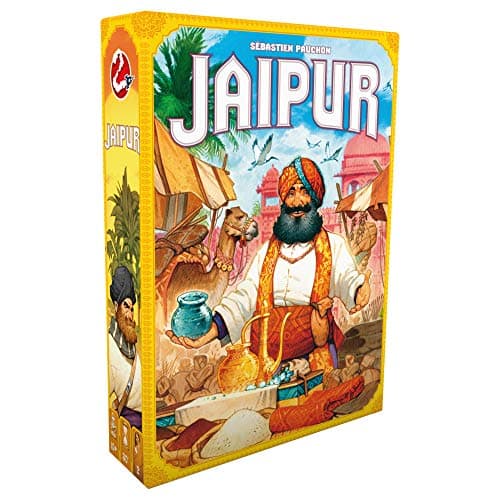
A two-player-only trading card game. You collect and sell goods in sets, racing the other trader for bonus tokens that shrink as they are taken. Best of three rounds decides it.
Players
2
Playing time
30 minutes
Age
10+
Designer
Sebastien Pauchon
Publisher
Asmodee / GameWorks
Published
2009
Who should skip it
Skip it if you want a board on the table. This is cards and tokens, and it looks slight next to a game with a map.
+−What is the most important skill in 7 Wonders Duel?
Denial. Because the card layout is shared, taking a card to prevent your opponent getting it is frequently worth more than taking the card that helps you most.
+−How do you avoid losing to a science victory?
Count their science symbols at the start of every turn. Six different symbols ends the game instantly, and it is the most common way a player who is ahead on points loses.
+−Should I build military in 7 Wonders Duel?
Enough to keep the marker away from your capital and to pose a threat, then stop. Military cards score poorly on points, so over-investing wins the track and loses the game.
+−Why does the last wonder never get built?
Only seven of the eight selected wonders are constructed during a game. That makes building your cheap useful wonders early a way of denying options, and being the one who builds the seventh a genuine edge.