For most two-person households, yes: 7 Wonders Duel is published for exactly 2 players at 30 minutes, has three simultaneous win conditions, and stays interesting for years. It is not worth it if one of you dislikes direct conflict, if it would be your first board game, or if your evenings are under 20 minutes.
We earn a commission when you buy through links on this page, at no extra cost to you. It does not change which games we recommend or what we say about them. How this site is funded.
This is the question people search after they have seen the price and the reputation and want someone to tell them whether the two match. The short answer is that for most pairs they do, and the longer answer is that there are three specific households where they do not.
We have not played it. What we can do is set out what the published design actually delivers, who it delivers it to, and where the money is better spent -- with every specification cited to the publisher.
01
What you are actually paying for
Three things, and they are the reasons the game has sat at the top of the two-player category since 2015.
A genuine two-player-only design. Repos Production lists it at exactly 2 players. It is not the larger 7 Wonders scaled down -- it is a separate game built for two from the first sketch, with no dummy player and no scaling patch.
Three simultaneous win conditions. Civilian points count at the end, but military supremacy and scientific supremacy end the game the instant they trigger. That single structure is what makes it worth owning: a losing position on points is never actually lost, so no game is over until it is over.
Longevity. This is the game people with hundreds of others still keep. The shared card pyramid means every pick is also a denial, and the decision space is large enough that you are still finding lines at game one hundred.
02
The three households where it is not worth it
One of you dislikes direct conflict. This is the big one. Taking a card specifically to deny it is standard play, and the military track pushes toward the other player's capital. If being targeted sours the evening for either of you, the best duel in print is still the wrong purchase, and Patchwork or Jaipur will get played ten times as often.
It would be your first board game. The card symbols are a small visual language, and game one runs well past the stated 30 minutes with a rulebook on the table. That first session is when a non-gamer decides whether this is fun or homework. Buy Jaipur first and come back.
Your evenings are genuinely short. Thirty minutes is honest once you know the game, but it is thirty minutes of concentration with no slack. If a 15-minute game is what actually fits your week, Onitama or Sky Team will come off the shelf more.
03
What worth it means against the alternatives
The fair comparison is not against nothing, it is against the other things you could buy with the same money.
Against Jaipur: Jaipur is cheaper to learn, has no attacking, and gets played more often. Duel is deeper and lasts longer. Most pairs end up owning both, and if you are buying one first, Jaipur is the lower-risk purchase.
Against Splendor Duel: same designer, same length, same player count, but a race rather than a fight. If conflict is the worry, Splendor Duel is the way to get a real duel without it.
Against Sky Team: a different kind of evening entirely. If the reason you are hesitating is that you are not sure you want to compete with each other, that hesitation is the answer, and a co-op is the better buy.
04
What about the expansions
Not until the base game has gone stale. Both Pantheon and Agora require the base game, both add a layer, and both make the first-game explanation longer. The base game is complete on its own and is not waiting to be fixed by a purchase.
If you have played twenty games and still find the three-track tension gripping, you have not run out of the base game yet. Our expansions guide covers when each one is actually worth adding.
05
What we did instead of playing it
We have not played this. What we did: took the player count, playing time and age from Repos Production's own site, confirmed it is currently in print, and worked from the published structure of the three victory tracks. No price appears in this prose -- the buy button carries live pricing, stamped with the date checked.
What we would buy
Picks drawn from the games covered on this site, chosen against the criteria above.
We earn a commission when you buy through links on this page, at no extra cost to you. It does not change which games we recommend or what we say about them. How this site is funded.
The strongest all-round two-player game in print, and the one most couples settle on.
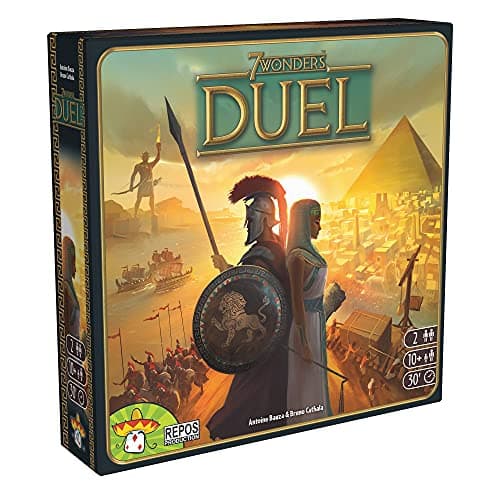
A two-player-only card drafting game where each side builds a civilization across three ages. Three ways to win -- civilian points, military supremacy and scientific dominance -- run at once, so every card you take is also a card denied.
Players
2
Playing time
30 minutes
Age
10+
Designer
Antoine Bauza and Bruno Cathala
Publisher
Repos Production
Published
2015
Who should skip it
Skip it if you want a relaxing evening. Three win conditions run at once, so you are always watching what the other person is about to do.
The best first two-player card game there is: five minutes to teach, and it keeps giving for years.
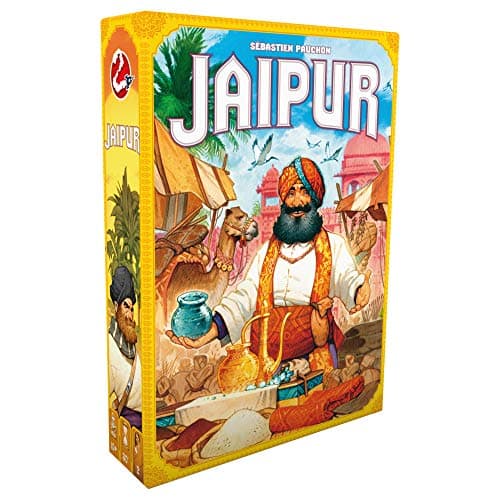
A two-player-only trading card game. You collect and sell goods in sets, racing the other trader for bonus tokens that shrink as they are taken. Best of three rounds decides it.
Players
2
Playing time
30 minutes
Age
10+
Designer
Sebastien Pauchon
Publisher
Asmodee / GameWorks
Published
2009
Who should skip it
Skip it if you want a board on the table. This is cards and tokens, and it looks slight next to a game with a map.
The gentler duel: an engine builder where you are racing rather than attacking, and the shared gem board is the whole game.
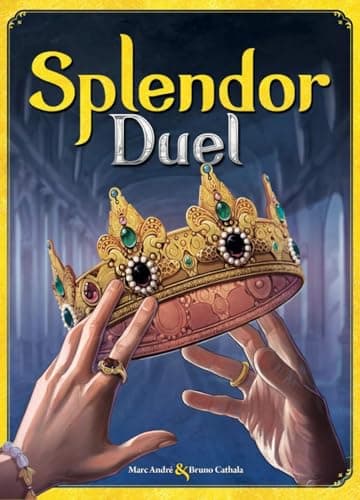
A two-player-only engine-building game in the Splendor universe. You draft gem tokens from a shared board to buy Jewel cards across three levels, chasing three separate victory conditions -- points, a color majority, or crowns. 67 Jewel cards, 25 tokens, 3 Privilege scrolls, 4 Royal cards.
Players
2
Playing time
30 minutes
Age
10+
Designer
Bruno Cathala and Marc Andre
Publisher
Space Cowboys
Published
2022
Who should skip it
Skip it if you want direct conflict. The tension is in what you take from the shared board before the other person can, never in anything you do to their cards.
For most pairs, yes. It is published for exactly 2 players at 30 minutes, its three simultaneous win conditions keep every game tense, and it stays interesting for years. It is the wrong buy if one of you dislikes direct conflict or if it would be your first board game.
+−Is 7 Wonders Duel good for beginners?
Not as a first game. Its card symbols take a game to read fluently, which makes the first session long. Jaipur is the better first purchase; Duel is the better second one.
+−Is 7 Wonders Duel worth it if we do not like conflict?
No. Denying cards and pushing the military track are core to the game. Splendor Duel gives a similar competitive feel without direct conflict, and Patchwork has none at all.
+−Are the 7 Wonders Duel expansions worth it?
Only once the base game has gone stale. Both require the base game and both add rules. The base game is complete on its own.