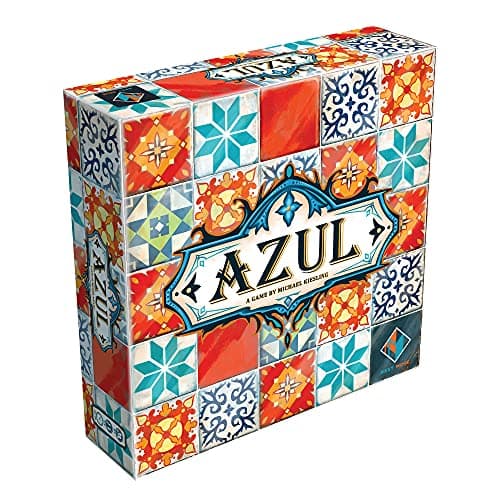
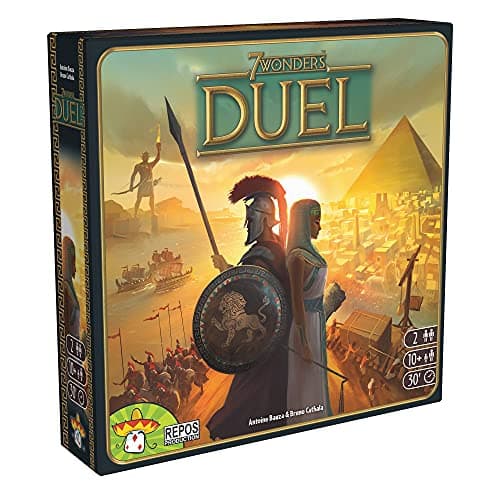
Buy 7 Wonders Duel if you want the better two-player game: Repos Production publishes it for exactly 2 players at 30 minutes, three win conditions run at once, and there is almost no luck in it. Buy Azul if you want the Spiel des Jahres winner that also seats four, teaches in five minutes, and is the easier game to hand to someone who does not play.
We earn a commission when you buy through links on this page, at no extra cost to you. It does not change which games we recommend or what we say about them. How this site is funded.
This comparison pits the game this site most often ends up recommending against the game the wider hobby most often recommends, and they are not the same game for a reason worth understanding. 7 Wonders Duel was built for two people and nothing else. Azul was built to be the game a family of four can learn in one evening, and it won the biggest prize in the hobby for doing exactly that.
Both are excellent. Neither is a compromise. But they are answers to different questions, and if you ask the wrong one of them to be the other you will be disappointed -- Azul will feel insubstantial to a pair who wanted a duel, and 7 Wonders Duel will feel like homework to someone who wanted something pretty and quick.
Quick picks
#
Game
Players
Time
Price
1
7 Wonders Duel
The strongest all-round two-player game in print, and the one most couples settle on.
Player counts and playing times come from each publisher, cited on that game's review page. Tap a row to jump to the full write-up.
01
The verified specs
7 Wonders Duel -- 2 players, 30 minutes, ages 10+. Antoine Bauza and Bruno Cathala, Repos Production, 2015. Standalone; does not need 7 Wonders, which Repos publishes for 3-7 players.
Azul -- 2-4 players, 30-45 minutes, age rating not stated by any reachable source. Michael Kiesling, Plan B Games, 2017. Winner of the 2018 Spiel des Jahres, the 2018 As d'Or, Origins Best Family Game and Fan Favorite, a Dice Tower award and Mensa Select.
7 Wonders Duel is Built for two on this site's labeling. Azul is Plays at two. Neither has a publisher-stated solo mode.
02
How we judged it
Two criteria do nearly all the work between these games, and a third settles the ties.
The first is how much the result depends on your decisions. A two-player game has nowhere to hide: if the outcome is mostly luck, the better player cannot express that, and if it is mostly skill, the weaker player loses every time. Which of those you want is a genuine preference and not a quality judgement.
The second is teach time, because the most common way a two-player game fails is that it never gets to a second play. A game that takes forty minutes to explain needs to be very good to earn that.
The third is who else lives in your house. It settles more of these decisions than anyone admits.
03
7 Wonders Duel is the better game, if you want a duel
Cards sit in overlapping pyramids across three ages, partly face down, and you take the uncovered ones. Which cards appear is shuffled, but from the moment a card is visible every decision is pure information -- there are no dice and no hidden hands.
Three ways to win run simultaneously. You can win on civilian points at the end, or at any moment by military supremacy, or by scientific dominance. Two of those three can end the game instantly, mid-age, before your own plan has paid off. That means every card you take is also a card denied, and you spend the whole game watching which of three clocks the other person is closest to.
The practical consequence is that this is the game where a stronger player wins consistently and the loser can usually see exactly where it went wrong. For two people who want to get better at something together, that is the feature. For a pair with a real skill gap who both want to win sometimes, it is the problem -- and it is the main reason we would not put this in front of every household.
It is also the denser teach of the two. Not hard, but there are three win conditions, progress tokens, a resource economy and a military track to explain before the first card is taken. Expect fifteen minutes, not five.
04
Azul is the better game to own, if the table changes
Azul's rules fit in two sentences. You take every tile of one color from one supply -- all of them, whether or not you can use them -- and arrange them in rows. At the end of a round, one tile from each filled row moves onto your 5x5 board where it scores by where it sits relative to the tiles already there, and the surplus in that row is discarded at a cost.
A first game starts inside five minutes and is genuinely fun rather than a practice round, which is the thing 7 Wonders Duel cannot claim. And at two players Azul is sharper than its family-game reputation suggests: with one opponent you can read exactly what they need and take a color purely to deny it, forcing them to pick up tiles they will have to throw away.
Then there is the seat count, which is blunt and frequently decisive. Azul plays 2-4. When somebody comes over, the box still works. 7 Wonders Duel does not scale at all, and the multiplayer 7 Wonders is a separate purchase.
What Azul will not give you is depth of decision on the scale of Duel. There is one kind of action. It is a very good action, and the advanced placement mode -- where you may place colors anywhere rather than in fixed positions -- is a real second game. But a pair who want to study a game for a hundred plays will exhaust Azul before they exhaust 7 Wonders Duel.
There is also a difference in how each game handles a skill gap, and it is the opposite of what the box weights suggest. 7 Wonders Duel has almost no luck, so experience converts almost directly into wins and the more practised player takes most games -- excellent if you both want to improve at the same thing, corrosive if only one of you is putting in the plays. Azul's shuffled tile supply gives a less experienced player a real chance at a strong round without the game being dumbed down. For a household where one person plays far more than the other, that is frequently the deciding fact, and it points at the family game rather than the duel.
05
The award record, and what it does not mean
Azul's shelf is the strongest of any game we cover and it is worth taking seriously: the 2018 Spiel des Jahres, the 2018 As d'Or Jeu de l'Annee, the 2018 Origins Award for Best Family Game plus the Origins Fan Favorite, a 2018 Dice Tower award and a Mensa Select certification.
What that record genuinely tells you is that the game is accessible, elegant and holds up in front of people who play hundreds of games a year. If you want a safe purchase, or a gift, that is real evidence and 7 Wonders Duel has nothing comparable to show you.
What it does not tell you is anything at all about two-player play. The Spiel des Jahres measures how well a game works at a family table. It is not a two-player award, and treating it as one would be exactly the kind of borrowed authority this site tries not to trade in. On the specific question of which is the better game for two people, the award is silent and 7 Wonders Duel is the answer.
06
If the answer is 'both, but tiles', there is a third box
A fair number of people land on this comparison because they want Azul's tiles and 7 Wonders Duel's sharpness, and until 2025 that combination did not exist.
It does now. Next Move Games publishes Azul Duel for exactly 2 players at 45 minutes, ages 10+, standalone. It takes the Azul draft and makes it adversarial: each factory has a sun side and a moon side, and when you take all tiles of one color from the sun side you choose the order the leftovers are stacked onto the moon for your opponent to pick over. That rule is meaningless with three players and is the point of the box.
It is not a drop-in replacement for either game here -- it is a heavier teach than Azul and it has no track record at all next to a 2015 game with a decade of players. But if what you want is a tile game that fights back, it is the most direct answer we cover.
07
Pick this if
Pick 7 Wonders Duel if you want the best two-player game we cover, if you want decisions rather than luck to settle it, and if both of you enjoy getting better at the same game over time. Built for exactly two, 30 minutes, 10+.
Pick Azul if you need the box to seat up to four, if the teach has to be under five minutes, if you are buying a gift, or if you want something beautiful on the table that still has real pressure at two. Plays at two, 2-4, Spiel des Jahres winner.
Pick Azul Duel if you want the tile drafting but built for exactly two and with teeth. Pick neither if one of you dislikes competing at all -- both of these have a loser in them, and a co-op like Codenames: Duet is the honest answer to that.
The strongest all-round two-player game in print, and the one most couples settle on.
A two-player-only card drafting game where each side builds a civilization across three ages. Three ways to win -- civilian points, military supremacy and scientific dominance -- run at once, so every card you take is also a card denied.
Players
2
Playing time
30 minutes
Age
10+
Designer
Antoine Bauza and Bruno Cathala
Publisher
Repos Production
Published
2015
Who should skip it
Skip it if you want a relaxing evening. Three win conditions run at once, so you are always watching what the other person is about to do.
Five major awards in 2018, and a draft where you must take every tile of the color you want -- including the ones you cannot use.
A tile-drafting game for 2-4 players. You take every tile of one color from a shared supply and arrange them in rows, then move one tile from each filled row onto a 5x5 board where it scores by where it sits relative to the others. Rounds continue until a player completes a row across their board, with bonuses for complete rows, columns and full color sets. Designed by Michael Kiesling, published by Plan B Games in 2017.
Players
2-4
Playing time
30-45 minutes
Designer
Michael Kiesling
Publisher
Plan B Games
Published
2017
Who should skip it
Skip it if you want a game built only for two. Plan B Games lists 2-4, and a two-player-only Azul exists separately as Azul Duel.
+−Is 7 Wonders Duel or Azul better for two players?
7 Wonders Duel. It is published for exactly 2 players, has almost no luck, and runs three simultaneous win conditions that make every card a decision about both players. Azul is genuinely good at two but was designed as a 2-4 family game.
+−Which is easier to learn?
Azul, by a wide margin. Its core rule fits in two sentences and a first game starts in about five minutes. 7 Wonders Duel needs three win conditions, progress tokens, a resource economy and a military track explained first -- expect fifteen minutes.
+−Which is better for a couple with different experience levels?
Azul. 7 Wonders Duel has almost no luck, so a stronger player wins consistently, which can sour an evening. Azul's drafting leaves more room for a less experienced player to have a good game.
+−Does Azul work well with only 2 players?
Yes, and it is arguably the tightest way to play it: with one opponent you can read exactly what they need and take a color to deny it. Plan B Games publishes it for 2-4, and since 2025 there is also Azul Duel, built for exactly two.
+−Is 7 Wonders Duel just the two-player version of 7 Wonders?
No. It is a separate standalone game, not a variant. Repos Production publishes 7 Wonders for 3-7 players and 7 Wonders Duel for exactly 2, and you do not need one to play the other.
+−Which one should I buy as a gift?
Azul. It teaches in five minutes, seats four, is beautiful unwrapped, and has an award record the recipients will recognize if they look it up. 7 Wonders Duel is the better gift only for a couple you know already plays games.