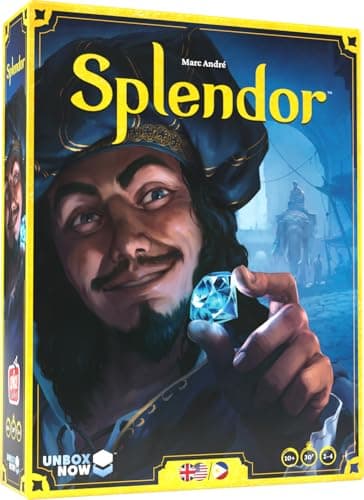
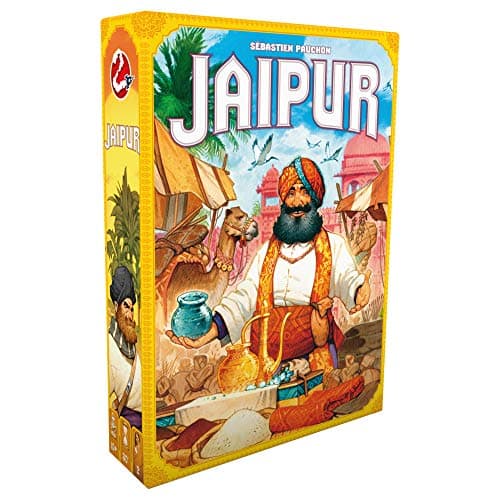
Buy Jaipur if the two of you are the only players: Asmodee and GameWorks publish it for exactly 2 at 30 minutes, it teaches in about five minutes, and it costs less. Buy Splendor if the box needs to seat three or four -- Space Cowboys lists it at 2-4 with a real two-player setup, but only its tokens scale down, not its card market, so it plays looser at two than at a full table.
We earn a commission when you buy through links on this page, at no extra cost to you. It does not change which games we recommend or what we say about them. How this site is funded.
These two land on the same shortlist constantly, and the reason is sound: both are half-hour gateway games built on the same basic pleasure, which is collecting something and deciding when to cash it in. Both teach in minutes, both are the game people hand to someone who says they do not play board games, and both sit in the same mid price bracket.
The decision between them is not about which is better designed, because both are genuinely good. It comes down to one fact that most comparisons bury: Jaipur is published for exactly two players, and Splendor is published for two to four. On a site organized around that distinction, that is the whole answer -- but the interesting part is what it does to the two-player game itself, which the next few sections get into.
We have not played either game. The specifications come from each publisher's own page, with the two-player setup details from a rules reproduction, all cited at the bottom.
Quick picks
#
Game
Players
Time
Price
1
Jaipur
The best first two-player card game there is: five minutes to teach, and it keeps giving for years.
The gateway engine builder, and it does scale down honestly -- but only the tokens shrink at two, not the card market, so it loosens where Splendor Duel tightens.
Player counts and playing times come from each publisher, cited on that game's review page. Tap a row to jump to the full write-up.
01
The verified specs
Jaipur -- 2 players, 30 minutes, ages 10+. Sebastien Pauchon, Asmodee and GameWorks, 2009. A trading card game: collect goods in sets and sell them, racing the other trader for bonus tokens that shrink as they are taken. Best of three rounds decides it.
Splendor -- 2-4 players, 30 minutes, ages 10+. Marc Andre, Space Cowboys, 2014. One action per turn: take gem tokens, reserve a card and take a gold joker, or buy a card. Cards grant permanent gem bonuses, and the first player to 15 prestige points triggers the final round. 90 Development cards, 10 Noble tiles, 7 tokens in each of five gem colors plus 5 gold.
At two players Splendor removes three tokens of each gem color, leaving four of each, keeps all five gold, and reveals three nobles instead of five. The 90 Development cards and the face-up market do NOT change with the player count.
On this site's labeling: Jaipur is Built for two, Splendor is Plays at two. Neither has a publisher-stated solo mode.
02
What they actually have in common
More than the themes suggest, and it is worth being precise about it, because the shared parts are why the choice is hard rather than obvious.
Both run on a timing decision rather than on a clever combo. In Jaipur you hold goods to sell them in bigger sets, because selling three or more earns a bonus token -- and those bonus tokens shrink as they are taken, so waiting is worth more right up until it is worth less. In Splendor you take gem tokens and spend them on cards, and the cards you buy leave permanent discounts behind, so the question is always whether to buy the affordable thing now or hold for the card that makes everything cheaper later.
Both are also genuinely light. Jaipur gives you two options on a turn: take goods, or sell goods. Splendor gives you one action from a short list. Neither has an exception you need a reference card for, and in both cases a first game is a real game rather than a practice round.
And both are quiet. Nobody attacks anybody, nothing gets destroyed, no card forces a discard. The pressure in each comes from the shared supply -- the goods on the table, the tokens on the board -- which makes them both safe buys for a pair where one person dislikes direct conflict.
03
The difference that decides it: who else will play
Jaipur is published for exactly two and that is the end of it. There is no variant for three, no dummy hand, nothing to add. It is a two-player game in the way a tandem bicycle is a two-person bicycle.
Splendor is published for 2-4, and the box genuinely supports a table. When a friend turns up, Splendor is still playable and Jaipur goes back on the shelf. For a household that hosts even occasionally, that single fact outweighs everything else on this page, and we would not argue with anyone who chose on it alone.
The flip side is the one this site exists to point out. Every design decision in Jaipur was made for a pair, because a pair is all it has to serve. Splendor's design brief was a table of up to four, and the two-player game is the result of scaling that down -- well, as the next section shows, but still a scaling-down rather than a purpose-built thing.
04
How well Splendor actually scales to two
Better than most 2-4 games, and the detail is worth knowing rather than taking on faith. Splendor has a real two-player setup, not a note saying it works anyway: you remove three tokens of each gem color so only four of each remain, the five gold jokers stay in, and you reveal three noble tiles instead of five.
That is aimed at the right thing. The economy runs on gem tokens, and with only two people drawing from a full seven-of-each supply nobody would ever run short. Cutting it to four keeps the tokens worth fighting over, and the ten-token hand limit means a single opponent hoarding one color takes a real bite out of what is available.
Here is the asymmetry, though, and it is the honest core of the comparison. The tokens scale down. The 90 Development cards and the face-up market you buy them from do not. At four players, four people are reaching for the same cards and the one you were saving toward is often gone. At two, the same market is picked over by half as many hands, so your long-range plan usually survives.
The result is that Splendor at two is a more buildable, more plannable, slightly gentler game than Splendor at four. Whether that is good news depends entirely on what you wanted. If you wanted a tight duel, that loosening is the argument for Jaipur. If you wanted half an hour of building something without being constantly disrupted, it is an argument for Splendor.
One more sourced consequence, because it changes how a turn feels. One of Splendor's actions is to take two gem tokens of the same color, and it is legal only if at least four of that color remain. At two players there are only four of each to begin with, so that action is available while a color sits at full strength and closes the moment anyone takes from it. It goes from routine to occasional.
05
Teach time, and the first evening
Jaipur wins this, and by enough to matter if the plan is to hand the game to someone who is not sure they want to play.
Jaipur's rules fit on a page: take goods or sell goods, hold sets to earn the shrinking bonus tokens, camels are their own thing, best of three rounds. A first game is under way inside five minutes and the structure forgives a bad start, because losing round one costs you a round rather than the evening.
Splendor is close behind and genuinely easy, but there is more to lay out: the card rows across three levels, the gem economy, the permanent discounts cards leave behind, the nobles, the ten-token limit, and the fact that reaching 15 prestige points triggers a final round rather than ending immediately. Call it ten minutes rather than five, and the first game is where you work out that buying cheap cards early is what makes the expensive ones reachable.
There is also a difference in shape worth knowing. Jaipur is best of three short rounds, so the game has an arc with two natural resets. Splendor is one continuous race to 15. A pair who like a game that gives them a second chance will prefer Jaipur's structure; a pair who want one build with no interruptions will prefer Splendor's.
06
Footprint, components and price
Jaipur is cards and tokens. There is no board, it sets up in under a minute, and it fits in a bag without thinking about it. That is a real advantage if your table is small or shared, or if the game needs to travel.
Splendor is the more substantial object: 90 cards, 10 noble tiles and 40-odd gem tokens, and the tokens are the thing people remark on -- they have a weight to them that cardboard chits do not. It needs more table than Jaipur and more setup, though neither is onerous by board game standards.
On price, Jaipur is the cheaper of the two at the time of writing, with live figures for both in the table above and the date we read them. It is not a large gap and we would not decide on it, but if this is a first purchase and the budget is doing real work, it points the same way the player count does.
Neither game has a publisher-stated box size, so we cannot give you measured dimensions the way our travel pages do. What we can say without measuring is that one is a deck in a small box and the other is a board game, which is the distinction most buyers are actually asking about.
07
If you want the best of both: the third box
Worth naming because a fair number of people arrive at this comparison wanting Splendor's engine building in something built for two, and that game exists.
Space Cowboys published Splendor Duel in 2022 for exactly 2 players at 30 minutes, ages 10+, from the same designer as the base game plus Bruno Cathala. It is standalone and does not need the base box. Its tokens sit on a shared grid and you may only take up to three that form an uninterrupted line, which rebuilds the contested-every-turn feeling the base game loses at two -- as a rule, rather than relying on a crowded table to supply it. It also replaces the single 15-point finish line with three live victory conditions, any of which can end the game on the spot.
So the honest three-way summary: Jaipur if you want the lightest, cheapest, most portable two-player game of this kind; Splendor if the box must seat up to four; Splendor Duel if you want the deepest version of this economy built for exactly two. We compare Jaipur against the Duel separately, and we have a fuller answer on whether the base Splendor is worth it at two.
08
Pick this if
Pick Jaipur if the two of you are the only people who will play, if you want the five-minute teach, if the game has to travel or share a small table, or if you want the cheaper box. Built for exactly two, 30 minutes, 10+. Honest downside: it looks slight -- cards and tokens, no board -- and it will never seat a third person.
Pick Splendor if the box needs to seat three or four, if you want the heavier components and the more substantial table presence, or if you specifically want a single uninterrupted build rather than best-of-three. Plays at two, 2-4, 30 minutes, 10+. Honest downside: only the tokens scale at two, so card competition drops and the game plays looser than at a full table, and the take-two-of-one-color action becomes situational.
Pick Splendor Duel instead of either if you want this kind of economy built for exactly two and do not need extra seats. It is the deeper two-player game of the three, at the cost of a slightly longer teach than Jaipur and no room for a third player.
Pick Lost Cities if what appealed was Jaipur specifically -- the small box, the quick teach, the timing decision -- and you want another of that kind rather than a board game. Reiner Knizia's two-player card game is published for exactly 2 at 30 minutes and is the cheapest real game we cover.
The best first two-player card game there is: five minutes to teach, and it keeps giving for years.
A two-player-only trading card game. You collect and sell goods in sets, racing the other trader for bonus tokens that shrink as they are taken. Best of three rounds decides it.
Players
2
Playing time
30 minutes
Age
10+
Designer
Sebastien Pauchon
Publisher
Asmodee / GameWorks
Published
2009
Who should skip it
Skip it if you want a board on the table. This is cards and tokens, and it looks slight next to a game with a map.
The gateway engine builder, and it does scale down honestly -- but only the tokens shrink at two, not the card market, so it loosens where Splendor Duel tightens.
A gem-trading engine builder for 2-4 players. One action per turn: take gem tokens, reserve a development card and take a gold joker, or buy a card. Cards grant permanent gem bonuses that make later cards cheaper, and the first player to reach 15 prestige points triggers the final round. 90 Development cards, 10 Noble tiles, 7 tokens in each of five gem colors plus 5 gold. At two players three tokens of each gem color are removed, leaving four of each.
Players
2-4
Playing time
30 minutes
Age
10+
Designer
Marc Andre
Publisher
Space Cowboys
Published
2014
Who should skip it
Skip it if the two of you are the only people who will ever play. Space Cowboys publishes Splendor Duel for exactly two, and it is the better two-player game by a clear margin.
Jaipur, if two players is all you will ever play: it is published for exactly 2, teaches in about five minutes and costs less. Splendor is the better buy if the box needs to seat three or four, and it does have a real two-player setup -- but only its tokens scale down, not its card market, so it plays looser at two than at a full table.
+−Does Splendor work with 2 players?
Yes. Space Cowboys publishes it for 2-4 and the rulebook has a dedicated two-player setup: remove three tokens of each gem color leaving four of each, keep all five gold, and reveal three nobles instead of five. The caveat is that the 90 Development cards and the face-up market do not scale, so there is less competition for cards at two.
+−Which is easier to learn?
Jaipur, by about five minutes. Its turn is take goods or sell goods, and best-of-three rounds forgive a bad start. Splendor is still light but has card rows across three levels, permanent card discounts, nobles and a ten-token limit to explain first.
+−Which is better value?
Jaipur is the cheaper box at the time of writing and the live prices for both are in the table above, each stamped with the date we read it. Splendor gives you more components for the money -- 90 cards, nobles and weighted gem tokens -- so which is better value depends on whether you want more game or a smaller one.
+−Should I buy Splendor Duel instead?
If two players is all you will ever play and you want this economy at its deepest, yes. Space Cowboys published Splendor Duel in 2022 for exactly 2 players, and its shared token grid restores the contested-every-turn feeling the base game loses at two. Buy the base Splendor instead only if you need three or four seats.
+−Can you play Jaipur with more than 2 players?
No. Jaipur is published for exactly 2 players, with no variant for three and no official way to add a seat. If you need a game that scales, Splendor at 2-4 is the one on this page that does it.
+−Are either of these good for someone who does not play board games?
Both are, and that is part of why they are compared so often. Jaipur is the easier teach and the lower-risk gift; Splendor's weighted gem tokens tend to get picked up and turned over before anyone has read a rule, which is its own kind of persuasion.