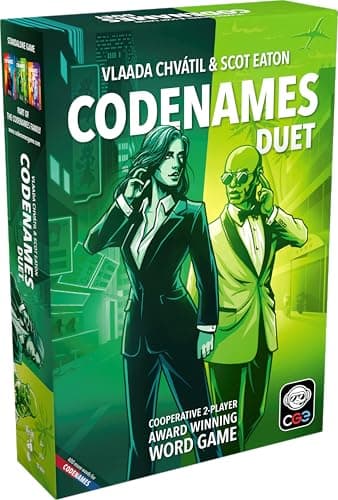
The alpha player problem is only solved structurally: buy a cooperative game where information is hidden by rule, so no single player can see enough to direct both turns. Sky Team does this absolutely; Codenames: Duet caps it with a one-word clue limit.
We earn a commission when you buy through links on this page, at no extra cost to you. It does not change which games we recommend or what we say about them. How this site is funded.
In group cooperative games, the alpha player is the person who quietly ends up telling everyone what to do. At two players it has a different and worse shape: there is no group to dilute it, so one person is playing the game and the other is operating the pieces.
It is rarely deliberate. It usually comes from one person knowing the rules better, and it is corrosive precisely because everyone involved has good intentions.
01
Why the usual advice does not work
Most guidance on this is aimed at groups and amounts to social management: agree not to backseat, take turns leading, let people make their own mistakes. All fine advice for a games night with five people.
None of it survives a household. You are going to play this game dozens of times with the same person, and asking someone to permanently suppress how they think about a puzzle is not a stable arrangement. The person doing the suppressing gets bored and the person being protected can tell.
The other common suggestion -- play a harder difficulty so both brains are needed -- helps at the margin and then stops. A sufficiently strong player is still stronger at the hard setting.
02
The mechanisms that genuinely prevent it
Secret hands with a rules-level ban on revealing. This is the only complete fix. If you literally cannot know what your partner holds, you cannot compute their optimal move for them. Sky Team is the purest example: you may not tell your partner what dice you rolled.
Hard-capped clue bandwidth. If the only thing you can transmit is one word and a number, the amount of steering possible has a ceiling regardless of how much better you are. Codenames: Duet works this way.
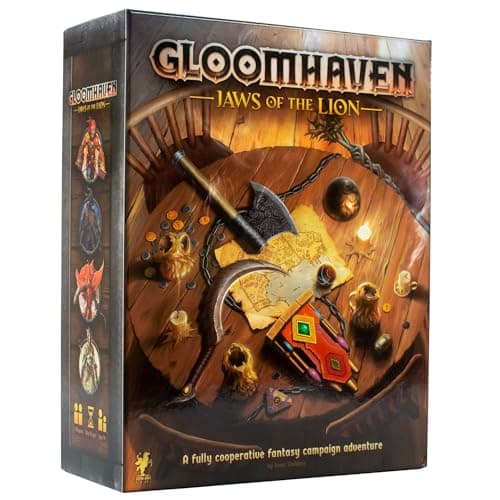
Simultaneous selection. When both players commit to an action at the same time, before seeing each other's choice, there is no window in which one can advise the other. Gloomhaven: Jaws of the Lion uses this for its card selection each round.
Asymmetric information by role. Each player knows something the other does not, structurally. Sky Team again -- the pilot and co-pilot control different instruments and see different halves of the problem.
03
The mechanisms that only discourage it
Worth knowing so you do not pay for a solution you are not getting. Open information with a suggestion not to advise is not a fix. Traitor mechanics do not apply at two. Time pressure and sand timers help a little, by making deliberation costly, but a fast player is still a fast player.
Role abilities that differ -- one of you is the pilot, one is the engineer -- sound like a fix and mostly are not. If both of you can see the whole board, knowing the other person's ability list is enough to plan their turn for them.
04
What to buy, by situation
If the imbalance is large and long-standing, go straight to Sky Team. It removes the possibility rather than the temptation, it costs no more than any other co-op, and it is fifteen minutes so a bad game costs nothing.
If it is mild -- one of you is a bit quicker and it occasionally grates -- Codenames: Duet is enough, and it is more fun to talk over. If neither of you has played a cooperative game at all yet, start with Forbidden Island anyway; you may not have this problem, and it is cheap to find out.
What we would buy
Picks drawn from the games covered on this site, chosen against the criteria above.
We earn a commission when you buy through links on this page, at no extra cost to you. It does not change which games we recommend or what we say about them. How this site is funded.
A fifteen-minute co-op you play in near silence, and the tension is extraordinary.
A two-player-only cooperative game. One of you is pilot, one is co-pilot, and you land an aircraft by placing dice on a shared cockpit board -- without discussing which dice you hold.
Players
2
Playing time
15 minutes
Age
12+
Designer
Luc Remond
Publisher
Le Scorpion Masque
Published
2023
Who should skip it
Skip it if you want to talk freely. The no-talking restriction is the whole game, and some pairs find that frustrating rather than thrilling.
Built around two people and honest about it, though the publisher lists it as 2+ rather than two only.
A cooperative word-association game. You each see half of a shared key card and give one-word clues to guide the other to the right agents in a 5x5 grid, avoiding the assassin.
Players
2+
Playing time
15 minutes
Age
11+
Designer
Vlaada Chvatil and Scot Eaton
Publisher
Czech Games Edition
Who should skip it
Skip it if one of you thinks in wildly different associations from the other. That gap is funny once and exhausting by the fourth game.
Plays at two1-4 players · 1-2 hours · ages 14 and up
The campaign game two people can actually finish, because it teaches itself across the first five scenarios.
A supports-more cooperative campaign widely played at two. A standalone Gloomhaven entry with a 25-scenario story and a tutorial built into the opening scenarios.
Players
1-4
Playing time
1-2 hours
Age
14 and up
Designer
Isaac Childres
Publisher
Cephalofair Games
Published
2020
Who should skip it
Skip it if you cannot leave a game set up or commit to a run of evenings. A campaign abandoned at scenario four is money spent on a shelf.
The player who ends up directing everyone else's turns in a cooperative game, usually because they know the rules best. At two players it turns the other person into an assistant.
+−Can you fix the alpha player problem by agreeing not to do it?
Not durably in a household. You will play the same game with the same person dozens of times, and asking someone to permanently suppress how they think is not a stable arrangement.
+−Which two-player co-op prevents it completely?
Sky Team. You may not tell your partner what dice you hold, so neither player has enough information to compute the other's move.
+−Do different player roles solve it?
Mostly no. If both of you can see the whole board, knowing the other's ability list is enough to plan their turn. Hidden information is the thing that works.