A cooperative game works at two players when it has hidden information you cannot legally share, a hard limit on communication, and a clock that runs on a fixed schedule rather than per player. Games missing all three tend to collapse into one person directing both turns.
We earn a commission when you buy through links on this page, at no extra cost to you. It does not change which games we recommend or what we say about them. How this site is funded.
Cooperative games are marketed as though the player count is a detail. It is not. A co-op at two players is a structurally different game from the same box at four, and the design either accounts for that or it does not.
The good news is that you can predict which you are buying without playing it. Three features, all visible in the rules summary or on the back of the box.
01
1. Hidden information you are not allowed to share
This is the single most reliable predictor. If the rules let you show your hand or state exactly what you hold, then at two players one of you eventually will -- and from that moment there is one brain playing two positions while the other person moves pieces.
Look for an explicit restriction, not just a convention. Sky Team is the clearest example in print: you may not tell your partner what dice you are holding, and that is a rule rather than an etiquette suggestion. Because neither of you can see the whole picture, neither of you can run the whole game.
Weaker versions exist and are still useful. Codenames: Duet limits you to one word and a number, which caps how much steering is possible even though the guessing conversation is open.
02
2. A communication limit that survives a determined player
Some games say you should not discuss specifics. That is a suggestion, and at two players suggestions lose. What you want is a restriction that cannot be dissolved by two people who would rather win.
The test: if the two of you agreed right now to ignore the spirit of the rule, would the game notice? If your hand is secret, yes -- you physically cannot share what you are not allowed to reveal. If the rule is only that you should not tell each other what to do, no. The second kind is fine for people who enjoy playing in the spirit of a game, and it is exactly the kind that fails in a household where one person is more experienced.
03
3. A fixed clock, not a per-player one
This one is counterintuitive and it is why some co-ops are harder at two. Games where the threat escalates on a fixed schedule -- Forbidden Island's rising water, Forbidden Desert's storm -- give a pair the same amount of pressure as a group with twice the actions.
That is usually good. It stops the game becoming a solvable puzzle, which is the failure mode when two experienced players have plenty of time to optimize. But it means you should start one difficulty notch lower than a group would, and expect to lose the first few attempts.
If a game scales its threat by player count instead, check the two-player setup carefully. Some do this well and some effectively hand a pair an easier game, and an easy co-op is a co-op you play three times.
04
How the games we recommend score on all three
Applying the checklist to the co-ops in our list, in order of how well they hold up at two.
Sky Team -- hidden dice you may not reveal, an absolute communication restriction, and a fifteen-minute fixed structure. Passes all three, and it is also the only one published for exactly two players.
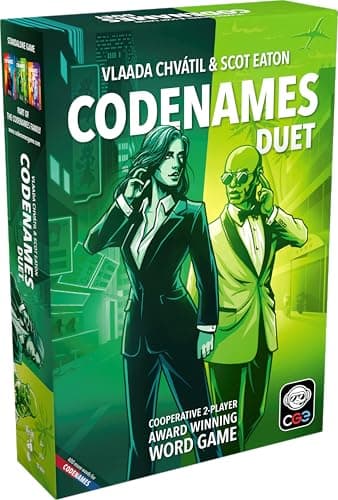
Codenames: Duet -- hidden half of a shared key, a hard one-word clue limit, and a fixed turn budget. Passes all three, though the open guessing conversation leaves some room for a dominant player.
Forbidden Island and Forbidden Desert -- open information, no communication limit, fixed clock. One out of three, which is why these two rely on the timer to stay interesting and why they suit pairs who genuinely enjoy planning together.
Gloomhaven: Jaws of the Lion -- hidden card selection each round is real hidden information, and it is the reason the campaign works at two rather than becoming one person's spreadsheet.
05
The buying rule this produces
If you have never played a co-op, buy a one-out-of-three game first. Forbidden Island is cheap, gentle, and teaches you the vocabulary of the genre in half an hour, and if it turns out the two of you do not enjoy cooperative games you have lost very little.
If you have played co-ops and the problem you are trying to solve is that one of you takes over, do not buy another open-information game and hope. Buy the structural fix. Sky Team costs about the same and makes the behavior impossible rather than impolite.
What we would buy
Picks drawn from the games covered on this site, chosen against the criteria above.
We earn a commission when you buy through links on this page, at no extra cost to you. It does not change which games we recommend or what we say about them. How this site is funded.
A fifteen-minute co-op you play in near silence, and the tension is extraordinary.
A two-player-only cooperative game. One of you is pilot, one is co-pilot, and you land an aircraft by placing dice on a shared cockpit board -- without discussing which dice you hold.
Players
2
Playing time
15 minutes
Age
12+
Designer
Luc Remond
Publisher
Le Scorpion Masque
Published
2023
Who should skip it
Skip it if you want to talk freely. The no-talking restriction is the whole game, and some pairs find that frustrating rather than thrilling.
Built around two people and honest about it, though the publisher lists it as 2+ rather than two only.
A cooperative word-association game. You each see half of a shared key card and give one-word clues to guide the other to the right agents in a 5x5 grid, avoiding the assassin.
Players
2+
Playing time
15 minutes
Age
11+
Designer
Vlaada Chvatil and Scot Eaton
Publisher
Czech Games Edition
Who should skip it
Skip it if one of you thinks in wildly different associations from the other. That gap is funny once and exhausting by the fourth game.
The cheapest way to find out whether co-op games work for the two of you.
A supports-more cooperative game that plays at two. You collect four treasures from a sinking island of 24 tiles and escape before the water level rises past the exit.
Players
2-4
Playing time
30 minutes
Age
10+
Designer
Matt Leacock
Publisher
Gamewright
Who should skip it
Skip it if you have already played a modern co-op. It is deliberately gentle and you will solve it inside a handful of games.
+−Why do cooperative games break down with two players?
Because with only one other person, an open-information game lets the more confident player see everything and effectively direct both turns. The other player becomes an assistant rather than a participant.
+−What is the best two-player co-op for avoiding that?
Sky Team. You may not tell your partner what dice you hold, so neither of you has enough information to run both sides. It is also published for exactly two players.
+−Are cooperative games easier or harder with two players?
Usually harder. Most co-ops escalate threats on a fixed schedule, so a pair faces the same pressure with half the actions. Start one difficulty notch below what a group would choose.
+−Should our first cooperative game be a hard one?
No. Buy something gentle like Forbidden Island first to find out whether cooperative play suits the two of you at all, then buy for the specific problem you discover.