Start with Forbidden Island if you want the cheapest way to find out whether co-ops suit you, Codenames: Duet if you want to talk, or Sky Team if you want a game published for exactly two players. All three teach in ten minutes or less.
We earn a commission when you buy through links on this page, at no extra cost to you. It does not change which games we recommend or what we say about them. How this site is funded.
Cooperative games are the easiest sell in the hobby and the easiest to buy wrong. The pitch is obvious -- nobody loses to their partner -- and the failure modes are not obvious at all.
The two that catch people are the same every time. One person ends up quietly playing both sides, and the game turns out to be much harder than expected. Both are predictable before you spend anything, and this guide is about predicting them.
01
Losing is the normal state
This is the thing to internalize before your first game, because it prevents the most common disappointment.
A well-tuned cooperative game is meant to be lost more often than won, especially early. The tension only exists if the threat is real, so designers tune these games so that a first attempt usually fails. That is the product working, not you playing badly.
A co-op the two of you beat on the first try is a game you will have shelved within a month, because there is nothing left to find out. If your first session ends in a loss and you immediately want to try again, that is exactly the reaction the design is aiming for.
02
The alpha player problem, and how to see it coming
In a group this is when one confident player ends up directing everyone. At two players it is worse, because there is no group to dilute it -- one person plays the game and the other operates the pieces.
It is almost never deliberate. It usually comes from one person knowing the rules better, and it is corrosive precisely because both people mean well.
The fix is structural, not social. Buy a game where the information is genuinely split, so one person cannot compute both turns even if they want to. Sky Team is the cleanest example: you may not tell your partner what dice you are holding, at all. Codenames: Duet limits you to one word and a number, which caps how much steering is possible.
Games with fully open information -- Forbidden Island among them -- rely on both players choosing to play in the spirit of the thing. That is fine for many households and a poor bet if you already know one of you tends to take over.
03
Three things to check before buying
Is there hidden information you are not allowed to share? This is the strongest predictor of whether a co-op survives at two players. A rules-level restriction beats an etiquette suggestion every time.
Does it have a difficulty dial? Most good co-ops do, usually as a starting position or a number of threats. At two players, start one notch below what a group would pick -- most cooperative games run on a fixed clock, so a pair faces the same pressure with half the actions.
Does one session resolve? A campaign co-op asks for a run of evenings in sequence and somewhere to store the game between them. That is a genuinely different purchase, and it is the most commonly abandoned one in the hobby.
04
Which of the three to start with
Forbidden Island is the cheapest way to find out whether cooperative play suits the two of you at all. It is deliberately gentle, it teaches the vocabulary of the genre -- roles, a shared action pool, a rising threat track -- in half an hour, and if it turns out co-ops are not for you, very little was spent finding out. Gamewright lists it at 2-4 players, so it is not a two-player-only design.
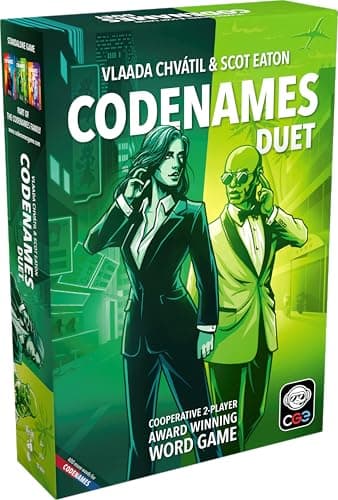
Codenames: Duet is the one to buy if the appeal is spending the evening talking. The conversation is the game rather than a distraction from it. Czech Games Edition lists it at 2+, not exactly 2.
Sky Team is the one to buy if you want a genuinely two-player-only co-op, if you enjoy pressure, or if the take-over problem is the specific thing you are trying to design around. Fifteen minutes, and near-silent throughout.
05
What we did instead of playing these
We have not played these games. What we did: took the player count, playing time and age from each publisher's own page, checked which state exactly two players, and confirmed each is still in print by checking those pages are live. Every figure links to its source below.
What we would buy
Picks drawn from the games covered on this site, chosen against the criteria above.
We earn a commission when you buy through links on this page, at no extra cost to you. It does not change which games we recommend or what we say about them. How this site is funded.
The cheapest way to find out whether co-op games work for the two of you.
A supports-more cooperative game that plays at two. You collect four treasures from a sinking island of 24 tiles and escape before the water level rises past the exit.
Players
2-4
Playing time
30 minutes
Age
10+
Designer
Matt Leacock
Publisher
Gamewright
Who should skip it
Skip it if you have already played a modern co-op. It is deliberately gentle and you will solve it inside a handful of games.
Built around two people and honest about it, though the publisher lists it as 2+ rather than two only.
A cooperative word-association game. You each see half of a shared key card and give one-word clues to guide the other to the right agents in a 5x5 grid, avoiding the assassin.
Players
2+
Playing time
15 minutes
Age
11+
Designer
Vlaada Chvatil and Scot Eaton
Publisher
Czech Games Edition
Who should skip it
Skip it if one of you thinks in wildly different associations from the other. That gap is funny once and exhausting by the fourth game.
A fifteen-minute co-op you play in near silence, and the tension is extraordinary.
A two-player-only cooperative game. One of you is pilot, one is co-pilot, and you land an aircraft by placing dice on a shared cockpit board -- without discussing which dice you hold.
Players
2
Playing time
15 minutes
Age
12+
Designer
Luc Remond
Publisher
Le Scorpion Masque
Published
2023
Who should skip it
Skip it if you want to talk freely. The no-talking restriction is the whole game, and some pairs find that frustrating rather than thrilling.
+−What is the best first cooperative board game for two players?
Forbidden Island if you want to find out cheaply whether co-ops suit you, Codenames: Duet if you want to talk while playing, or Sky Team if you want a game published for exactly two players.
+−Are you supposed to lose cooperative board games?
Often, yes. A well-tuned co-op is designed so early attempts usually fail, because the tension depends on the threat being real. A co-op you beat first time is one you will shelve quickly.
+−How do we stop one person taking over?
Buy a game where information is split by rule rather than by agreement. Sky Team forbids telling your partner what dice you hold; Codenames: Duet caps you at one word and a number. Open-information co-ops rely on self-restraint.
+−Are cooperative games easier with two players?
Usually harder. Most run on a fixed threat clock rather than a per-player one, so a pair faces the same pressure with half the actions. Start one difficulty notch below what a group would choose.