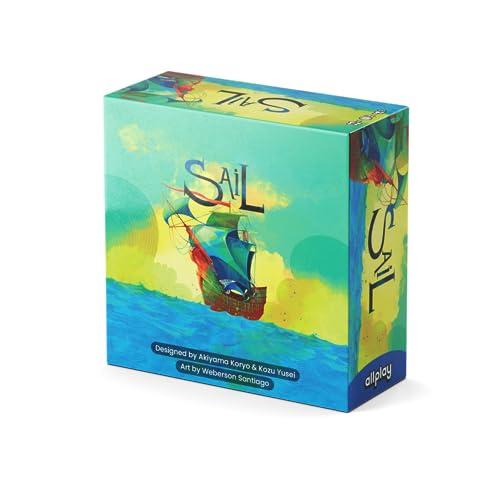
Sail is a two-player-only cooperative trick-taking game from Allplay, stated at 20 minutes for ages 11 and up. You play cards into tricks to steer a ship across an ocean board while a Kraken chases you, and you are not allowed to tell your partner what you are holding.
We earn a commission when you buy through links on this page, at no extra cost to you. It does not change which games we recommend or what we say about them. How this site is funded.
Most cooperative games for two are cooperative games that happen to work at two. Sail is not one of those. Allplay publishes it for exactly 2 players, it is built around a restriction that only makes sense with one other person, and at 20 minutes it is the shortest co-op on this site by some distance.
It is also the second cooperative trick-taker we cover, after Fox in the Forest Duet, which is two more than a genre built on beating the person opposite you had any right to produce. What separates Sail from Duet is that the thing you are racing is visible: there is a Kraken token behind your ship, it moves, and you can see exactly how much trouble you are in.
01
What Allplay actually states
Exactly 2 players. Allplay's spec block reads "Players: 2" -- not 2-4, not 2+. Built for two on this site's labeling.
20 minutes, written "20 min" on the publisher's page. The shortest cooperative game we cover.
Ages 11 and up. Slightly higher than most light card games, and worth noting if you were buying for a younger pair.
Main mechanic: co-op trick taking, in Allplay's own "Tricky Card Games" series. Box size class: Small.
Contents: 34 cards (27 playing cards, 6 pirates, 1 Kraken, 4 player aids), 3 boards (ocean, Kraken, play area), 5 trackers and 26 tokens, plus a scenario book.
Not stated by the publisher, so not stated here: no designer is credited, no artist is credited, and no release year is given. The page also gives a box size CLASS rather than dimensions, so we print no measurements.
02
The tricks are not the point, which takes a game to absorb
In every competitive trick-taker you have played, winning a trick is good and the question is how often to do it. Sail keeps the mechanism and throws out the scoring. One of you leads a card, the other follows suit if able, and then the icons on the two cards decide what your ship does -- helm icons sail it onward, and the winner of the trick decides which direction it turns.
So winning a trick is not a reward. It is a steering decision, and quite often you want to lose one deliberately because your partner is better placed to choose the direction. That inversion is the whole design, and it takes a hand or two before it stops feeling backwards.
The cards also carry cannon icons, which let you push back the Kraken instead of moving forward. That is the game's central tension and it is a good one: every card you spend attacking is a card you did not spend traveling, and the Kraken does not stop.
You get five hands to reach the end of the map. That is a hard, visible limit rather than a vague sense of pressure, and it means a loss is usually traceable to two or three specific decisions rather than to bad luck in general.
03
The communication limit, and why we can describe this one
You cannot tell your partner what is in your hand. Allplay says so plainly -- the page asks whether you can "move across the map without talking to your crewmate" and describes your plans getting a wrench thrown in "because of the lack of communication".
That is worth a sentence of context. When we reviewed Fox in the Forest Duet, the other cooperative trick-taker we cover, we had to tell readers that its publisher does not state its communication rules anywhere, so we would not either. Allplay does state them, which is why this page can describe how the restriction actually bites and that one could not.
What the restriction produces is the familiar and genuinely good co-op feeling of reading intent from actions. Your partner leads a high card in a suit you are short in; that tells you something, and it is the only thing they are allowed to tell you. Over a few games you build a shared vocabulary of plays that mean things, which is the best part of the genre.
It also means Sail does not have the alpha player problem. One player cannot direct both hands because one player does not have the information -- the same structural fix Sky Team uses, and a more reliable one than asking people to be polite about it.
04
Asymmetric pirates and the scenario book
Each player takes a pirate with its own ability, and the box has six of them for two seats, so the pairing changes between games. Allplay leans on this as a replay-value answer and it is a reasonable one for a game this short: a twenty-minute game needs a reason to be played four times in an evening rather than once.
There is also a scenario book, which is the more substantial answer. Like Sky Team's airports, it gives you a sequence of harder situations to work through rather than one fixed challenge, and that suits a pair who play the same game repeatedly.
The honest qualification: we can tell you these exist because the publisher lists them in the box contents. We cannot tell you how much the pirate powers actually change a game or how long the scenarios last, because that is not stated and we have not played through them. If scenario count is your deciding factor, the rulebook is linked from the publisher's page.
05
Who should skip it
Skip it if what you want from a cooperative game is to solve a problem out loud together. This is the same warning we give for Sky Team and it applies just as hard here: the communication limit is not flavor, it is the mechanic, and you cannot house-rule it away without deleting the game. If the appeal of co-op for you is collaborative planning, Codenames: Duet or a Forbidden game will serve you far better.
Skip it if you want a trick-taker in the ordinary sense. Someone who loves the push-and-pull of winning exactly the right number of tricks is being sold something quite different here, and may well bounce off it. The original Fox in the Forest is the game for that person.
Skip it if twenty minutes is too short to feel like an occasion. Some pairs want the evening to be the game; Sail is a game you fit into an evening. That is a real preference and not a flaw in either direction.
And one practical note rather than a criticism: the 11+ age rating is higher than the box size and the twenty-minute length might lead you to expect, so it is not automatically the right pick for a parent buying for a younger child to play along with.
06
Where it sits against the other co-ops we cover
Against Fox in the Forest Duet, the other cooperative trick-taker: Duet is 30 minutes and ages 10+, Sail is 20 minutes and 11+, and both are published for exactly two. The real difference is that Duet's publisher never says what you may tell each other while Allplay does, and that Sail gives you a visible antagonist where Duet gives you a path to walk.
Against Sky Team, which remains the best cooperative game for two that we cover: Sky Team is shorter still at 15 minutes, rated 12+, and uses dice rather than cards. If you want one two-player co-op and no more, that is still the one we would buy. Sail is the better pick if you specifically want cards, or if you already own Sky Team and want the same kind of silence in a different shape.
Against the Forbidden family, which is where most people start: those are 2-4 and 2-5 player games that work at two, and they let you talk. Sail is the opposite proposition on both counts.
What we would buy
Picks drawn from the games covered on this site, chosen against the criteria above.
We earn a commission when you buy through links on this page, at no extra cost to you. It does not change which games we recommend or what we say about them. How this site is funded.
The shortest cooperative game we cover, and the only one where the thing you are fighting is on a timer you can see.
A two-player-only cooperative trick-taking game. You and your partner play cards into tricks, but you are not trying to win them -- the icons on the cards steer a ship across an ocean board, the trick's winner decides which way it turns, and a Kraken closes in behind you. You get five hands to reach the end, and you cannot tell each other what you are holding.
Players
2
Playing time
20 minutes
Age
11+
Publisher
Allplay
Who should skip it
Skip it if you want to talk your way through a problem together. The communication limit is the game, and twenty minutes of guessing at your partner's hand is the whole experience rather than a phase of it.
A trick-taking game where the two of you are on the same side, which is not supposed to be possible.
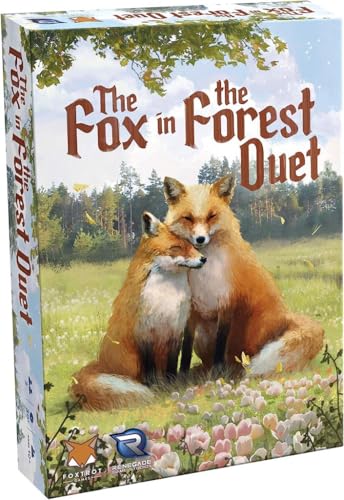
A cooperative trick-taking card game for exactly two. The three suits are Doves, Roses and Stars, and rather than scoring tricks against each other you spend them moving along a forest board, collecting gems and trying to stay on the path. A shared team tracker replaces the two separate scores the original game keeps.
Players
2
Playing time
30 minutes
Age
10+
Publisher
Renegade Game Studios
Who should skip it
Skip it if what you want is to beat the person across the table. There is no winner here -- you both clear the forest or you both lose to it.
A fifteen-minute co-op you play in near silence, and the tension is extraordinary.
A two-player-only cooperative game. One of you is pilot, one is co-pilot, and you land an aircraft by placing dice on a shared cockpit board -- without discussing which dice you hold.
Players
2
Playing time
15 minutes
Age
12+
Designer
Luc Remond
Publisher
Le Scorpion Masque
Published
2023
Who should skip it
Skip it if you want to talk freely. The no-talking restriction is the whole game, and some pairs find that frustrating rather than thrilling.
Exactly 2. Allplay's spec block states "Players: 2" and describes it as a two-player trick-taking game, which is why it is labeled Built for two here rather than Plays at two.
+−Does Sail have a solo mode?
Not one the publisher states. Allplay lists Players 2 and its page describes no solo variant, so we are not going to tell you there is one. If you are looking specifically for a cooperative game that supports one player, Gloomhaven: Jaws of the Lion is the game we cover with a publisher-stated minimum of one.
+−Can you talk during Sail?
Not about your hand. Allplay describes playing "without talking to your crewmate" and frames the lack of communication as the thing that complicates your plans. Reading your partner's intent from the cards they play is the game.
+−How long does Sail take?
20 minutes, per Allplay's own spec block, which makes it the shortest cooperative game on this site. You get five hands to reach the end of the map, so the length is structural rather than an estimate.
+−Is Sail good if we already own Fox in the Forest Duet?
Reasonably, yes, because they fail differently. Both are cooperative trick-takers for exactly two, but Duet runs 30 minutes and has you moving along a path collecting gems, while Sail runs 20 and puts a Kraken behind you that closes in whether you deal with it or not. Owning both gives you two different pressures rather than the same evening twice.
+−Who designed Sail?
Allplay's product page credits no designer and no artist, so we do not print a name. That is a gap in the publisher's own page rather than a judgment about the game -- every specification on this review comes from that page, and we would rather say what is missing than fill it in from a retailer listing.
+−What is the Sail: Seafarer Expansion?
An Allplay add-on listed alongside the base game that the publisher describes as adding more legendary pirates with asymmetric powers, plus new scenarios. There is also a Meeple Upgrade, which replaces some of the cardboard tokens with wooden pieces. Neither carries its own spec block, so we name them without printing specifications and without recommending them as part of the base purchase.
+−Is Sail a good first cooperative game for two?
It is a good second one. The rules are short, but the communication limit makes it a demanding introduction, and the 11+ rating is higher than most gateway card games. For a genuinely gentle start we would point you at the Forbidden games, where you are allowed to plan out loud.