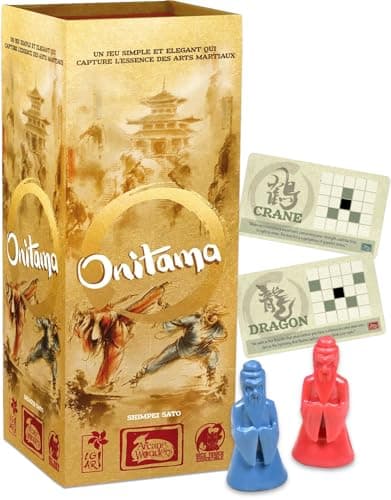
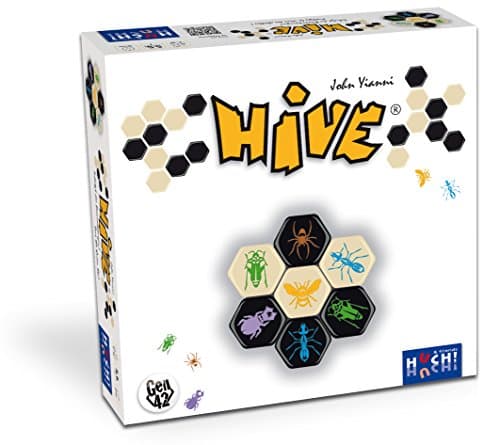
The best quick two-player games are Sky Team and Onitama at a publisher-stated 15 minutes, and Hive, Santorini and Love Letter at 20. Short does not mean shallow: Hive has the highest skill ceiling of any game we cover.
We earn a commission when you buy through links on this page, at no extra cost to you. It does not change which games we recommend or what we say about them. How this site is funded.
The most useful board game in a two-person household is usually not the best one. It is the one short enough to get played on a Tuesday.
A 90-minute game needs the evening cleared, which means it waits for a weekend that keeps not arriving. A 15-minute game happens on the way past the table. Over a year the short game gets played forty times and the long one gets played four.
So this guide ranks by publisher-stated playing time, and the games below are chosen specifically to show that brevity and depth are unrelated.
01
Why short games get played and long ones do not
It is not really about time, it is about the decision to start. A long game asks you to commit an evening before you know how the evening will go. A short game asks for almost nothing, so you say yes.
The second effect is bigger: short games get played twice. Losing a 15-minute game costs nothing and you can immediately play again, which means a bad first game does not end the session. Losing a 90-minute game ends the night on a defeat, and that quietly makes the next suggestion less appealing.
This is also why short games are the right answer when there is a skill gap or when one of you dislikes losing. The stakes per game are so low that the record stops mattering.
02
The publisher-stated times
Every figure below is from the publisher's own page or the game's reference entry, linked at the bottom. These are times for people who know the game -- a first play always runs longer.
15 minutes -- Sky Team (Le Scorpion Masque) and Onitama (Arcane Wonders). The two shortest games we recommend, and neither is a filler.
20 minutes -- Hive (Gen42), Santorini (Roxley) and Love Letter (AEG, then Z-Man Games). Hive in particular is the deepest game on this entire site despite the twenty-minute figure.
30 minutes -- Jaipur, Lost Cities, The Fox in the Forest, 7 Wonders Duel. Past the scope of this guide, but worth knowing as the next tier up.
03
Short is not the same as light
This is the confusion worth clearing up, because it stops people buying good games.
Playing time measures how long a session runs. Rules weight measures how much you have to learn. Strategic depth measures how much room there is to get better. All three are independent, and the games here prove it.
Hive runs twenty minutes, has rules that fit on a card, and has a skill ceiling comparable to a classical abstract -- it will still be teaching you things at game two hundred. Onitama runs fifteen minutes and its central idea, that using a move card hands that card to your opponent, produces a genuine tactical puzzle on every turn.
Meanwhile plenty of two-hour games are long because of upkeep rather than depth. Length is not a quality signal in either direction.
04
Building a short-game shelf
Three games covers it, and they should pull in different directions so the choice is meaningful rather than arbitrary.
Take one cooperative: Sky Team, where you are on the same side and cannot discuss your dice. Take one pure duel: Hive or Onitama, no luck, better player wins. Take one with a shuffle in it: Love Letter, where the deck decides enough that anyone can win a round.
That set handles a tired evening, a competitive mood and a five-minute gap, and all three fit in a bag. Adding a fourth short game usually just adds choosing friction.
05
When a short game is the wrong call
Two situations, worth naming so this guide is not just an argument for its own list.
If you have genuinely cleared an evening and want an experience rather than a game, short does not deliver it. A campaign game or a long asymmetric duel gives you something a fifteen-minute box cannot, and that is a real category of enjoyment.
And if one of you finds fast games stressful, brevity works against you. A 15-minute game is 15 minutes of concentration with no slack in it -- Sky Team in particular is near-silent and relentless. A longer game with more downtime is genuinely more relaxing for some players.
What we would buy
Picks drawn from the games covered on this site, chosen against the criteria above.
We earn a commission when you buy through links on this page, at no extra cost to you. It does not change which games we recommend or what we say about them. How this site is funded.
A fifteen-minute co-op you play in near silence, and the tension is extraordinary.
A two-player-only cooperative game. One of you is pilot, one is co-pilot, and you land an aircraft by placing dice on a shared cockpit board -- without discussing which dice you hold.
Players
2
Playing time
15 minutes
Age
12+
Designer
Luc Remond
Publisher
Le Scorpion Masque
Published
2023
Who should skip it
Skip it if you want to talk freely. The no-talking restriction is the whole game, and some pairs find that frustrating rather than thrilling.
Perfect information, sixteen move cards, and a rules explanation that takes under two minutes.
A two-player-only abstract on a 5x5 grid. Five move cards are in play at once and they physically pass between the two of you, so arming yourself always arms the opponent.
Players
2
Playing time
15 minutes
Age
14+
Publisher
Arcane Wonders
Who should skip it
Skip it if you dislike losing to a mistake you can see clearly in hindsight. Nothing is hidden, so every loss is yours.
Chess without a board, in tactile tiles, and it survives the hundredth game better than most.
A two-player-only abstract strategy game with no board: 22 tactile tiles that build the playing surface as you place them. Surround the opposing queen bee to win.
Players
2
Playing time
20 minutes
Age
9 and up
Publisher
Gen42 Games
Box size
210mm x 210mm x 50mm
Who should skip it
Skip it if abstract games leave you cold. There is no theme here to carry you through a bad position.
Plays at two2 to 6 (Second Edition) players · 20 minutes
The smallest game we recommend, and at two it becomes a tight deduction duel rather than a party filler.
A supports-more microgame that sharpens at two. You hold one card, draw a second, and play one -- deducing what the other person is holding from what they discard.
Players
2 to 6 (Second Edition)
Playing time
20 minutes
Designer
Seiji Kanai
Publisher
Alderac Entertainment Group, then Z-Man Games
Published
2012
Who should skip it
Skip it if you want a main event. This is a five-minute game you play four times, not an evening.
+−What is the best two-player game under 20 minutes?
Sky Team at a publisher-stated 15 minutes if you want cooperative, or Hive at 20 if you want a competitive game with real depth. Onitama is the fastest to learn at under two minutes of rules.
+−Are short board games shallow?
No. Hive runs 20 minutes, has rules that fit on a card, and has the highest skill ceiling of any game we cover. Playing time, rules weight and strategic depth are three independent measurements.
+−Why do short games get played more?
Because starting one costs almost nothing, and because you can play twice. A short loss does not end the evening, where a 90-minute loss does.
+−How many short games should we own?
About three, pulling in different directions: one cooperative, one luck-free duel, one with a shuffle. That covers most moods without adding choosing friction.