A two-person game night works when it is short enough to repeat: pick a fixed evening, keep two or three games you both already know, plan for 30 to 60 minutes rather than a whole evening, and stop on a win rather than a loss.
We earn a commission when you buy through links on this page, at no extra cost to you. It does not change which games we recommend or what we say about them. How this site is funded.
Most advice about game nights is written for groups, where the challenge is scheduling and the energy comes from the crowd. With two people the problems are completely different: scheduling is easy and the energy has to come from the games themselves.
The failure mode is not a bad evening. It is a good evening that never repeats, because it was too much effort to set up again.
01
Keep the session shorter than you think
The instinct is to plan a whole evening. Resist it. A two-hour block needs protecting, and anything that needs protecting eventually gets canceled.
Thirty to sixty minutes is the length that survives contact with a normal week. That means games in the 15 to 45 minute band -- Sky Team at 15, Onitama at 15, Jaipur and Lost Cities at 30, Watergate at 30 to 60 -- and it means being genuinely willing to play one game and stop.
The counterintuitive part: shorter sessions produce more total play. A 30-minute commitment happens on a Tuesday. A two-hour one waits for a weekend that keeps not arriving.
02
Own fewer games than you want to
A shelf of twenty half-learned games is worse than three you both know cold, because every session starts with choosing, and choosing is friction. Two people staring at a shelf is how twenty minutes disappears.
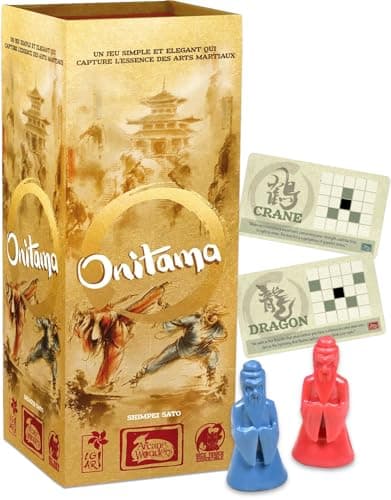
Three is about right: one short game for a tired evening, one main game you are both getting better at, and one that is the opposite of the main game in tone. For example Onitama, 7 Wonders Duel, and Codenames: Duet -- fifteen minutes, a real duel, and something conversational.
Add a fourth only when one of the three has genuinely stopped earning its place, not because something new looks interesting.
03
Set it up before you want to play
The gap between deciding to play and starting is where the evening is lost. Setup, rules refreshing and finding the score pad all happen while enthusiasm drains.
Two habits that fix it. Leave the game you are currently playing most somewhere it can be reached without moving anything else. And do setup while doing something else -- while the kettle boils, while a partner finishes a call. Arriving at the table with a game already laid out changes the decision from should we play to shall we start.
04
How to end
1Decide the number of games before you start. Two games of Onitama, or one Jaipur match. An open-ended session ends when someone gets tired, which means it ends badly.
2Alternate who goes first, and treat a pair of games as one result. This removes first player advantage and removes the argument about it.
3Stop on a win where you reasonably can. Ending on a loss makes next week's suggestion sound like a chore, and this single habit does more for repetition than any other.
4Put it away, or deliberately leave it out. Both work. What kills the next session is a half-cleared table that is neither.
05
The thing to avoid
Do not teach a new game at the end of a long day. Rules explanations at 11pm are how good games get a bad first impression they never recover from, and the person being taught will associate the game with being tired and confused.
New games get taught at the start of a session, ideally at a weekend, ideally when both of you have eaten. It sounds fussy. It is the difference between a game entering the rotation and a game living on the shelf.
What we would buy
Picks drawn from the games covered on this site, chosen against the criteria above.
We earn a commission when you buy through links on this page, at no extra cost to you. It does not change which games we recommend or what we say about them. How this site is funded.
Perfect information, sixteen move cards, and a rules explanation that takes under two minutes.
A two-player-only abstract on a 5x5 grid. Five move cards are in play at once and they physically pass between the two of you, so arming yourself always arms the opponent.
Players
2
Playing time
15 minutes
Age
14+
Publisher
Arcane Wonders
Who should skip it
Skip it if you dislike losing to a mistake you can see clearly in hindsight. Nothing is hidden, so every loss is yours.
The best first two-player card game there is: five minutes to teach, and it keeps giving for years.
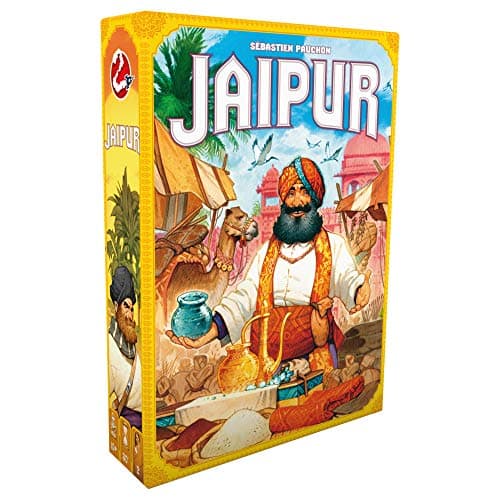
A two-player-only trading card game. You collect and sell goods in sets, racing the other trader for bonus tokens that shrink as they are taken. Best of three rounds decides it.
Players
2
Playing time
30 minutes
Age
10+
Designer
Sebastien Pauchon
Publisher
Asmodee / GameWorks
Published
2009
Who should skip it
Skip it if you want a board on the table. This is cards and tokens, and it looks slight next to a game with a map.
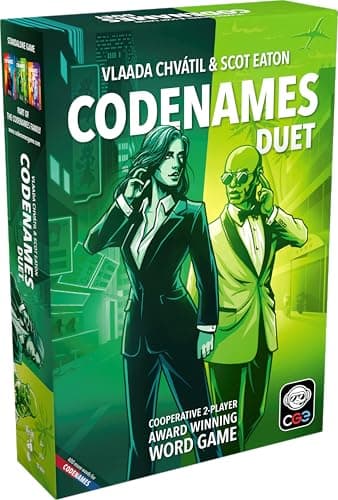
Built around two people and honest about it, though the publisher lists it as 2+ rather than two only.
A cooperative word-association game. You each see half of a shared key card and give one-word clues to guide the other to the right agents in a 5x5 grid, avoiding the assassin.
Players
2+
Playing time
15 minutes
Age
11+
Designer
Vlaada Chvatil and Scot Eaton
Publisher
Czech Games Edition
Who should skip it
Skip it if one of you thinks in wildly different associations from the other. That gap is funny once and exhausting by the fourth game.
Thirty to sixty minutes. That is the length that survives a normal week, and shorter sessions produce more total play than ambitious ones that keep getting postponed.
+−How many board games should a couple own?
Around three to start: one short game, one main game you are both improving at, and one different in tone. A large shelf adds choosing friction to every session.
+−When is the worst time to teach a new game?
Late at night at the end of a long day. The person learning associates the game with being tired and confused, and that first impression rarely recovers.
+−Should we stop playing on a win or a loss?
On a win where you reasonably can. Ending a session on a defeat makes the next suggestion feel like a chore, and this is the single best habit for making game nights repeat.