Catan Studio states 3-4 players for the base game, so two people cannot play it as published. The publisher's own two-player answer is Rivals for CATAN, a standalone card game at 30-75 minutes. If you want the building and the resource squeeze rather than the Catan name, 7 Wonders Duel and Splendor Duel are the stronger buys.
We earn a commission when you buy through links on this page, at no extra cost to you. It does not change which games we recommend or what we say about them. How this site is funded.
This question usually arrives with a copy of Catan already on the shelf and two people in the house. It is worth answering the literal version first, because it saves people money: Catan Studio publishes the base game for 3-4 players. Not 2-4. Two people cannot play the box as it is published, and any two-player Catan you have read about is either a separate product or a house rule.
So the useful question is not which game is most like Catan. It is which part of Catan you are trying to keep. People mean four quite different things -- the building, the resource squeeze, the gateway weight, or the trading and table talk -- and only three of those survive the drop to two players. This page takes them one at a time, and is honest about the one that does not survive.
01
First, the part that does not translate
If what you love about Catan is the trading -- the haggling, the alliances that last one turn, the person who will not give you wheat -- then no two-player game replicates it, including the official two-player Catan. That is not a failure of design. A negotiation market needs at least three people, because with two there is only one possible trading partner and nobody to play against them.
We would rather say this plainly than sell you a substitute that will disappoint you. If the social negotiation is the point, the honest advice is to keep Catan for nights when you have four people and buy a two-player game for the other nights, choosing it on its own merits rather than on resemblance.
Everything below is about the other three things Catan gives you, all of which do translate.
02
How we judged these
Published for two. Every pick states a player count that includes exactly two, verified on the publisher's own page -- no house rules and no scaling patches.
Building something that grows. The core Catan pleasure is watching a position compound, so a pick has to give you an engine or a tableau rather than just a hand of cards.
A resource squeeze you feel. Catan is about wanting something you cannot get. Picks had to create scarcity between the two players rather than against a deck.
Gateway weight, not hobby weight. Catan teaches in about fifteen minutes to people who do not play games. Anything demanding an evening of rules study was out.
03
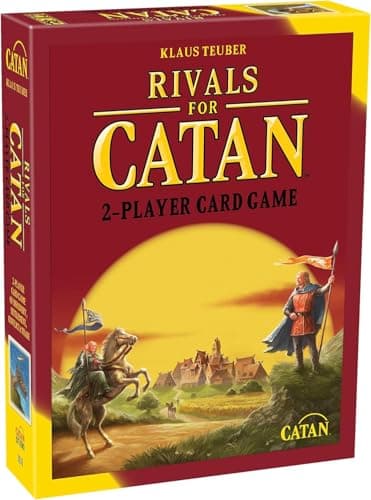
The publisher's own answer: Rivals for CATAN
If the Catan setting specifically is what you want, this is the product Catan Studio points you at. The publisher states 2 players, ages 10 and up, and 30-75 minutes depending on which mode you play. It is standalone -- it does not require the base game and does not use its board.
You build a principality out of cards rather than settling a shared island: region cards produce resources, and you expand with settlements, roads, cities and special cards. Catan Studio stages the learning curve deliberately, with an introductory game called The First Catanians and three theme sets after it, so you can start simple and add complexity when you want it.
Two honest cautions. First, the thing that makes it good is also what makes it not-Catan: this is a card game about combos, and the absence of a negotiation market is structural. Second, the published time range is wide -- the introductory game runs about thirty minutes but the full Duel of the Princes mode is stated at 60-75, so buying it expecting a quick weeknight game is a mistake.
04
If you want the civilization building: 7 Wonders Duel
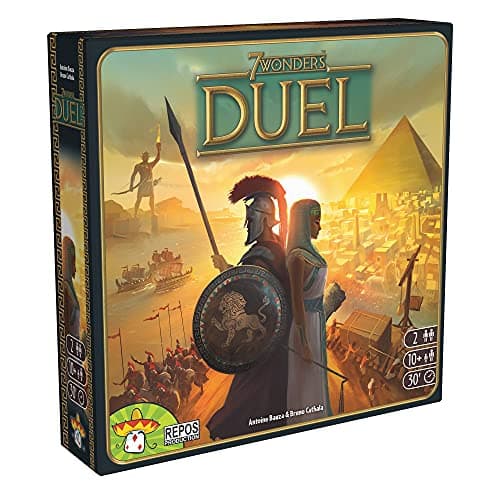
Repos Production publishes 7 Wonders Duel for exactly 2 players at 30 minutes, ages 10 and up. It is the pick for the Catan owner whose favorite part was watching a civilization take shape across a game, and it is the game most households in this position end up keeping.
Cards are laid out in overlapping pyramids and you may only take the ones that are uncovered, so every card you take also uncovers something for the other person. That is the Catan resource squeeze rebuilt without dice: you are not hoping for wheat, you are deciding which of two good cards to take and which to hand over.
It also has three win conditions running at once -- civilian points, military supremacy and scientific dominance -- and two of them end the game on the spot. The honest downside is that this makes it the least relaxing game here. Catan at four is sociable and forgiving; this is thirty minutes of watching what the other person is about to do, and that is a different evening.
05
If you want the resource engine: Splendor Duel
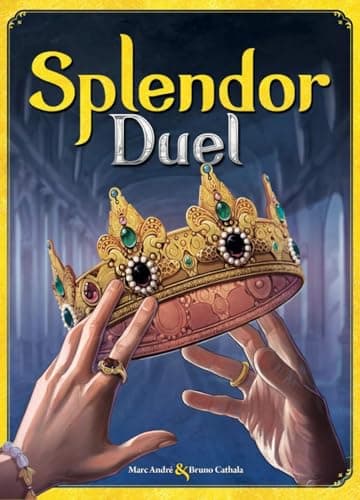
Space Cowboys publishes it for exactly 2 players at 30 minutes, ages 10 and up. Of everything on this site it is the closest to the specific feeling of accumulating resources and spending them on things that make future turns cheaper.
Gems come off a shared 25-token grid, and you may take up to three that form an uninterrupted line. Cards you buy leave a permanent discount behind, so the position compounds exactly the way a good Catan position does. Three victory conditions are live from the first turn, and any of them ends the game immediately.
Skip it if you want the sociable end of Catan. There is no direct attack, but the shared grid is genuinely tight, and the abrupt endings mean an engine one turn from paying off can score nothing. It is also the pick most likely to feel abstract to somebody who liked Catan for its island and its little wooden houses.
06
If you want the trading, minus the table: Jaipur
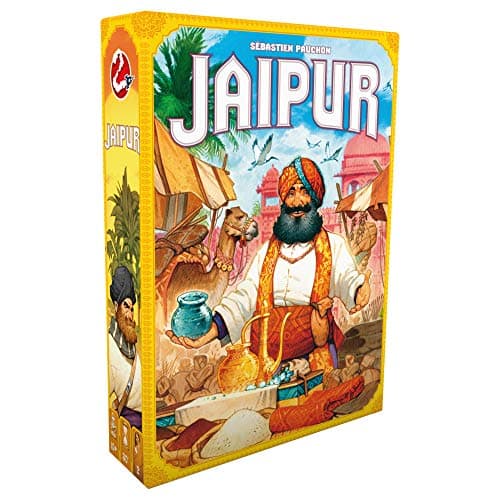
Space Cowboys publishes Jaipur for exactly 2 players at 30 minutes, ages 10 and up, and it is the closest thing to Catan's commerce that works with one opponent. You are not negotiating, but you are trading goods for value that visibly shrinks as the other person sells.
Goods tokens are stacked with the most valuable on top, so every sale your opponent makes lowers what your own goods will be worth. That produces the thing Catan trading actually produces -- pressure to act before the other person does -- without needing a third party to bargain with.
It teaches in about five minutes, which makes it the best pick here for a household where one person does not really play games. The downside is table presence: this is cards and tokens, and after a board covered in hexes and roads it can look slight.
07
If you want the calm: Patchwork
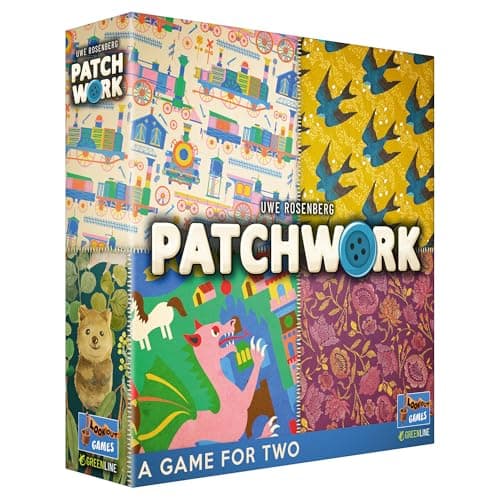
Worth naming because a good number of people who ask this question liked Catan for the building rather than the competing. Lookout Games publishes Patchwork for exactly 2 players at about 30 minutes, ages 8 and up -- the lowest age rating we cover.
You buy fabric patches and fit them onto your own quilt, paying in buttons and in time. It keeps the satisfaction of a position that fills in and grows, and it removes conflict almost entirely: you never touch the other person's board, and the game cannot end suddenly.
The stated reason to skip it is real and it is the opposite of Catan's appeal: there is very little interaction. If the reason you play is to be in a game with someone rather than beside them, this will read as two people doing puzzles at the same table.
08
What about the Catan expansions and variants?
A fair question, and here is the limit of what we will claim. Catan Studio's page for the base game states 3-4 players and lists a 5-6 player expansion as a separate product; it does not describe a two-player option for the base box. We have not verified the player counts of every Catan expansion and spin-off, so we are not going to tell you which of them do or do not work at two.
What we can say is that the publisher's designated two-player product in the Catan line is Rivals for CATAN, which is why it is the pick above. If you want certainty about any other Catan product, its own page on catan.com states its player count, and that is a better source than us.
09
What we did instead of playing these
We have not played these games. What we did: took every player count, playing time and age rating from the publisher's own product page -- Catan Studio for the base game and for Rivals, Repos Production, Space Cowboys and Lookout Games for the rest -- and confirmed each pick is currently purchasable before featuring it. Where a publisher does not state something, such as the designer of Rivals for CATAN, we leave it out rather than filling it in. No price appears in this prose; the buy buttons carry live pricing, stamped with the date checked.
What we would buy
Picks drawn from the games covered on this site, chosen against the criteria above.
We earn a commission when you buy through links on this page, at no extra cost to you. It does not change which games we recommend or what we say about them. How this site is funded.
The publisher's own answer to wanting Catan at two, and a genuinely different game from the box you already own.
A two-player-only card game in the Catan universe, standalone and not requiring the base game. You build a principality from region and settlement cards rather than on a shared board. The publisher stages it as an introductory game plus three theme sets, and states 30-75 minutes depending on which mode you play.
Players
2
Playing time
30-75 minutes
Age
10+
Publisher
Catan Studio
Published
2010
Who should skip it
Skip it if what you love about Catan is the trading and the table talk. With one opponent there is no negotiation market, and no card can replace haggling with three people.
The strongest all-round two-player game in print, and the one most couples settle on.
A two-player-only card drafting game where each side builds a civilization across three ages. Three ways to win -- civilian points, military supremacy and scientific dominance -- run at once, so every card you take is also a card denied.
Players
2
Playing time
30 minutes
Age
10+
Designer
Antoine Bauza and Bruno Cathala
Publisher
Repos Production
Published
2015
Who should skip it
Skip it if you want a relaxing evening. Three win conditions run at once, so you are always watching what the other person is about to do.
The gentler duel: an engine builder where you are racing rather than attacking, and the shared gem board is the whole game.
A two-player-only engine-building game in the Splendor universe. You draft gem tokens from a shared board to buy Jewel cards across three levels, chasing three separate victory conditions -- points, a color majority, or crowns. 67 Jewel cards, 25 tokens, 3 Privilege scrolls, 4 Royal cards.
Players
2
Playing time
30 minutes
Age
10+
Designer
Bruno Cathala and Marc Andre
Publisher
Space Cowboys
Published
2022
Who should skip it
Skip it if you want direct conflict. The tension is in what you take from the shared board before the other person can, never in anything you do to their cards.
The best first two-player card game there is: five minutes to teach, and it keeps giving for years.
A two-player-only trading card game. You collect and sell goods in sets, racing the other trader for bonus tokens that shrink as they are taken. Best of three rounds decides it.
Players
2
Playing time
30 minutes
Age
10+
Designer
Sebastien Pauchon
Publisher
Asmodee / GameWorks
Published
2009
Who should skip it
Skip it if you want a board on the table. This is cards and tokens, and it looks slight next to a game with a map.
The gentlest good game on this site. Two quilts, no attacking, and a surprisingly sharp puzzle underneath.
A two-player-only tile-laying game. You buy fabric patches on a shared time track and fit them onto a personal 9x9 quilt board, paying with buttons and with time.
Players
2
Playing time
about 30 minutes
Age
8+
Designer
Uwe Rosenberg
Publisher
Lookout Games
Published
2014
Who should skip it
Skip it if you want to interact. You are mostly solving your own board, and the only contact is who takes which patch first.
Not as published. Catan Studio states 3-4 players for the base game, so two people cannot play the box without a house rule. The publisher's own two-player product in the line is Rivals for CATAN, which is a separate standalone card game.
+−Is 2-player Catan fun?
The question is slightly wrong, because the base game is not published for two. What people usually mean is whether a house-ruled version is worth it, and our answer is that you will get a better evening from a game designed for two -- 7 Wonders Duel if you want the civilization building, Rivals for CATAN if you want the setting.
+−What is the closest two-player game to Catan?
Rivals for CATAN if you mean the setting, since it is the publisher's own two-player Catan game. Splendor Duel if you mean the feeling of gathering resources and spending them on cards that make later turns cheaper.
+−Does Rivals for CATAN need the base Catan game?
No. Catan Studio describes it as a standalone card game. It does not use the base game's board or pieces, and you can buy it without owning Catan at all.
+−Which of these is best if one of us does not really play board games?
Jaipur. It teaches in about five minutes against roughly fifteen for Catan, and there is no direct attacking, so nobody feels singled out. Patchwork is the other safe answer if you want something calmer still.
+−Can I keep the trading part of Catan in a two-player game?
Not the negotiation, no -- a bargaining market needs three or more people. You can keep the commercial pressure, which is what Jaipur does: you race one opponent for goods bonuses that shrink as they are taken.