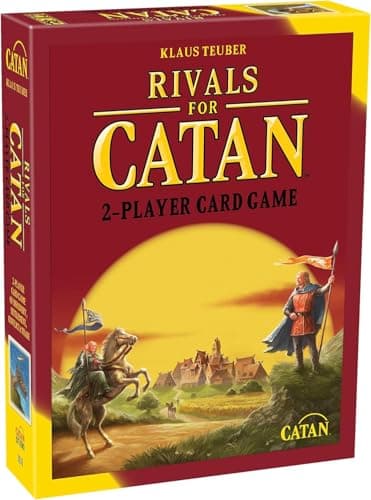
Rivals for CATAN is a two-player-only card game published by Catan Studio, stated at 30-75 minutes for ages 10 and up. It is standalone and does not need the base game. You build a principality from cards rather than settling a shared island, and there is no trading, because a negotiation market needs three or more people.
We earn a commission when you buy through links on this page, at no extra cost to you. It does not change which games we recommend or what we say about them. How this site is funded.
This is the game Catan Studio sells to people who own Catan and have two players in the house, and it is the most commonly misunderstood product in the line. It is not a two-player variant, not an expansion, and not a smaller version of the board game. It is a separate card game that happens to be set in Catan, and whether that is what you want is the whole decision.
It also has an unusual amount of game in it for a card box. The publisher ships three different ways to play at three different lengths, which is genuinely useful and also the thing most likely to make a buyer pick the wrong one first and come away unimpressed.
01
What you are actually buying
Catan Studio publishes it for exactly 2 players, ages 10 and up, at 30-75 minutes depending on which mode you play. It is standalone: it does not use the base game's board, hexes or pieces, and you can buy it without owning Catan at all.
Each of you builds a principality out of cards. You start with two settlements, a road between them, and six regions arranged around them, and you expand outward from there with roads, more settlements, cities, buildings and units. The board game's island is replaced by your own growing tableau of cards, and your opponent has their own.
It first appeared in 2010 as a revision of the earlier Catan Card Game. Worth knowing if you find an older box secondhand: the published reference notes that the two editions are not compatible with each other even though they share many cards.
02
Two dice, and why the event die is the interesting one
Every turn starts by rolling two dice. The production die decides which of the six region types produce this turn, and both players harvest from their matching regions -- so a roll is never purely good or bad for one person. Resources are the familiar Catan six: lumber, wool, grain, brick, ore and gold, each coming from its matching region.
The event die is the one that gives the game its character. Depending on the face, it hands out a bonus, takes resources away, sends brigands after stockpiled goods, or makes you draw from a dedicated event deck. It is the mechanism that replaces the robber and the table politics of the board game, and it is why two turns of this rarely feel the same.
The practical effect is that you are managing risk rather than negotiating. Holding a big pile of a resource is efficient and also exactly what the brigands punish, and that tension is the closest thing here to the pressure Catan creates by making you ask other people for wheat.
03
Three ways to play, and which to start with
This is the part worth getting right, because starting in the wrong mode is the most common way to have a mediocre first evening. The published thresholds are clear: the Introductory Game runs to 7 victory points, the Theme Games to 12, Duel of the Princes to 13, and the Tournament game to 15.
The Introductory Game -- the publisher calls it The First Catanians -- is about thirty minutes and uses a reduced card set. Start here. It teaches the dice, the regions and the building costs without the card abilities that make the longer modes interesting, and it is short enough that a bad first game costs you almost nothing.
The three theme sets after it -- the publisher names them The Era of Gold, The Era of Turmoil and The Era of Progress -- add cards and complexity, and Duel of the Princes combines them into the long game at 60-75 minutes. That range is the honest answer to how long this takes: it is a thirty-minute game and an hour-and-a-quarter game in the same box, and buying it expecting a quick filler is a mistake.
Settlements are worth 1 victory point and a city 2, and cards also hand out progress points that raise your hand limit, skill points that some events key off, and strength and commerce points that earn tokens worth a victory point while you hold them. Several small currencies, all feeding one total.
04
What it keeps from Catan, and what it drops
It keeps more than people expect. The resources are the same six, they still come from regions that produce on a die roll, and you still spend them on roads and settlements and upgrades. If what you like about Catan is the loop of harvesting and building, that loop is intact and it runs faster here because there is no waiting for three other people.
It drops the one thing everybody asks about: trading. There is no negotiation in this game, and there cannot be -- with one opponent there is only one possible trading partner and nobody to bid against them. Catan Studio replaced the deal-making with card abilities and the event die. That is a reasonable substitution and it is not the same pleasure, and we would rather say so plainly than let you find out after buying.
It also drops the shared map. You are not competing for the same hexes; you are each building your own principality and racing to a points total. Interaction comes through cards played against your opponent and through the event die, not through blocking a road they wanted.
05
Who this is genuinely for
Households that own Catan, mostly play as two, and have quietly stopped getting it off the shelf because it needs three.
Anyone who likes the resource-harvesting loop specifically and wants it without a table of four people.
Pairs who want a card game with real length to it. At 60-75 minutes the long mode is a proper evening, which most two-player card games are not.
Buyers who like a game that teaches itself in stages rather than dropping every rule on the table at once.
06
Who should skip it
Skip it if what you love about Catan is the trading and the table talk. This is the stated reason to skip it and it is the one that matters: no card in this box replaces haggling with three people, and buyers who wanted that specifically are the ones who end up disappointed.
Skip it if you want one clean set of rules. Three modes and three theme sets is generous, but it also means the game you learn first is not the game people are praising, and getting to the good version is a project. If you want depth immediately and without staging, 7 Wonders Duel gives you that in thirty minutes.
And skip it if dice-driven swings annoy you. Production is decided by a roll, and the event die can take resources off you through no fault of your own. Splendor Duel is the pick if you want the engine-building satisfaction with almost nothing left to chance.
07
The Deluxe edition, honestly
A Deluxe edition of Rivals is sold alongside the standard box, and people reasonably ask which to buy. We are not going to tell you, because we could not verify it: Catan Studio has no reachable page describing the Deluxe edition, and we will not summarize what a retail listing's marketing copy implies as though it were a specification.
What we can say is that the product reviewed here, and the one our buy button points at, is the standard edition. If you are choosing between them, the two retail listings sit side by side and the contents are the thing to compare.
08
What we did instead of playing it
We have not played this. What we did: took the player count, playing time, age, the standalone status and the names of the introductory game and three theme sets from Catan Studio's own page for the game; took the starting principality, the two dice, the six resources, the victory point thresholds for each mode and the settlement, city and card point values from a published reproduction of the rulebook, confirmed against the game's independent reference entry, which is also where the 2010 release and the Catan Card Game lineage come from. Catan Studio's own rulebook PDF is published as scanned images with no text layer, so it could not be quoted directly, and we say so rather than implying we read it. Sources are linked below and no price appears in this prose.
What we would buy
Picks drawn from the games covered on this site, chosen against the criteria above.
We earn a commission when you buy through links on this page, at no extra cost to you. It does not change which games we recommend or what we say about them. How this site is funded.
The publisher's own answer to wanting Catan at two, and a genuinely different game from the box you already own.
A two-player-only card game in the Catan universe, standalone and not requiring the base game. You build a principality from region and settlement cards rather than on a shared board. The publisher stages it as an introductory game plus three theme sets, and states 30-75 minutes depending on which mode you play.
Players
2
Playing time
30-75 minutes
Age
10+
Publisher
Catan Studio
Published
2010
Who should skip it
Skip it if what you love about Catan is the trading and the table talk. With one opponent there is no negotiation market, and no card can replace haggling with three people.
The strongest all-round two-player game in print, and the one most couples settle on.
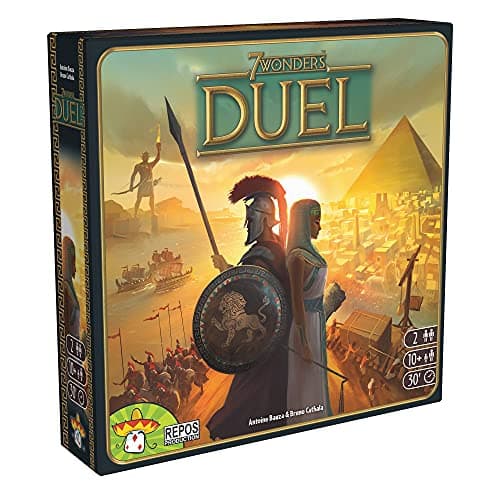
A two-player-only card drafting game where each side builds a civilization across three ages. Three ways to win -- civilian points, military supremacy and scientific dominance -- run at once, so every card you take is also a card denied.
Players
2
Playing time
30 minutes
Age
10+
Designer
Antoine Bauza and Bruno Cathala
Publisher
Repos Production
Published
2015
Who should skip it
Skip it if you want a relaxing evening. Three win conditions run at once, so you are always watching what the other person is about to do.
The gentler duel: an engine builder where you are racing rather than attacking, and the shared gem board is the whole game.
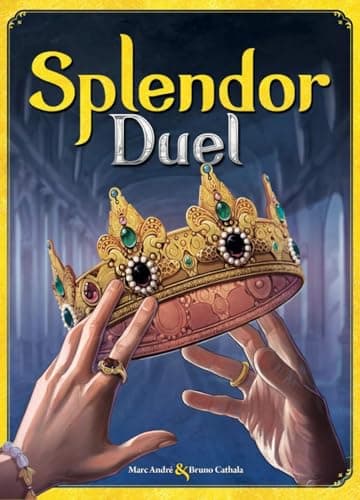
A two-player-only engine-building game in the Splendor universe. You draft gem tokens from a shared board to buy Jewel cards across three levels, chasing three separate victory conditions -- points, a color majority, or crowns. 67 Jewel cards, 25 tokens, 3 Privilege scrolls, 4 Royal cards.
Players
2
Playing time
30 minutes
Age
10+
Designer
Bruno Cathala and Marc Andre
Publisher
Space Cowboys
Published
2022
Who should skip it
Skip it if you want direct conflict. The tension is in what you take from the shared board before the other person can, never in anything you do to their cards.
Yes, if you own Catan, mostly play as two, and like the harvest-and-build loop. Catan Studio publishes it for exactly 2 players at 30-75 minutes. It is not worth it if the trading and negotiation is what you actually wanted -- that part does not exist here.
+−Do you need the base Catan game to play Rivals for CATAN?
No. Catan Studio describes it as standalone. It uses none of the base game's board or pieces, and you can buy and play it without owning Catan.
+−How do you win Rivals for CATAN?
By reaching a victory point total, and the total depends on the mode: 7 in the Introductory Game, 12 in the Theme Games, 13 in Duel of the Princes and 15 in the Tournament game. Settlements are worth 1 point and cities 2, with more from cards.
+−Is Rivals for CATAN the same as playing Catan with 2 players?
No, and this is the key point. Catan Studio states 3-4 players for the base game, so it is not published for two at all. Rivals is a separate card game, not a variant of the board game.
+−Which Rivals for CATAN mode should I start with?
The Introductory Game, which runs to 7 victory points and takes about thirty minutes. It teaches the dice and the building costs on a reduced card set before the theme sets add abilities.
+−How long does Rivals for CATAN take?
The publisher states 30-75 minutes, and the spread is real rather than padding: the introductory mode is about thirty minutes and Duel of the Princes is stated at 60-75.
+−Should I buy the standard or the Deluxe edition?
We do not say, because we could not verify what the Deluxe edition adds -- there is no reachable publisher page for it. The edition reviewed here is the standard one.