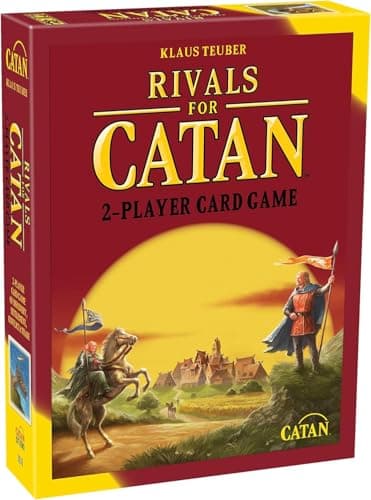
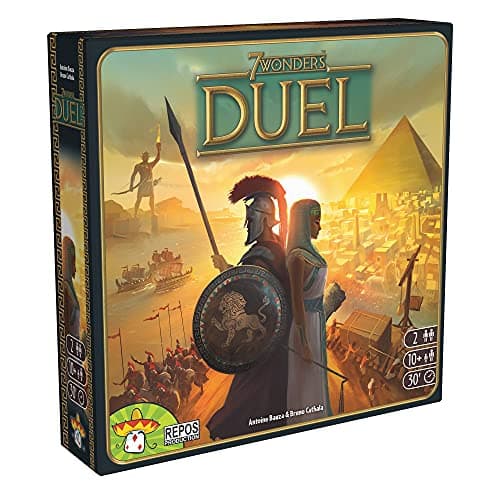
Buy 7 Wonders Duel if you want the better and tighter game: exactly 2 players, 30 minutes, three live win conditions and almost no luck. Buy Rivals for CATAN if you want something friendlier with dice and swings, and if the Catan setting is what draws you. Both are standalone and neither needs its parent game.
We earn a commission when you buy through links on this page, at no extra cost to you. It does not change which games we recommend or what we say about them. How this site is funded.
This is a genuinely useful comparison because the two games occupy the same odd position. Each is the publisher's official answer to a famous multiplayer game that does not work at two -- Repos Production lists 7 Wonders at 3-7 players, Catan Studio lists CATAN at 3-4 -- and each is a separate box rather than a variant. If you own either parent game and there are two of you, one of these is what you are being pointed at.
They are not, however, the same kind of solution. One is a tight, nearly luckless duel that finishes in half an hour. The other is a longer, dice-driven game that feels much closer to a family evening. Picking between them is mostly a question of how much chance you want in the result.
Quick picks
#
Game
Players
Time
Price
1
7 Wonders Duel
The strongest all-round two-player game in print, and the one most couples settle on.
Player counts and playing times come from each publisher, cited on that game's review page. Tap a row to jump to the full write-up.
01
The verified specs
7 Wonders Duel -- 2 players, 30 minutes, ages 10+. Antoine Bauza and Bruno Cathala, Repos Production, 2015. Standalone; does not need 7 Wonders.
Rivals for CATAN -- 2 players, 30-75 minutes, ages 10+. Catan Studio, 2010. Standalone; does not need CATAN. The publisher's page names no designer and lists no contents.
Both are published for exactly two players. Neither scales up and neither has a solo mode.
02
The difference that decides it: how much luck
7 Wonders Duel has very little. Cards sit in overlapping pyramids, partly face down, and you take the uncovered ones -- so which cards appear is shuffled, but from the moment a card is visible the decision is pure information. There are no dice. A stronger player will win consistently, and when you lose you can usually see exactly where.
Rivals for CATAN is built on dice. A production die decides which of your regions harvest each turn, and an event die hands out bonuses, takes resources away, sends brigands after stockpiles, or makes you draw an event card. You are managing risk rather than calculating a line.
This is the whole decision and it points in opposite directions for different households. If you want your decisions to be the thing that decides it, buy Duel. If a weaker player needs a real chance of winning -- or if you simply enjoy a game where the dice give you something to react to -- Rivals is the better evening.
03
Length, and what the ranges hide
Duel's 30 minutes is honest from the second game onward. The one caveat is its symbol language: the cards communicate resources, chains, science and military in icons, and until you read them fluently your first game or two will run long with the rulebook open.
Rivals' 30-75 minutes is not a fudge, it is three different games. The introductory mode runs to 7 victory points in about half an hour; the theme games go to 12; Duel of the Princes goes to 13 and is stated at 60-75 minutes. So this box can be a weeknight filler or a full evening depending on which mode you set up.
Practical consequence: if you want a reliable half-hour game, Duel is the safer purchase. If you want one box that stretches from short to long, Rivals does something Duel does not.
04
What each one keeps from its parent
Rivals keeps more of Catan than Duel keeps of 7 Wonders. The resources are the familiar six, they still come from regions that produce on a die roll, and you still spend them on roads, settlements and city upgrades. A Catan player will recognize the loop immediately.
7 Wonders Duel keeps the theme and the three-age structure but rebuilds the engine. The original passes hands around a table; Duel replaces that with the pyramid layout, because passing hands between two people destroys the hidden information the original depends on. It is the more radical redesign of the two.
Both drop the same thing, and it is worth saying plainly: trading. Neither game has negotiation, because a bargaining market needs three or more people. If haggling is what you liked about Catan or the table politics of 7 Wonders, neither of these replaces it and no two-player game will.
05
Which is the better game
7 Wonders Duel, and we would say so even though it is the less approachable of the two. Three win conditions live from the first turn -- points, military and science, with two of them ending the game on the spot -- give it a decision space Rivals does not match, and it is the game most pairs on this site end up settling on.
That is not a dismissal of Rivals. It does something Duel cannot: it makes a two-player game feel like a family game night, and it stretches across three lengths. For a household where one person plays board games and the other is being invited along, that matters more than depth.
The stated reasons to skip each are the honest summary. Skip Duel if you want a relaxing evening, because three simultaneous win conditions mean you are always watching the other person. Skip Rivals if what you love about Catan is the trading and the table talk, because that is gone.
06
Pick this if
Pick 7 Wonders Duel if you both enjoy competing, want depth in half an hour, and want your decisions rather than the dice to decide the game.
Pick Rivals for CATAN if the Catan setting appeals, if a weaker player needs a real chance, or if you want one box that can be a thirty-minute game or a seventy-five-minute one.
Own both only if you like the pair of them for different nights. They are not similar enough to be redundant, but they do overlap in the slot they fill.
The strongest all-round two-player game in print, and the one most couples settle on.
A two-player-only card drafting game where each side builds a civilization across three ages. Three ways to win -- civilian points, military supremacy and scientific dominance -- run at once, so every card you take is also a card denied.
Players
2
Playing time
30 minutes
Age
10+
Designer
Antoine Bauza and Bruno Cathala
Publisher
Repos Production
Published
2015
Who should skip it
Skip it if you want a relaxing evening. Three win conditions run at once, so you are always watching what the other person is about to do.
The publisher's own answer to wanting Catan at two, and a genuinely different game from the box you already own.
A two-player-only card game in the Catan universe, standalone and not requiring the base game. You build a principality from region and settlement cards rather than on a shared board. The publisher stages it as an introductory game plus three theme sets, and states 30-75 minutes depending on which mode you play.
Players
2
Playing time
30-75 minutes
Age
10+
Publisher
Catan Studio
Published
2010
Who should skip it
Skip it if what you love about Catan is the trading and the table talk. With one opponent there is no negotiation market, and no card can replace haggling with three people.
+−Which is better, 7 Wonders Duel or Rivals for CATAN?
7 Wonders Duel is the better game: more decision space, almost no luck, and a reliable 30 minutes. Rivals for CATAN is the friendlier one, with dice, swings and three game lengths in one box.
+−Do either of them need the original game?
No. Both are standalone. 7 Wonders Duel does not need 7 Wonders and Rivals for CATAN does not need CATAN -- neither uses its parent game's components.
+−Which has more luck?
Rivals for CATAN, clearly. It runs on a production die and an event die. 7 Wonders Duel has no dice at all; its only randomness is which cards are shuffled into the display.
+−Which is better for someone new to board games?
Rivals for CATAN, if they already know Catan -- the resource loop will be familiar. Otherwise the introductory mode is a gentler thirty minutes than learning 7 Wonders Duel's symbol language.
+−Can you trade in either game?
No. Neither has negotiation, because a trading market needs three or more players. Both replace it with card abilities, and Rivals also with its event die.