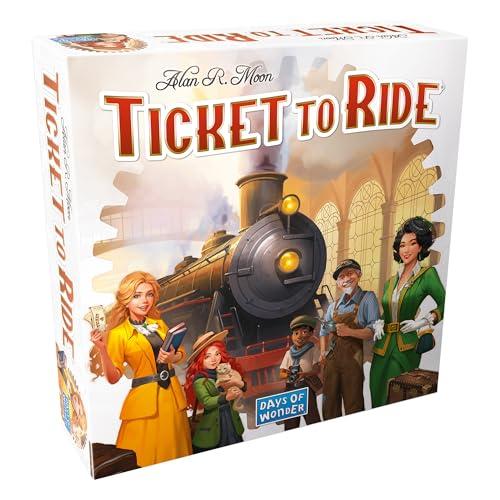
It works, and it is the gentlest of the big gateway games at two -- but it is also the least contested. Ticket to Ride is recommended for 2-5 players, and below a stated player threshold only one of each pair of parallel double routes may be claimed, which is a real adjustment. What does not change is the map: two players get the whole 1910 board, so the race to claim a route before your opponent does mostly evaporates. Buy it for the flexibility and the 8+ rating; buy a two-player design if you want friction.
We earn a commission when you buy through links on this page, at no extra cost to you. It does not change which games we recommend or what we say about them. How this site is funded.
Ticket to Ride is the best-selling game in this category and the one most households already own, which makes the two-player question one of the most asked in the hobby. It is also one of the worst-answered, because the honest answer has two halves that point in opposite directions and most write-ups only give you one of them.
The first half: the game does adjust for a pair, and the adjustment is a real rule rather than a shrug. The second half: the thing that most needed to change did not change. Both halves are below, and so is the question people actually ask next, which is which version of the game to buy if two is your normal player count.
One sourcing caveat up front, because it affects how much weight to put on the figures here. We could not reach a publisher page for this game -- the Days of Wonder product URL and the Asmodee store URL both return 404, and no official page surfaced in search. Everything below therefore rests on the game's reference entry, which is the fallback this site uses when a publisher page is unreachable, and we have not played the game.
01
The short answer, and the verified specs
Ticket to Ride -- recommended for 2-5 players, 30-60 minutes, ages 8+. Alan R. Moon, Days of Wonder, first released 2004. The board is a 1910 map of the United States and southern Canada.
Nine colors of transport card plus a multicolored Steam locomotive that acts as a wild. You spend matching sets to claim routes between cities and try to complete the destination tickets in your hand.
DOES change at two: below a stated threshold of players, only one of each pair of parallel double routes may be claimed.
Does NOT change at two: the map. Same board, same cities, same route network as a five-player game.
We print no component count, because the reference entry gives none and no publisher page was reachable. The widely-repeated train-car figure is retailer copy we cannot cite.
On this site's labeling it is Plays at two, not Built for two, and it has no publisher-stated solo mode.
02
How we judged this, and the pattern across four gateway games
This is the fourth 2-N gateway game put through the same three questions, and the four answers together are more useful than any single one.
First: does the publisher support two players, or is two a fan variant? Ticket to Ride passes -- the original is recommended for 2-5.
Second: does the game scale down, and does the scaling target the thing that creates tension? Here are the four answers side by side. Azul scales the thing that matters, reducing the number of factory displays so the shared tile supply shrinks for a pair. Splendor scales half of itself -- three tokens of each gem color come out, but the card market is untouched. Carcassonne scales nothing at all. And Ticket to Ride scales the map, by closing one lane of each double route below a certain number of players.
That makes Ticket to Ride the only one of the four whose adjustment is geographic rather than about supply, and it is a genuinely clever fix as far as it goes. The next two sections are about how far it goes.
Third: is there a design built for exactly two? For Azul it is Azul Duel and for Splendor it is Splendor Duel, both in print. For Ticket to Ride the answer is more complicated and gets its own section, because it is the question people are actually searching for.
03
What the double-route rule does, and the number we will not print
Several of Ticket to Ride's city pairs are joined by two parallel routes rather than one. With a full table both lanes are in play, so two different players can each run a train between the same pair of cities. Below a stated threshold of players, only one of the two may be claimed -- the second lane is closed.
That is exactly the right instinct. Fewer players means less competition for any given connection, so shutting one lane restores some of the scarcity that a crowded board supplies for free. It means a route your opponent takes is genuinely gone rather than merely inconvenient, which is the single most important source of tension in this game.
Here is the limit, and we would rather state it than paper over it: the exact player threshold is not given by any source we could reach. The reference entry says the restriction applies below a stated threshold without saying what the threshold is, and with no publisher page available there is nowhere else to check. The number is printed in the rulebook in the box. We are not going to guess at a figure that governs how you set up your game.
This is the same call we made on Azul's two-player factory count. The mechanism is not in doubt and is worth knowing about before you buy; the figure is not ours to invent.
04
The map does not shrink, and that is the real cost
Now the half that most answers skip. Closing one lane of the double routes reduces the supply of connections slightly. It does not reduce the board.
Two players sit down in front of the same 1910 map of the United States and southern Canada that five players use. The same cities, the same spread of routes, the same distances. With five people that board is crowded and the game is a scramble -- you take the route you can reach because the one you wanted will be gone. With two, there is an enormous amount of track and one other person, and the odds that they want the specific connection you are building toward are much lower.
The consequence is that Ticket to Ride at two drifts toward two people building separate rail networks in parallel. You are each completing your own destination tickets with far less interference, and the game becomes a race on efficiency rather than a fight over territory. Some pairs enjoy exactly that, and it makes the game a calm, pleasant forty minutes. But if what you liked about Ticket to Ride was the moment someone takes the route you needed and your plan collapses, that moment gets much rarer with one opponent.
It is the same shape of problem as Carcassonne, which we looked at separately: a game whose interaction is spatial, handed to two people on a board sized for more. Ticket to Ride handles it better than Carcassonne because it at least closes the double lanes, but it does not solve it.
05
Which Ticket to Ride is best for two players? An honest, checked answer
This is the other half of what people search for, and it deserves a real answer rather than a shrug toward the expansion shelf.
The reference entry does identify editions designed for low player counts, and they are specific: Nordic Countries is recommended for 2-3 players at 30-60 minutes, and Switzerland is 2-3 players at 30-45 minutes, with a review quoted there calling Switzerland ideal for competitive two-player games. So the answer in principle is clear -- if two or three is your normal count, those are the maps built for it.
The problem is availability, and we checked rather than assuming. Neither is currently purchasable as a standalone game through the retailer this site links. Switzerland now ships only as a combined India and Switzerland product that is sold as an expansion and requires a base game, so it is not a two-player game you can buy on its own. We found no live standalone Nordic Countries listing at all. A Nordic-themed Northern Lights edition does exist and is in stock, but it is a different product and we have not sourced its player count, so we are not going to put a number on it.
So the practical answer is narrower than the theoretical one. If you want Ticket to Ride, buy the base game -- it is the one that is actually in print and it is recommended for 2-5. If what you specifically want is a route-building game built for two people, the honest answer is that Ticket to Ride does not currently sell you one, and you would do better with a game designed for two from the start.
06
What Ticket to Ride has that the two-player designs do not
Three things, and for a lot of households one of them settles it.
The age rating. Ages 8 and up, which is low enough that this is a genuine family purchase rather than an adult game a child can be walked through. Only Carcassonne at 7+ goes lower on this site. The core action -- collect matching cards, spend them to claim a route -- is about as teachable as a rule gets.
The seat count. Up to five. That is more than Azul's four and more than Splendor's four, and it is the reason this box is in so many houses: it covers a pair on a weeknight and a family at Christmas without anyone having to choose. No game built for exactly two can do that, and we would not pretend the trade is one-sided.
And recognition. If you are buying a gift, or persuading someone who does not think board games are for them, the fact that they have probably heard of this one is worth something real. It is the best-selling game of its type for a reason, and "we played Ticket to Ride once" is a sentence a lot of people can say.
Against that, the honest summary: it is the most flexible box on this page and the least contested at two. Those are the same fact seen from two sides.
07
Who each pick is for
Ticket to Ride -- best for the household that wants one box covering two people and up to five, and best of all if a child of eight will be playing. Recommended 2-5, 30-60 minutes, 8+, and the double routes do get restricted at low counts. Honest downsides: the map does not shrink, so at two the blocking that makes it tense mostly disappears; the exact double-route threshold is not in any source we could reach; and no publisher page was available, so the specs rest on the reference entry.
Azul -- best for the pair who want a 2-N game that genuinely scales for two. Its setup reduces the number of factory displays with the player count, so the draft stays squeezed, and taking every tile of one color lets you deny your opponent deliberately. Honest downsides: no reachable source states its age rating, and it seats four rather than five.
7 Wonders Duel -- best for the pair who read this page and decided they want every turn contested. Repos Production publishes it for exactly 2 players at 30 minutes, ages 10+, with almost no luck and three win conditions running at once. Honest downsides: the densest teach here, and with so little luck a stronger player wins consistently.
Jaipur -- best for the pair who want the easy teach and the low price without the big board. Published for exactly 2 players at 30 minutes, ages 10+, and it starts inside five minutes. Honest downside: it is cards and tokens with no board, so it looks slight next to a map and a pile of plastic trains.
Buy nothing new if you already own it -- best if Ticket to Ride is already on your shelf and getting played. Nothing on this page fixes a game you are enjoying, and the honest moment to buy is when the parallel-networks feeling starts to bore you.
What we would buy
Picks drawn from the games covered on this site, chosen against the criteria above.
We earn a commission when you buy through links on this page, at no extra cost to you. It does not change which games we recommend or what we say about them. How this site is funded.
The best-selling gateway game there is, and at two you get the whole 1910 map to yourselves -- which removes most of the blocking that makes it tense at four.
A route-building game for 2-5 players on a 1910 map of the United States and southern Canada. You collect colored transport cards and spend matching sets to claim railway routes between cities, trying to complete the destination tickets in your hand before the trains run out. Nine card colors plus a multicolored locomotive wild card. Below a stated threshold of players, only one of each pair of parallel double routes may be claimed.
Players
2-5
Playing time
30-60 minutes
Age
8+
Designer
Alan R. Moon
Publisher
Days of Wonder
Published
2004
Who should skip it
Skip it if you want a contested game. The board does not shrink for a pair, so the main interaction -- racing someone to a route before they take it -- mostly evaporates with only one opponent.
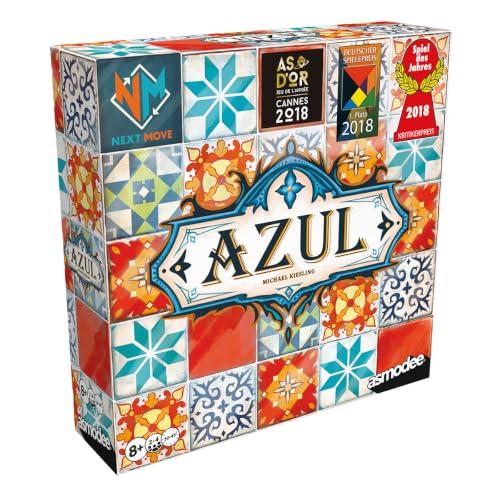
Five major awards in 2018, and a draft where you must take every tile of the color you want -- including the ones you cannot use.
A tile-drafting game for 2-4 players. You take every tile of one color from a shared supply and arrange them in rows, then move one tile from each filled row onto a 5x5 board where it scores by where it sits relative to the others. Rounds continue until a player completes a row across their board, with bonuses for complete rows, columns and full color sets. Designed by Michael Kiesling, published by Plan B Games in 2017.
Players
2-4
Playing time
30-45 minutes
Designer
Michael Kiesling
Publisher
Plan B Games
Published
2017
Who should skip it
Skip it if you want a game built only for two. Plan B Games lists 2-4, and a two-player-only Azul exists separately as Azul Duel.
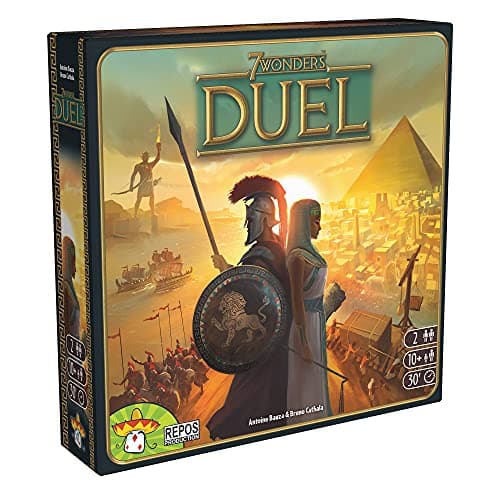
The strongest all-round two-player game in print, and the one most couples settle on.
A two-player-only card drafting game where each side builds a civilization across three ages. Three ways to win -- civilian points, military supremacy and scientific dominance -- run at once, so every card you take is also a card denied.
Players
2
Playing time
30 minutes
Age
10+
Designer
Antoine Bauza and Bruno Cathala
Publisher
Repos Production
Published
2015
Who should skip it
Skip it if you want a relaxing evening. Three win conditions run at once, so you are always watching what the other person is about to do.
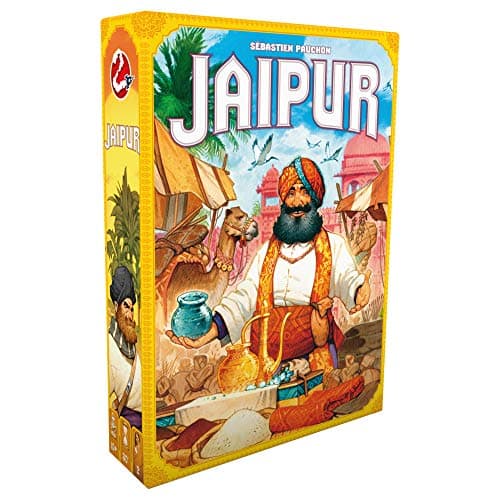
The best first two-player card game there is: five minutes to teach, and it keeps giving for years.
A two-player-only trading card game. You collect and sell goods in sets, racing the other trader for bonus tokens that shrink as they are taken. Best of three rounds decides it.
Players
2
Playing time
30 minutes
Age
10+
Designer
Sebastien Pauchon
Publisher
Asmodee / GameWorks
Published
2009
Who should skip it
Skip it if you want a board on the table. This is cards and tokens, and it looks slight next to a game with a map.
It works and it is officially supported -- the original is recommended for 2-5 players -- but it is the least contested of the big gateway games at two. Below a stated player threshold only one of each pair of parallel double routes may be claimed, which helps, but the map itself does not shrink, so two players have a lot of track and little reason to fight over the same connections.
+−Does Ticket to Ride change the rules for 2 players?
One rule does change: below a stated threshold of players, only one of each pair of parallel double routes may be claimed. The threshold is not given by any source we could reach, so we do not print a number -- it is in the rulebook in the box. Nothing about the board, the cities or the route network changes.
+−Which Ticket to Ride is best for 2 players?
The editions designed for low counts are Nordic Countries and Switzerland, both recommended for 2-3 players, and a review quoted in the reference entry calls Switzerland ideal for two. But neither is currently purchasable standalone: Switzerland now ships only as a combined India and Switzerland expansion that requires a base game, and we found no live standalone Nordic Countries listing. In practice, buy the base game or buy a game designed for two.
+−Can you play Ticket to Ride with 2 players?
Yes, with no house rules needed. Two players is within the recommended 2-5 range for the original game, and the double-route restriction exists specifically to adjust for lower player counts.
+−What age is Ticket to Ride for?
Ages 8 and up per the reference entry. That is the second-lowest rating of any game covered here, behind Carcassonne at 7+, and it makes this a genuine family box rather than an adult game a child tags along with.
+−Is Ticket to Ride or Azul better for two players?
Azul, if you are choosing purely on the two-player game: its setup reduces the shared tile supply with the player count, so the competition survives, while Ticket to Ride's board does not shrink. Ticket to Ride wins on flexibility -- five seats against four, and an 8+ rating against an age rating no reachable source states for Azul.
+−Does Ticket to Ride have a solo mode?
No solo mode is stated for the base game in any source we could reach. Of the games covered here, only Gloomhaven: Jaws of the Lion has a publisher-stated minimum of one player.