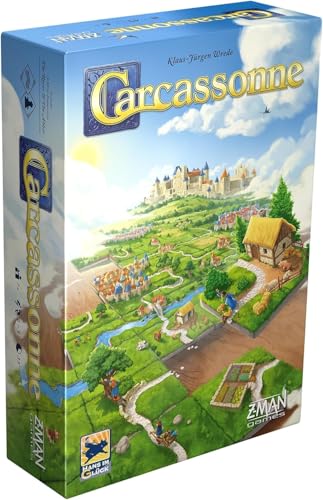
Yes, with one caveat worth knowing before you buy: Z-Man Games publishes Carcassonne for 2-5 players, but nothing in its setup scales down. The same 72-tile stack and the same eight followers each are used at two as at five, so a pair gets a longer, calmer, more buildable game with far fewer contested placements. Buy it if that appeals and you want a 7+ game the whole family can play; buy a two-player-only design if you want every turn to be a fight.
We earn a commission when you buy through links on this page, at no extra cost to you. It does not change which games we recommend or what we say about them. How this site is funded.
Carcassonne is one of the three or four games that almost everyone who plays board games owns, and the question of whether it works for a pair gets asked constantly. The usual answer is "yes, it's fine" or "no, it's better with more", and neither is useful, because neither explains what actually changes.
The answer here is unusually concrete, and it is a fact about the box rather than an opinion about the game: Carcassonne's setup does not change with the player count at all. Not the tile stack, not the follower count, nothing. That one fact drives everything about how it plays at two, and it is also what separates it from the other two gateway games we have examined this way.
We have not played it. The specifications come from Z-Man Games' own product page, the game's reference entry and a rules reproduction, all cited at the bottom. Where a figure conflicts between sources, the publisher's is the one used and the conflict is stated.
01
The short answer, and the verified specs
Carcassonne -- 2-5 players, 30-45 minutes, ages 7+. Klaus-Jurgen Wrede, Hans im Gluck, first released 2000; Z-Man Games publishes the current English edition.
Contents: 72 land tiles, 40 meeples, 12 river tiles, 5 abbots, 1 scoreboard and the rulebook. One land tile is the start tile and the rest are shuffled face down.
Each player takes 8 followers of their color and puts one on the scoreboard as a score marker, leaving 7 to place.
NOTHING in the setup changes with the player count. The same tile stack, the same follower count, the same start tile. There is no two-player variant in the base rules.
At 7+, this is the lowest age rating of any game covered on this site.
On this site's labeling it is Plays at two, not Built for two, and it has no publisher-stated solo mode.
02
How we judged this, and what the other two taught us
This is the third 2-N gateway game we have put through the same three questions, and the pattern across the three is more useful than any one answer.
First: does the publisher actually state that two players is supported, or is two a fan variant? Carcassonne passes without qualification -- Z-Man Games lists 2-5.
Second: does the shared supply scale down? This is the question that separates games that merely tolerate a pair from games that still feel contested. Azul passes it -- its setup reduces the number of factory displays with the player count, so the tile supply shrinks for a pair and the squeeze survives. Splendor half-passes -- three tokens of each gem color come out leaving four, but the 90 development cards and the face-up market are unchanged. Carcassonne does not pass it at all: there is no player-count-dependent setup anywhere in the rules.
Third: is there a design by the same publisher built for exactly two? For Azul the answer is Azul Duel, for Splendor it is Splendor Duel, and for Carcassonne the answer is complicated enough to need its own section near the end.
So the ranking of the three at two players falls out of the second question: Azul tightens, Splendor loosens on one axis, and Carcassonne loosens on every axis. That does not make Carcassonne a bad two-player game -- it makes it a different one, and the next two sections are about what you actually get.
03
What not scaling actually does: you each place far more tiles
The tile stack is Carcassonne's clock. The game ends on the turn the last tile is placed, and there are 72 land tiles regardless of how many people are at the table. So the number of turns in a game is fixed, and the only thing the player count changes is how those turns are divided.
At five players you each place roughly fourteen or fifteen tiles. At two you each place roughly half the stack. That is not a small difference -- it is the difference between a game where you take what you are given and a game where you can actually execute a plan over a dozen turns.
The reference entry makes the same point from the other direction, and it is worth quoting the sense of it: conserving followers matters more with fewer players, precisely because each player places more tiles. With seven followers to cover thirty-six placements, committing a knight to a city that may never close is a more expensive mistake at two than at five, where you were going to run out of turns before you ran out of meeples.
So the skill at two shifts from opportunism to patience. You have time to build a large city, and you also have to decide when to free a follower rather than chase one more point. People who find Carcassonne shallow at a full table often find this version of it considerably more interesting.
04
The cost: the board sprawls and nobody is in your way
Here is the honest downside, and it follows from the same fact. Carcassonne's interaction is almost entirely about placement -- putting a tile where it blocks someone's city from closing, or dropping a knight into a city you can share, or taking the one spot that would have completed a road. All of that depends on there being enough other people to create congestion.
At two, there is half as much congestion. The board grows outward with far less contest over any given edge, your opponent's half of it is often somewhere you have no reason to go, and the games can drift toward two people building side by side rather than over each other. Nothing in the rules prevents you from playing aggressively, but the geometry stops forcing it.
The scoring rules sharpen that effect in one specific place worth knowing. Fields do not score during the game at all -- farmers stay on the board, and at the end only fields touching completed cities score, three points to whoever has the most farmers on the adjoining fields. With five players that is a genuine scramble. With two it is a head-to-head that is often decided by one placement.
None of this is a defect. It is the predictable result of a design that was balanced for a crowded board being handed to two people, and a buyer deserves to know it before spending rather than after.
05
The publisher did make a two-player Carcassonne, and you probably cannot buy it
This is where Carcassonne differs most from the other two games in this series, and it is the one place the usual recommendation on this site does not work.
For Azul the answer to "I only ever play at two" is Azul Duel, published by Next Move Games in 2025 for exactly two players and in print. For Splendor it is Splendor Duel, published by Space Cowboys in 2022 for exactly two and in print. Both are standalone, both are easy to buy, and both are reviewed here.
Carcassonne's equivalent exists on paper: the game's reference entry names Carcassonne: The Castle, a 2003 two-player spin-off designed by Reiner Knizia. But we could not find a live listing for it through the retailer this site links, so there is nothing we can honestly send you to buy. We are naming it rather than hiding it, because knowing a thing exists is useful even when the answer is that it is not currently available.
The practical consequence: if you want a tile game built for exactly two, the realistic purchase is not a Carcassonne at all. It is Azul Duel, where the draft was rebuilt around having a single opponent, or Patchwork, if what you actually want is tile-laying with no interference whatsoever.
06
What Carcassonne has that the alternatives do not
Two things, and for a lot of households they decide it.
The first is the age rating. Z-Man Games rates Carcassonne 7 and up, which is the lowest of any game covered on this site -- lower than Patchwork and Santorini at 8+, and three years below the 10+ that most of the shelf carries. If there is a young child who will eventually be playing, this is the game that takes them earliest, and the tile-matching rule is genuinely teachable to a seven-year-old in a way that a card economy is not.
The second is the seat count. It plays up to five, which is more than Azul's four and more than Splendor's four. A box that covers two people on a Tuesday and five at a family gathering is doing work that no two-player-only game can do, and that flexibility is worth more than a slightly tighter duel to plenty of buyers.
There is also the matter of what you get for the money. The box includes the River mini-expansion's 12 tiles and 5 abbots alongside the 72 base tiles, so there is more in it than the base game strictly needs -- which is unusual at this price and gives a pair something to add once the plain game is familiar.
One conflict to flag, since this page is about trusting figures. Z-Man Games states 30-45 minutes; the reference entry says 30-90 and the retail listing says 35. We use the publisher's range, but note that the 72-tile stack has to be emptied regardless of player count, so a two-player game does not get shorter just because there are fewer of you.
07
Who each pick is for
Carcassonne -- best for the household that wants one box covering two players and up to five, and best of all if a child as young as seven will be playing. 2-5 players, 30-45 minutes, 7+, and the River tiles are included. Honest downside: nothing scales down, so at two the board sprawls with half the contested placements and the game is calmer rather than tighter.
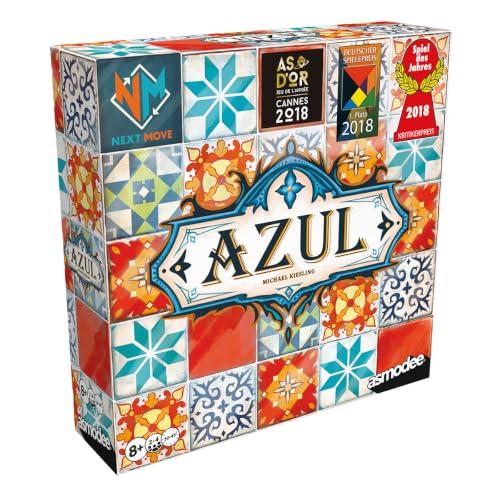
Azul -- best for the pair who want a 2-4 tile game that actually scales for two. Its setup reduces the number of factory displays with the player count, so the draft stays squeezed, and the take-every-tile-of-one-color rule means you can deny your opponent on purpose. Honest downside: no reachable source states its age rating, and it tops out at four seats rather than five.
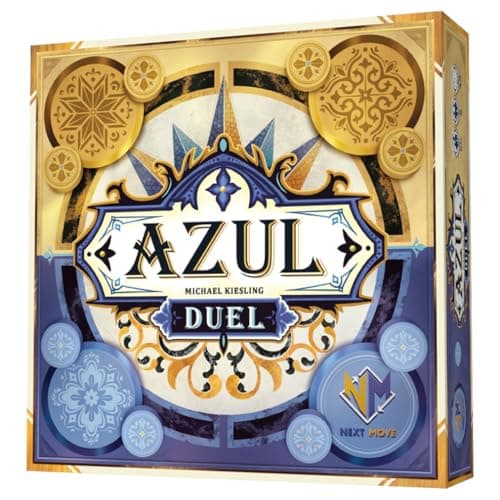
Azul Duel -- best for the pair who want tile drafting built for exactly two. Next Move Games, 2025, exactly 2 players, 45 minutes, 10+, with a draft rebuilt so you choose the order your leftovers are stacked for your opponent. Honest downside: a clear step up in rules, no track record yet, and it will never seat a third.
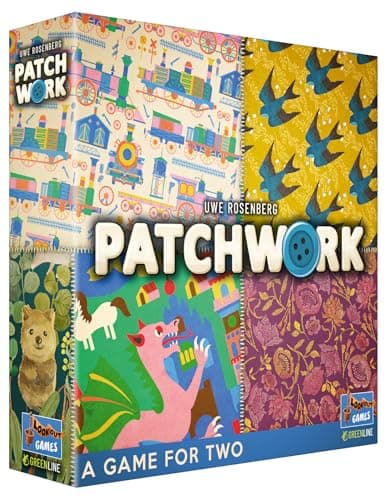
Patchwork -- best for the pair who want tile-laying with no interference at all. Lookout Games, exactly 2 players, about 30 minutes, 8+, and nothing in it lets either player touch the other's board. Honest downside: it is a spatial puzzle first, and the absence of interaction that makes it safe makes it feel cold to some pairs.
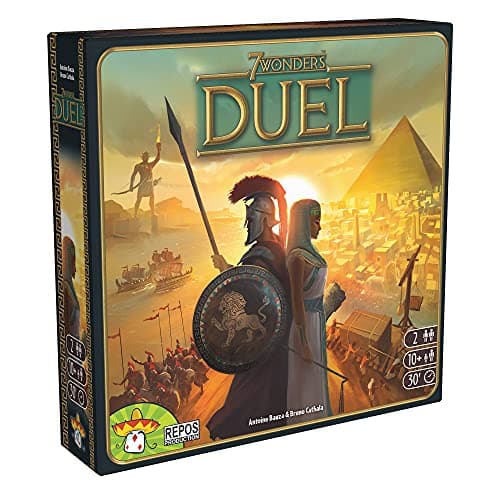
7 Wonders Duel -- best for the pair who read this page and decided they want every turn contested. Repos Production, exactly 2 players, 30 minutes, 10+, almost no luck and three win conditions running at once. Honest downside: the densest teach of these, and with so little luck a stronger player wins consistently.
What we would buy
Picks drawn from the games covered on this site, chosen against the criteria above.
We earn a commission when you buy through links on this page, at no extra cost to you. It does not change which games we recommend or what we say about them. How this site is funded.
The gateway tile-layer, and the one game here whose setup does not change at two at all -- you get the whole 72-tile stack between you, which makes it longer and calmer rather than tighter.
A tile-laying game for 2-5 players. You draw and place a land tile so its roads, cities and fields match their neighbors, then optionally place one of your followers on it as a thief, knight, monk or farmer. Completed roads, cities and monasteries score during play; incomplete ones and the farmers score at the end, and the game ends on the turn the last tile is placed. 72 land tiles, 40 meeples, 12 river tiles, 5 abbots and a scoreboard. Setup does not change with the player count.
Players
2-5
Playing time
30-45 minutes
Age
7+
Designer
Klaus-Jurgen Wrede
Publisher
Hans im Gluck / Z-Man Games
Published
2000
Who should skip it
Skip it if you want every turn contested. Nothing is scaled down for a pair, so the board sprawls with half the competition for placements, and a two-player-only design will give you more friction per turn.
Five major awards in 2018, and a draft where you must take every tile of the color you want -- including the ones you cannot use.
A tile-drafting game for 2-4 players. You take every tile of one color from a shared supply and arrange them in rows, then move one tile from each filled row onto a 5x5 board where it scores by where it sits relative to the others. Rounds continue until a player completes a row across their board, with bonuses for complete rows, columns and full color sets. Designed by Michael Kiesling, published by Plan B Games in 2017.
Players
2-4
Playing time
30-45 minutes
Designer
Michael Kiesling
Publisher
Plan B Games
Published
2017
Who should skip it
Skip it if you want a game built only for two. Plan B Games lists 2-4, and a two-player-only Azul exists separately as Azul Duel.
The Azul family built for exactly two, and the first game here where you draft a tile and decide what the other person is allowed to reach next.
A two-player-only tile-drafting game in the Azul family. You take every tile of one color from a factory's sun side, then choose the order the leftovers are stacked onto its moon side for your opponent to pick over. Tiles fill a single pattern line at a time and move onto dome tiles that score by row and column, across five rounds. Published by Next Move Games for exactly 2 players at 45 minutes.
Players
2
Playing time
45 minutes
Age
10+
Designer
Michael Kiesling
Publisher
Next Move Games
Published
2025
Who should skip it
Skip it if you want the game everyone recognizes. This is the newer, sharper box; the 2017 Azul is the one your guests have heard of and the one that seats four.
The gentlest good game on this site. Two quilts, no attacking, and a surprisingly sharp puzzle underneath.
A two-player-only tile-laying game. You buy fabric patches on a shared time track and fit them onto a personal 9x9 quilt board, paying with buttons and with time.
Players
2
Playing time
about 30 minutes
Age
8+
Designer
Uwe Rosenberg
Publisher
Lookout Games
Published
2014
Who should skip it
Skip it if you want to interact. You are mostly solving your own board, and the only contact is who takes which patch first.
The strongest all-round two-player game in print, and the one most couples settle on.
A two-player-only card drafting game where each side builds a civilization across three ages. Three ways to win -- civilian points, military supremacy and scientific dominance -- run at once, so every card you take is also a card denied.
Players
2
Playing time
30 minutes
Age
10+
Designer
Antoine Bauza and Bruno Cathala
Publisher
Repos Production
Published
2015
Who should skip it
Skip it if you want a relaxing evening. Three win conditions run at once, so you are always watching what the other person is about to do.
Yes, and it is officially supported -- Z-Man Games publishes it for 2-5. The thing to know is that nothing in the setup scales down: the same 72-tile stack and the same eight followers each are used at two as at five. So a pair each place roughly half the stack, which gives you time to execute a plan, but the board sprawls with far fewer contested placements than the design assumes.
+−Does Carcassonne setup change for 2 players?
No. There is no player-count-dependent setup anywhere in the base rules. The start tile goes down, the remaining tiles are shuffled face down, and each player takes 8 followers with one placed on the scoreboard as a score marker. Compare Azul, which reduces the number of factory displays at two, and Splendor, which removes three tokens of each gem color.
+−Is there a two-player version of Carcassonne?
The game's reference entry names Carcassonne: The Castle, a 2003 two-player spin-off designed by Reiner Knizia. We could not find a live listing for it through the retailer we link, so we do not recommend it as a purchase. If you want a tile game built for exactly two, Azul Duel or Patchwork are the realistic options.
+−How long does Carcassonne take with 2 players?
Z-Man Games gives 30-45 minutes for the game generally; the reference entry says 30-90 and the retail listing says 35, so treat the range loosely. What is certain is that the 72-tile stack has to be emptied regardless of player count, so a two-player game does not get shorter for having fewer people in it.
+−What age is Carcassonne for?
Z-Man Games rates it 7 and up, which is the lowest age rating of any game covered on this site -- Patchwork and Santorini are 8+ and most of the shelf is 10+. The tile-matching rule is the part that makes it teachable that young.
+−Is Carcassonne or Azul better for two players?
Azul, if you are choosing purely on the two-player game. Azul's setup reduces its shared tile supply with the player count so the draft stays contested, while Carcassonne's does not scale at all. Carcassonne wins on flexibility instead: 7+ against an unstated age rating, and up to five seats against four.
+−Does Carcassonne have a solo mode?
No solo mode is stated by the publisher. Of the games covered here, only Gloomhaven: Jaws of the Lion has a publisher-stated minimum of one player.