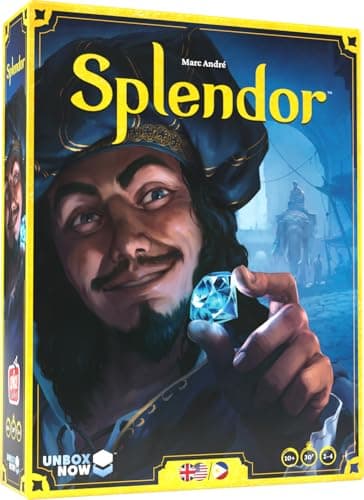
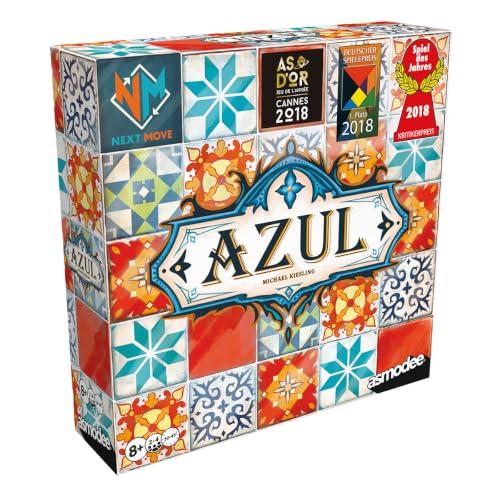
For a pair, buy Azul. Both are 2-4 gateway games at around half an hour, but Azul's setup scales its shared tile supply down with the player count, so two players get a tighter game -- while Splendor scales only its tokens and leaves its card market at full size, which makes it looser at two than at a full table. Buy Splendor instead if you want the engine-building arc, or a Duel edition if two is all you will ever play.
We earn a commission when you buy through links on this page, at no extra cost to you. It does not change which games we recommend or what we say about them. How this site is funded.
These two get compared more than almost any other pair of modern board games, and for good reason: they are the two games most often handed to someone who says they do not play board games, they both finish inside about half an hour, they both teach in minutes, and they sit in the same price bracket. If you are buying one good-looking gateway game, these are the two on the shelf.
Almost every comparison of them is written for a table of four, which is where this one differs. Plan B Games publishes Azul for 2-4 and Space Cowboys publishes Splendor for 2-4, so for a pair the interesting question is not which is better in general -- it is which of them actually survives being scaled down to two people. That turns out to have a clear answer, and it is not the one the general reputation of the two games would predict.
We have not played either game. Specifications come from each publisher's own page and each game's reference entry, with the two-player setup details from a rules reproduction, all cited at the bottom. Where no reachable source states a figure, this page does not print one.
Quick picks
#
Game
Players
Time
Price
1
Azul
Five major awards in 2018, and a draft where you must take every tile of the color you want -- including the ones you cannot use.
The gateway engine builder, and it does scale down honestly -- but only the tokens shrink at two, not the card market, so it loosens where Splendor Duel tightens.
Player counts and playing times come from each publisher, cited on that game's review page. Tap a row to jump to the full write-up.
01
The verified specs
Azul -- 2-4 players, 30-45 minutes. Michael Kiesling, Plan B Games, 2017. Winner of the 2018 Spiel des Jahres plus five further major awards. No reachable source states an age rating.
Splendor -- 2-4 players, 30 minutes, ages 10+. Marc Andre, Space Cowboys, 2014. 90 Development cards, 10 Noble tiles, 7 tokens in each of five gem colors plus 5 gold.
At two players, Splendor removes three tokens of each gem color, leaving four of each, keeps all five gold, and reveals three nobles instead of five. Its 90 Development cards and face-up market do NOT change.
At two players, Azul reduces the number of factory displays, which is the mechanism by which its shared tile supply scales with the player count.
Both are Plays at two on this site's labeling -- neither was built for two. Each has a separate two-player-only sibling: Azul Duel (2025) and Splendor Duel (2022). Neither base game has a publisher-stated solo mode.
02
How we judged this, since both are 2-4
When both candidates support the same player range, the usual criteria stop separating them and one question does all the work: what does the game remove when there are only two of you, and does removing it make the game tighter or looser?
That matters because contention is what makes both of these games interesting. In each one the fun is that you want something from a shared supply and cannot have all of it. At four players the supply is picked over constantly, so scarcity comes free. At two it has to be engineered, either by shrinking the supply or by living with a supply that is suddenly generous.
So the three things we looked at, in order: does the shared supply scale down, does the game's other half also scale, and what does the mismatch do to a two-player game. Teach time, components and price come after that, because both games are light and good-looking and neither wins those by enough to decide anything.
03
Azul scales the thing that matters
Azul's central rule is the reason it works at two. When you take tiles, you take every tile of the one color you have chosen from the one place you have chosen -- all of them, whether or not you can use them -- and whatever will not fit in your rows is discarded at a cost in points. The pressure is permanent: getting what you need usually means taking more than you can place.
The setup then scales the shared supply with the player count by reducing the number of factory displays, so a pair is not drafting from a table laid out for four. That is the right lever to pull, because the supply is the whole game. Fewer places to take from means fewer safe takes, which means the squeeze survives the drop to two.
We are deliberately not printing the exact number of displays for a two-player game. The reference entry we work from does not state the per-player-count setup, Plan B Games' own domain now redirects elsewhere and Asmodee's product page renders empty, so the figure is in the rulebook in the box and not in anything we can cite. The principle is not in doubt; the number is not ours to invent.
What a pair actually gets is a sharper game than four players get. With one opponent you can see exactly which color they are building toward, so you can take it purely to deny them and force them to pick up tiles they will discard at a penalty. Good two-player Azul is largely about making the other person waste a turn, which is a more pointed game than the scramble at a crowded table.
04
Splendor scales half the game
Splendor does bother with a two-player setup, and that deserves credit: you remove three tokens of each gem color so only four of each remain, the five gold jokers stay in, and you reveal three noble tiles instead of five. The economy runs on gem tokens, so cutting the supply is aimed at the right place and it works.
Then the other half of the game does not move. The 90 Development cards and the face-up market you buy them from are identical at two players and at four. So two people pick over a card market built for four, and the card you were saving toward is far more likely to still be there when your turn comes back.
The result is a split personality at two. Token competition stays sharp because the supply was deliberately cut. Card competition drops by half because it was not. Splendor at two is therefore more buildable and more plannable than Splendor at four -- and if what you wanted was a contested duel, that is the problem. Your engine runs with less interference than the design assumes.
There is a second, smaller consequence worth knowing because it changes a turn. One of Splendor's actions is to take two gem tokens of the same color, and it is legal only if at least four of that color remain. At two players there are only four of each to begin with, so the action is available while a color sits at full strength and closes the moment anyone takes from it. A tool that is routine at four becomes occasional at two.
05
So the verdict, and the honest limit on it
For a pair, Azul. It scales the part of itself that generates the tension, and it rewards reading one opponent in a way that a four-player game cannot. Splendor scales its tokens and leaves its cards, so it loosens exactly where you wanted it to tighten.
The honest limit on that verdict is that "looser" is not the same as "worse", and some buyers want precisely what Splendor at two delivers. If your ideal half hour is building a gem engine without being constantly disrupted -- watching cheap early cards make expensive later ones reachable, with nobody snatching the card you planned around -- Splendor at two is a genuinely pleasant game and the reduced contention is a feature. We would not call that a mistake, only a different preference, and it is worth knowing which one you are before you buy.
The other thing Splendor has is the arc. It is one continuous race to 15 prestige points, with reaching that total triggering a final round rather than ending the game on the spot, and the compounding discounts mean the last few turns feel very different from the first few. Azul's rounds are structurally the same from start to finish; its variety comes from the board, not from a build.
06
Teach time, components and price
Both are light and the gap is small. Azul is marginally simpler to start: you take tiles, you put them in rows, filled rows move a tile onto your board and surplus is discarded. Splendor needs the card rows across three levels, the permanent discounts, the nobles and the ten-token limit laid out first. Call it five minutes against ten -- neither is an obstacle.
On components, Azul is the one people reach for. The acrylic tiles have a weight and finish that get picked up before anyone has read a rule, and the finished mosaic is the reason the game gets agreed to a second time. Splendor's weighted gem chips are its own answer to this and they are genuinely satisfying, but the board is functional rather than beautiful.
Both sit in the same mid price bracket, with live figures in the table above and the date we read them, so price is not a deciding factor between these two. Azul's award record is the more persuasive extra: the 2018 Spiel des Jahres plus the As d'Or, Origins Best Family Game and Fan Favorite, a Dice Tower award and a Mensa Select certification. Splendor has no comparable shelf.
One honest gap on Azul's side: no reachable source states an age rating for it, while Space Cowboys rates Splendor 10 and up. If you are buying with a specific child in mind, that asymmetry matters and the answer is to read the Azul box rather than trust this page.
07
If two is all you will ever play, neither of these is the answer
Both games have a two-player-only sibling, and for a household that will never seat a third person the sibling is the better purchase in each case. This is the point this site exists to make, so it would be strange to bury it.
Next Move Games published Azul Duel in 2025 for exactly 2 players at 45 minutes, ages 10+, standalone. It rebuilds the draft around having one opponent: each factory has a sun side and a moon side, and when you take all tiles of one color from the sun side you choose the order the leftovers are stacked onto the moon for your opponent to pick over. That rule is meaningless with a third player.
Space Cowboys published Splendor Duel in 2022 for exactly 2 players at 30 minutes, ages 10+, standalone. Its tokens sit on a shared grid and you may take up to three that form an uninterrupted line, which engineers the contention the base game loses at two, and three live victory conditions replace the single 15-point finish line.
So the full decision tree is short. Need the box to seat three or four? Azul is the better of these two at two players, and Splendor is the better one if you want the engine arc. Only ever two? Buy the Duel edition of whichever of the two families appeals -- tiles or gems -- and we have a review of each.
08
Pick this if
Pick Azul if you want the better of the two at two players, if the components and the award record matter to you, or if you want a draft where denying your opponent a color is a real move. 2-4 players, 30-45 minutes, Spiel des Jahres winner. Honest downsides: no reachable source states its age rating, its turn shape never changes across a game, and it is Plays at two rather than built for two.
Pick Splendor if you want the engine-building arc -- early cheap cards making late expensive ones reachable -- or if you specifically want a calmer two-player game with less interference. 2-4 players, 30 minutes, 10+. Honest downsides: only its tokens scale at two while its card market does not, so it plays looser than at a full table, and the take-two-of-one-color action becomes situational.
Pick Azul Duel if the tiles appeal and two is all you will ever play. Built for exactly two, 45 minutes, 10+, with a draft rebuilt for one opponent. Honest downside: a clear step up in rules from Azul, and no track record yet.
Pick Splendor Duel if the gems appeal and two is all you will ever play. Built for exactly two, 30 minutes, 10+, with a shared token grid and three live win conditions. Honest downside: it can end before your plan pays off, which some pairs dislike.
Five major awards in 2018, and a draft where you must take every tile of the color you want -- including the ones you cannot use.
A tile-drafting game for 2-4 players. You take every tile of one color from a shared supply and arrange them in rows, then move one tile from each filled row onto a 5x5 board where it scores by where it sits relative to the others. Rounds continue until a player completes a row across their board, with bonuses for complete rows, columns and full color sets. Designed by Michael Kiesling, published by Plan B Games in 2017.
Players
2-4
Playing time
30-45 minutes
Designer
Michael Kiesling
Publisher
Plan B Games
Published
2017
Who should skip it
Skip it if you want a game built only for two. Plan B Games lists 2-4, and a two-player-only Azul exists separately as Azul Duel.
The gateway engine builder, and it does scale down honestly -- but only the tokens shrink at two, not the card market, so it loosens where Splendor Duel tightens.
A gem-trading engine builder for 2-4 players. One action per turn: take gem tokens, reserve a development card and take a gold joker, or buy a card. Cards grant permanent gem bonuses that make later cards cheaper, and the first player to reach 15 prestige points triggers the final round. 90 Development cards, 10 Noble tiles, 7 tokens in each of five gem colors plus 5 gold. At two players three tokens of each gem color are removed, leaving four of each.
Players
2-4
Playing time
30 minutes
Age
10+
Designer
Marc Andre
Publisher
Space Cowboys
Published
2014
Who should skip it
Skip it if the two of you are the only people who will ever play. Space Cowboys publishes Splendor Duel for exactly two, and it is the better two-player game by a clear margin.
Azul. Both are published for 2-4, but Azul's setup scales its shared tile supply down with the player count, so a pair still gets a contested game. Splendor scales its gem tokens and leaves its 90 Development cards and card market at full size, so card competition drops at two and the game plays looser than at a full table.
+−Does Splendor work with 2 players?
Yes, and it has a dedicated two-player setup: remove three tokens of each gem color leaving four of each, keep all five gold, and reveal three nobles instead of five. The caveat is that the card market does not scale, so there is less competition for cards than the design assumes.
+−Which is easier to learn, Azul or Splendor?
Azul, marginally. Take every tile of one color from one place, fill rows, move a tile to your board, discard the surplus at a cost. Splendor needs the three card levels, the permanent discounts, the nobles and the ten-token limit explained first -- roughly ten minutes against five.
+−Which has better components?
Azul, for most people: the acrylic tiles get picked up before anyone reads a rule, and the finished mosaic is part of the appeal. Splendor's weighted gem chips are genuinely good, but its board is functional rather than beautiful.
+−Should I buy Azul Duel or Splendor Duel instead?
If two players is all you will ever play, yes -- both are standalone two-player-only games from the same families, and each engineers the contention its base game loses at two. Buy Azul Duel for the tile draft or Splendor Duel for the gem economy. Buy a base game instead only if the box needs to seat three or four.
+−Is Azul or Splendor better for a child?
Space Cowboys rates Splendor 10 and up. No reachable source states an age rating for Azul at all, so we do not print one -- read the box if that is the deciding factor. Both are light enough in rules that comprehension rather than content is the limit.
+−Which one has more replay value for a pair?
Azul's advanced placement mode, where you may place colors anywhere rather than in the positions the board dictates, is effectively a second and harder game inside the box. Splendor's variety comes from which cards and nobles appear, plus the shape of the engine you build, which changes the arc more than the decisions.