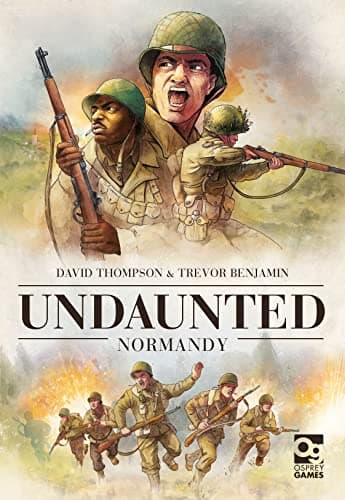
Undaunted: Normandy is worth it for a pair who want a real war game without a rulebook the size of a novel: Osprey Games lists it for exactly 2 players at 45-60 minutes, ages 14 and up, with a twelve-scenario campaign. It is not worth it if permanent losses frustrate you, because every casualty removes a card from your deck for good.
We earn a commission when you buy through links on this page, at no extra cost to you. It does not change which games we recommend or what we say about them. How this site is funded.
Undaunted: Normandy is the game we point people at when they say they want to try a war game and have been put off by every war game they have looked at. It is the rare one that does not ask you to learn a hex grid, a terrain chart and six pages of combat modifiers before the first shot.
It is also the game most likely to be bought for the wrong reason. People buy it because it is well reviewed and because deck-building is familiar, and some of them discover that what the design is actually about -- losing things permanently -- is not what they wanted from an evening. This page is about telling those two groups apart before anyone spends.
01
What you are actually paying for
A two-player-only deck-building war game published by Osprey Games, designed by David Thompson and Trevor Benjamin, illustrated by Roland MacDonald. The publisher states 2 players, 45-60 minutes, ages 14 and up.
The box holds 108 cards, 18 large map tiles, dice, tokens and a campaign booklet. The map is modular -- tiles are laid out per scenario -- so the terrain is different from one scenario to the next rather than a fixed board you memorize.
One side commands American forces and the other German, and the published rules describe a campaign of twelve scenarios, with further bonus scenarios published separately by Osprey. You can also simply replay a single scenario; the campaign is a structure, not a legacy game that consumes components.
02
Your deck is your squad, and that is the whole idea
In most deck-builders the cards are an abstraction -- resources, purchases, points. Here each card is a soldier, and the deck you shuffle is the squad you have available. Drawing a rifleman means that rifleman is reachable this turn; not drawing them means they are somewhere else.
The consequence is the line the publisher itself leads with: every casualty you take removes a card from your deck. Not discarded, not disabled -- removed. A squad that gets shot up early is a squad you will be short of for the rest of the scenario, and the deck you are drawing from gets thinner and less useful every time you are hit.
That single rule does more thematic work than any amount of terrain modifiers. Losses accumulate, pressure compounds, and a scenario that is going badly feels like a scenario going badly rather than a spreadsheet trending down. If you want to know whether a war game can be elegant, this is the argument.
You are not helpless about it. A Bolster action pulls cards from your reserve into your discard pile, so you can reinforce -- but reinforcing costs you the action you might have used to move or shoot, which is the trade the game keeps asking you to make.
03
Fog of War is the clever part
The mechanism most worth understanding before buying is the one that stops this from being a game of perfect information. Scouting -- moving into unscouted tiles and placing control markers -- is how you open up the board and how you claim ground. It also hands you a Fog of War card for each control marker you place.
Fog of War cards are dead weight. Per the published rules they carry no actions and the lowest initiative value, and they go into your deck. So the act of pushing forward literally clogs the deck you are drawing from, and an aggressive advance makes your next few hands worse. The only way to clear them out is a Scout's Recon action, which again costs you a turn's worth of doing something else.
That is an unusually honest piece of design. Advancing into unknown ground should cost you clarity, and here it does -- in the most direct way a card game can express it.
04
The initiative bid, and why every round has a real cost
Each round both players secretly choose one card from their hand and reveal it at the same time. The higher initiative value takes the initiative marker and decides who acts first.
The catch is that the card you bid is spent. It goes to the discard pile and you do not get to use its action this round. So winning initiative means burning a card you might have wanted, and the bid is genuinely painful when your hand is good and genuinely easy when your hand is full of Fog of War.
It is a small rule with a long tail. It means a bad hand is not purely bad -- it is cheap to bid from -- and it means the player who is winning on the board is often the player choosing whether that lead is worth a card.
05
The two households where it is not worth it
First, and this is the one we print on every page that features it: skip it if losing a unit permanently for the rest of a scenario will frustrate you. Casualties thin your deck, so a bad turn keeps costing you for the next forty minutes. Some players find that the most compelling thing in the box. Others find it demoralizing in a way that a points deficit never is, and no amount of appreciating the design fixes that reaction.
Second, the commitment is real. Osprey states 45-60 minutes and ages 14 and up -- the longest and the oldest-rated of the competitive games we cover. If your evenings are short or unpredictable, a game you cannot reliably finish is a game that stops coming off the shelf, and Onitama or Jaipur will get played twenty times while this gets played twice.
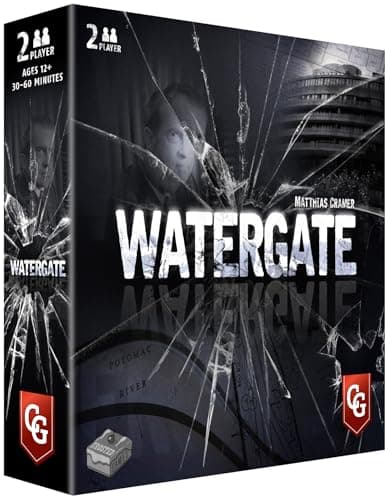
There is a third consideration that is not a flaw but is worth naming: it is a World War II game, and the theme is treated seriously rather than as set dressing. If a household would rather not spend an evening on that subject, that is a perfectly good reason to buy something else, and Watergate is the political-conflict alternative on this site that scratches a similar asymmetric itch at 30 to 60 minutes.
06
Normandy or North Africa first?
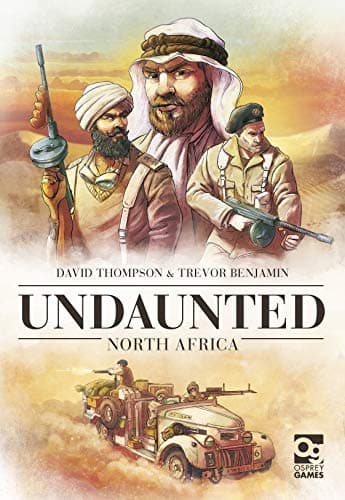
This is the question that follows immediately, because Osprey publishes both and they are standalone -- neither requires the other. North Africa is the shorter game: the publisher states 30-45 minutes against Normandy's 45-60, with the same designers and the same core system.
If you are buying exactly one and your evenings are tight, North Africa fits a weeknight better. Buy Normandy if the European theater is the setting that appeals to you, or if you want the longer scenarios. Neither is the beginner version of the other; they are two campaigns on one engine, and the prices move independently, so compare both buy buttons rather than assuming they match.
Owning both gives you two campaigns rather than two games. That is worth doing if the system clicks, and worth knowing before you buy the second box expecting something structurally new.
07
If you have never played a war game
This is the strongest case for the purchase. The deck-building frame means you already understand most of the game if you have played anything modern: draw a hand, play cards, manage a deck that changes over time. There is no combat results table to consult and no stack of modifiers to total up.
What you get in exchange for that low entry cost is genuine squad tactics -- covering fire, controlling ground, deciding whether to push into territory you cannot see. It is the least intimidating door into the genre we know of, and the campaign booklet introduces the pieces gradually rather than all at once.
The honest caveat is that it is a door into a genre, not a light game. At a stated 45-60 minutes and 14+, it sits at the heavy end of this site. If what you actually want is a short competitive game for two, this is not a smaller purchase dressed in khaki.
08
What we did instead of playing it
We have not played this. What we did: took the player count, playing time, age, designers, illustrator and box contents from Osprey Games' own page for the game, and took the twelve-scenario campaign, the initiative bid, the Fog of War rules, the Recon removal and the permanent-casualty rule from published reproductions of the rulebook, confirmed against a second independent source. Osprey's own rulebook PDF is published as scanned images with no text layer, so it could not be quoted directly, and we say so rather than implying we read it. Every source is linked below, and no price appears in this prose.
What we would buy
Picks drawn from the games covered on this site, chosen against the criteria above.
We earn a commission when you buy through links on this page, at no extra cost to you. It does not change which games we recommend or what we say about them. How this site is funded.
The best two-player war game in print, and the only one on this list that teaches deck-building and squad tactics at the same time.
A two-player-only deck-building war game. Each side commands American or German forces across a campaign of World War II scenarios, with 108 cards, 18 large map tiles, dice and tokens. Your deck is your squad, and losses thin it permanently.
Players
2
Playing time
45-60 minutes
Age
14+
Designer
David Thompson and Trevor Benjamin
Publisher
Osprey Games
Published
2019
Who should skip it
Skip it if losing a unit permanently for the rest of a scenario will frustrate you. Casualties remove cards from your deck, so a bad turn keeps costing you.
The same engine as Normandy, fifteen minutes shorter, and the better buy if you only want one of the two.
A two-player-only deck-building war game and standalone sequel to Undaunted: Normandy. Desert warfare across a campaign, with 100+ cards, 22 large map tiles, 4 dice and tokens. Shorter scenarios than Normandy at 30-45 minutes.
Players
2
Playing time
30-45 minutes
Age
14+
Designer
David Thompson and Trevor Benjamin
Publisher
Osprey Games
Who should skip it
Skip it if you already own Normandy and expected something new. The core system is identical -- this is a different theater, not a different game.
Asymmetric, historical, and finished inside an hour -- the shortest route into serious card-driven games for two.
A two-player-only asymmetric card-driven game. One side is the Nixon administration, the other the Washington Post, and every card is both an action for you and a resource for the opponent.
Players
2
Playing time
30-60 minutes
Age
12+
Designer
Matthias Cramer
Publisher
Capstone Games
Published
2019
Who should skip it
Skip it if you both want the same experience. The two sides play very differently and one of you will prefer a side.
+−Is Undaunted: Normandy worth it for two players?
Yes, if you want a real war game without a heavy rulebook. Osprey Games publishes it for exactly 2 players at 45-60 minutes, ages 14 and up, with a twelve-scenario campaign. It is not worth it if permanent losses frustrate you.
+−Is Undaunted: Normandy good for beginners?
It is an excellent first war game and a poor first board game. The deck-building frame makes it approachable for anyone who has played modern games, but at a stated 45-60 minutes and 14+ it is one of the heaviest things we cover.
+−Do you need Undaunted: North Africa as well?
No. Both are standalone and neither requires the other. North Africa is shorter at a published 30-45 minutes; Normandy runs 45-60. Owning both gives you two campaigns on the same system rather than two different games.
+−What happens when you lose a unit in Undaunted: Normandy?
Every casualty permanently removes a card from your deck for the rest of that scenario. That is the central mechanism: your deck is your squad, so losses thin what you can draw rather than just costing you points.
+−What are Fog of War cards?
Dead cards that clog your deck, with no actions and the lowest initiative value. You gain one for each control marker you place while scouting, so advancing costs you deck quality. The only way to remove them is a Scout's Recon action.
+−How long does Undaunted: Normandy really take?
The publisher states 45-60 minutes per scenario. Expect the first one or two to run longer while the initiative bid and the scouting rules settle, though the campaign booklet introduces the pieces gradually rather than all at once.