Buy Onitama if you want zero luck and a game that fits in fifteen minutes: Arcane Wonders lists exactly 2 players, 15 minutes, ages 14+. Buy War Chest if you want a main event where a draw keeps results open -- AEG lists 2-4 players, 30-60 minutes, also 14+.
We earn a commission when you buy through links on this page, at no extra cost to you. It does not change which games we recommend or what we say about them. How this site is funded.
Both of these are positional games about moving distinct pieces for advantage, both are rated 14 and up, and both teach in minutes rather than chapters. On a shelf they look like neighbors. In a household they behave like opposites.
Onitama has no luck in it at all once the pieces are set up. Every option is visible to both of you on every turn, so the better player wins and the loser can usually point at the move where it went wrong. War Chest hands you three unit coins out of a bag each round, which means the better player still wins over time but not reliably tonight.
That difference decides more than any feature comparison can. If one of you is clearly stronger, it determines whether the other keeps agreeing to play -- and that, far more often than depth or component quality, is what makes a two-player game stay on the table.
Quick picks
#
Game
Players
Time
Price
1
Onitama
Perfect information, sixteen move cards, and a rules explanation that takes under two minutes.
Player counts and playing times come from each publisher, cited on that game's review page. Tap a row to jump to the full write-up.
01
The question that actually decides this
Is a loss you could have prevented more satisfying than a loss you could not?
Onitama answers yes. There is no hidden information and no randomness after setup, so the game is a pure contest of reading the board. When you lose, it is legible: the mistake is there in hindsight, visible to both of you. Some players find that clarifying, and it is the reason the game rewards study.
War Chest answers no. You draw three coins from your bag each round, so what you are allowed to attempt is decided before you decide how to attempt it. A crisis you can see and cannot answer is a normal part of a game. The skill is in loading the bag and in making the most of an awkward hand, not in calculating a clean line.
Neither answer is better, and both are predictable about yourself before you spend anything. A household with a real skill gap should take the second answer seriously: variance is what lets the weaker player win actual games rather than being handed one.
02
The verified specs, side by side
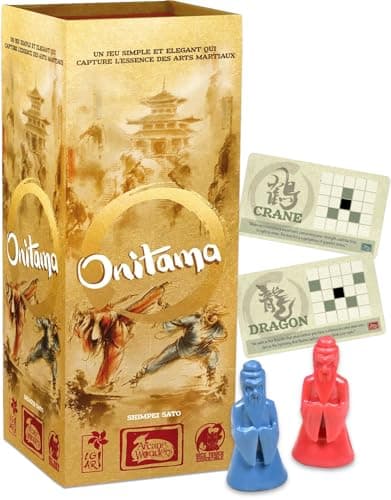
Onitama -- 2 players, 15 minutes, ages 14+. A 5x5 grid, sixteen move cards of which five are in play per game, and a roll-up mat. Arcane Wonders.
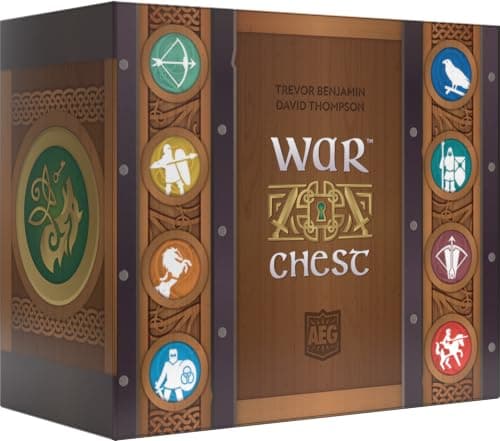
War Chest -- 2-4 players, 30-60 minutes, ages 14+. Trevor Benjamin and David Thompson, Alderac Entertainment Group. The box holds 79 poker-chip-style unit coins, 16 cards, a board, 4 bags, 16 cardboard tokens and a rulebook.
Neither publisher states a release year for its base game and neither names a designer in Onitama's case, so no year appears for either game anywhere on this site and Onitama carries no designer credit.
Both games were purchasable when this comparison was written. Nothing is featured on this site without an availability check first, and the live price sits on each button with the date it was checked.
03
How each game stops you doing what you want
This is the mechanical heart of both designs, and they arrive at the same restriction from opposite directions.
In Onitama, five of the sixteen move cards are in play: two in front of each player and one waiting to the side. You move a pawn according to one of your cards, and then you hand that card to your opponent and take the waiting one. The move you have been setting up is a move you are about to give away, so good play is largely about which card you can most afford to release. The restriction is symmetric, visible, and entirely your own doing.
In War Chest, the restriction is the bag. Each coin shows a military unit and can be spent on one of several actions, so a coin in your hand is a menu rather than an order -- but you only hold three of them, and you did not choose which three. The publisher frames the job as managing the armies on the battlefield and the ones still waiting to be deployed, which is the honest description: you shape the odds rather than the hand.
One game makes you responsible for arming your opponent. The other makes you work with what you were dealt. They produce a similar feeling of constraint and a completely different kind of regret.
04
Fifteen minutes against an hour
Arcane Wonders states 15 minutes for Onitama and AEG states 30-60 for War Chest, and the gap is the single most practical difference between them.
Onitama is a filler by length and a serious game by content. You will play three in a row and the rematch is instant, which makes it the one that gets to the table on a tired Tuesday. War Chest wants a deliberate sitting -- not an ordeal, but an evening's main event rather than something you squeeze in before bed.
Setup is similarly lopsided. Onitama is a mat, pieces and five cards; War Chest is coins into bags plus a board. Both are quick by the standards of their shelf, but only one of them is quick enough that a second game costs nothing to start.
05
Exactly two, or two to four?
On this site's labeling Onitama is Built for two and War Chest is Plays at two, and for once the label lines up with everything else about the two games.
Arcane Wonders lists Onitama at exactly 2 players. There is no scaling rule, no variant for three, and nothing in the box that exists for anyone but a pair. AEG lists War Chest at 2-4 and describes the four-player game as decided by teams, so the design brief was wider -- though the box ships four bags rather than two with a workaround, and nothing is scaled down when two people play it.
If the exactly-two guarantee is why you are on this site, Onitama is the cleaner answer and it costs less. If a game that can also seat four is useful in your house, War Chest gives up nothing at two to provide it.
06
What you are trying to do
The objectives are different in kind, and it changes the shape of the tension more than the rules suggest.
Onitama is a hunt. You win by capturing the opposing master or by moving your own master onto the opponent's starting square, so there are two routes and both are aimed at a single piece. Every turn is therefore about one or two critical squares, and a game can end abruptly from a position that looked balanced.
War Chest is a race. The game ends when a player or team has placed all of their control markers, which means the opposing units are the obstacle between you and the squares you need rather than the target. Fights happen to clear a path or deny one. There is a visible scoreboard on the board itself, so you always know how close you both are, and the ending arrives on schedule rather than out of nowhere.
A hunt rewards nerve and punishes a lapse in a way a race does not. A race keeps both players informed and involved to the final turn. Pick the tension you would rather live with.
07
Where the replay value comes from
Onitama gets its variety from setup. Only five of the sixteen move cards appear in any game, so the geometry changes before a piece has moved -- some sets are fast and aggressive, others cramped and positional. The box is small and the depth comes from recombination rather than content.
War Chest gets its variety from the draw and from what you put in the bag, and when that runs dry AEG sells four expansions -- Nobility, Siege, Nightfall and Shock Tactics -- all of which add units. That is a genuine strength if you want a line to grow into and a genuine irritation if an open-ended upsell path bothers you. The base game is complete and we would play it a long time before buying any of them.
Neither game has a campaign or a story. If a structured run of scenarios is what keeps you coming back, Undaunted: Normandy is the one to look at instead, and the comparison with War Chest is covered separately on this site.
08
Table space, portability and cost
Onitama is the smaller and cheaper of the two by a wide margin, and one of the more affordable games we cover; War Chest is one of the pricier boxes on the site. The live prices are on the buttons with the date checked and they move independently, so check both rather than trusting an ordering we cannot promise next week.
Footprint favors Onitama too, with one caveat worth knowing: the roll-up mat wants a flat surface, so it is a worse lap or tray-table game than a pure card game despite the small box. War Chest needs real table area for a board plus coins, which puts it firmly in the dining-table category.
What the extra money buys in War Chest is heft -- 79 poker-chip-style coins is the component everyone mentions first, and it does feel like a more expensive game in the hand. Whether that is worth roughly twice the outlay depends entirely on whether you want the longer, looser game it delivers.
09
Pick this if
Pick Onitama if you want zero luck, a two-minute teach, a game published for exactly two players, the lower price, or something that finishes in fifteen minutes so the rematch is immediate. It is the better first purchase for most households and the better study game for anyone who wants to get measurably better at something.
Pick War Chest if you want an evening's main event rather than a filler, if a draw each round suits your household better than perfect information, if component heft is part of the appeal, or if a game that also seats four earns its shelf space.
Pick both if you want a short sharp game and a long loose one, which is a reasonable shelf. They do not compete: fifteen minutes with nothing hidden and an hour with a bag are different purchases rather than two attempts at the same evening.
Pick neither if you want the deepest abstract on this site for two people. That is Hive, published for exactly two players at 20 minutes, with no cards, no dice and no bag -- and it is cheaper than War Chest.
10
What we did instead of playing these
We have not played either game. What we did: took the player count, playing time, age rating, the 5x5 grid, the sixteen move cards with five in play, the card-passing rule and the two win conditions for Onitama from Arcane Wonders' own product page, and the player count, playing time, age rating, designers, box contents and the core loop for War Chest from AEG's own product page -- three coins drawn per round, a coin usable for one of several actions, and the game ending when a player or team has placed all of its control markers.
Availability was checked before either game was featured, and no price appears in this prose: the buy buttons carry live pricing, stamped with the date checked.
What we deliberately do not state: a release year for either game, or a designer credit for Onitama, because neither publisher's page gives them and we could not reach a reference entry for either base game that did. There are no ratings out of ten on this page and no claim that we played a match of either game.
Perfect information, sixteen move cards, and a rules explanation that takes under two minutes.
A two-player-only abstract on a 5x5 grid. Five move cards are in play at once and they physically pass between the two of you, so arming yourself always arms the opponent.
Players
2
Playing time
15 minutes
Age
14+
Publisher
Arcane Wonders
Who should skip it
Skip it if you dislike losing to a mistake you can see clearly in hindsight. Nothing is hidden, so every loss is yours.
Plays at two2-4 players · 30-60 minutes · ages 14+
Bag-building married to board control, from the designers of Undaunted -- the most elegant big-box duel on this shelf.
A bag-building battlefield strategy game for 2-4 players. Each round you draw three unit coins from your bag and spend them to perform actions, and the game ends when one player or team has placed all of its control markers. 79 poker-chip-style unit coins, 16 cards, a board, 4 bags and 16 tokens. Designed by Trevor Benjamin and David Thompson, the pair behind Undaunted.
Players
2-4
Playing time
30-60 minutes
Age
14+
Designer
Trevor Benjamin and David Thompson
Publisher
Alderac Entertainment Group
Who should skip it
Skip it if you want certainty rather than a draw. You pull three unit coins from a bag each round, so what you are allowed to attempt is decided before you decide how to attempt it.
Onitama for zero luck, a fifteen-minute game and a lower price. War Chest for an evening-length contest where a draw each round keeps results open. Onitama is the better first purchase for most households; War Chest is the step up in length rather than in rules.
+−Is there any luck in Onitama or War Chest?
Onitama has none once play begins -- the only variance is which five of the sixteen move cards appear at setup. War Chest is built on variance: you draw three unit coins from a bag every round, and that is the design rather than a flaw.
+−Which one is built for exactly two players?
Onitama. Arcane Wonders lists exactly 2 players with no rules for more. AEG lists War Chest at 2-4 and describes the four-player game as team-based, so on this site it is Plays at two rather than Built for two.
+−Which is quicker to learn?
Onitama, and it is not close -- the rules explanation takes under two minutes. War Chest is still a short teach for its weight, with one loop to explain, but it asks more of a first sitting.
+−Which is better for a couple where one player is much stronger?
War Chest, generally. Onitama is perfect information, so the stronger player wins consistently and the losses are legible. The bag in War Chest gives the weaker player real wins rather than conceded ones, which is usually what keeps a game in rotation.
+−Do the War Chest expansions change the comparison?
Not for a first purchase. AEG sells Nobility, Siege, Nightfall and Shock Tactics, all of which add units, but the base box is a complete game. Treat them as a line to grow into rather than something the comparison depends on.