Undaunted: Normandy is the best two-player deck-building game: Osprey Games publishes it for exactly 2 players, your deck is a squad of soldiers, and casualties delete cards from it permanently. Dominion is the cheaper, lighter way to learn the mechanism, and War Chest swaps the deck for a bag.
We earn a commission when you buy through links on this page, at no extra cost to you. It does not change which games we recommend or what we say about them. How this site is funded.
Deck-building is the one modern mechanism most people can describe after a single game. You start with a weak deck, you buy better cards with it, the new cards shuffle in, and about twenty minutes later you are drawing a hand that could not have existed at the start. The feedback is immediate and visible, which is why it converted so many people who thought they did not like card games.
At two players it is unusually well behaved. There is no runaway-leader scramble of the kind four-player games suffer, because everything you buy is also something your single opponent did not get. The shared market becomes a tug-of-war rather than a lottery.
This page ranks the four deck-and-bag builders we cover. Two of them are published for exactly two players, one is the game that invented the genre, and one replaces the deck with a cloth bag -- and we explain below why that last one belongs on this list rather than beside it.
Quick picks
#
Game
Players
Time
Price
1
Undaunted: Normandy
The best two-player war game in print, and the only one on this list that teaches deck-building and squad tactics at the same time.
Player counts and playing times come from each publisher, cited on that game's review page. Tap a row to jump to the full write-up.
01
What we judged on
A deck-builder lives or dies on what the purchase actually changes. Judged in this order:
Does the deck mean something? In Undaunted a card is a soldier, and losing the soldier removes the card. That is the strongest version of the mechanism we cover, because the deck stops being an abstraction about two turns in.
Is the market a contest at two? With one opponent, the cards you leave behind are the cards they get. Games whose buy row refills slowly reward paying attention to what the other person needs; games with an enormous market do not.
Teach time. Dominion explains in about ten minutes. Undaunted takes a first scenario to click. We have said which is which rather than pretending they are equivalent.
Length against a real evening. Osprey states 45 to 60 minutes for Normandy and 30 to 45 for North Africa; the reference entry for Dominion gives about 30 minutes; Alderac states 30 to 60 for War Chest. Nothing here demands a cleared Saturday.
02
Who each pick is for
One line each.
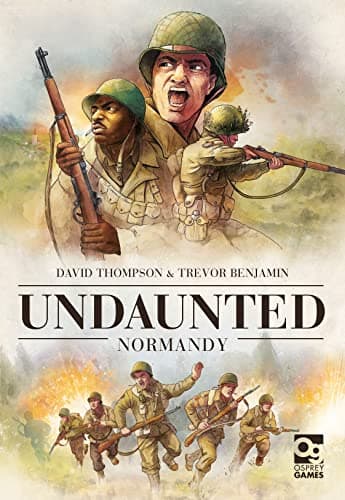
Undaunted: Normandy -- best for the pair who want the deck to be about something. Osprey publishes it for exactly 2 players at 45 to 60 minutes, ages 14+, with 108 cards and 18 large map tiles. One side commands American forces and one German, and a casualty removes that card from your deck for the rest of the scenario.
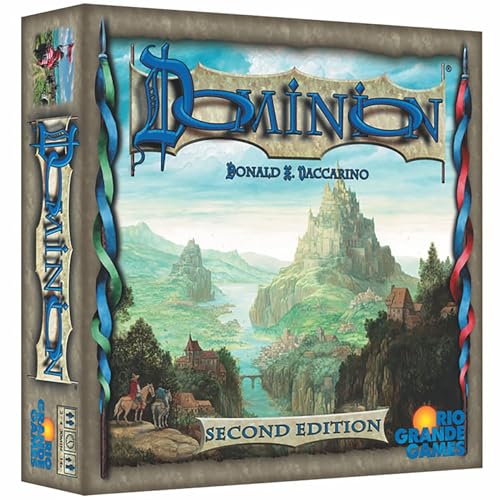
Dominion -- best for finding out cheaply whether you like the mechanism at all. Rio Grande Games publishes it for 2 to 4 players at about 30 minutes, and it is the game every other deck-builder is a reaction to. The ten kingdom piles you set up decide what each session is.
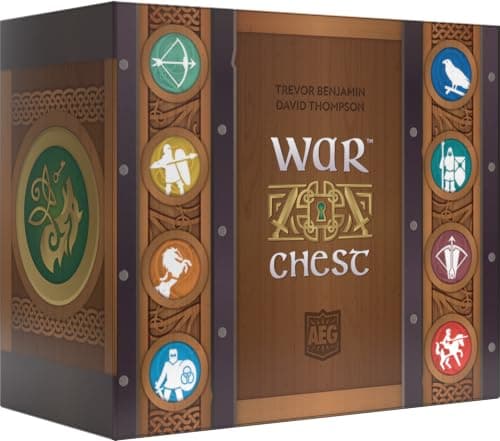
War Chest -- best for the pair who want board control rather than card play. Alderac publishes it for 2 to 4 at 30 to 60 minutes, ages 14+, from Trevor Benjamin and David Thompson -- the designers of Undaunted -- and you draw unit coins from a bag instead of cards from a deck.
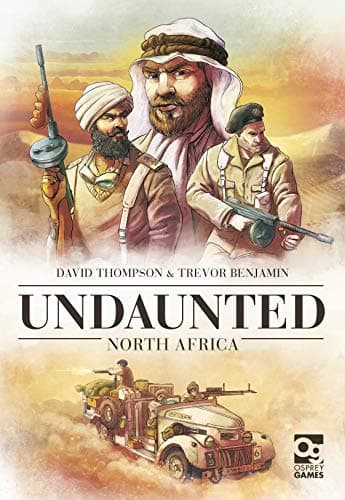
Undaunted: North Africa -- best for the reader who wants the Undaunted system fifteen minutes shorter. Osprey publishes it for exactly 2 at 30 to 45 minutes as a standalone sequel, so it does not need Normandy on the shelf first.
03
Deck-building and bag-building are the same idea in a different container
War Chest is on this page because the mechanism is identical in everything that matters: you acquire units, they go into a randomized pool you own, and you draw from that pool rather than choosing freely. The container is a cloth bag of poker-chip-style coins instead of a deck of cards.
What differs at the table is the order of the decisions. In a deck-builder you draw a hand and then decide what to do with it. In War Chest you draw three unit coins and the question becomes what those three units allow you to attempt this round -- the constraint arrives before the plan does.
Its designers are the pair who made Undaunted, which is not a coincidence. If you like the Undaunted loop but do not want a historical war setting, War Chest is the same instinct dressed as a medieval battlefield, and it seats up to four when it has to.
One practical consequence of the bag: you can see how much is left in it. A deck face-down on the table hides its own size unless you are counting, while a bag you have been drawing from all game is visibly emptying, which makes the endgame easier to read for whichever of you is not keeping a mental tally.
04
What changes at exactly two players
Dominion is the pick where the player count visibly rewrites the game. The ten kingdom piles and the supply of victory cards barely grow for more players, so at two the piles run down slowly and the handful of high-value victory cards becomes the entire race. A four-player game of Dominion is a scramble; a two-player game is a duel over a short list of cards you can both see on the table.
The Undaunted boxes never have to answer the question, because Osprey publishes both for exactly two. Nothing in either box goes unused, the scenarios are written for two commanders, and the campaign structure assumes the same two people come back.
War Chest supports up to four and plays its four-player game in teams, which is a different thing entirely. At two it is the cleanest version of itself, and that is how it is judged here.
05
The shuffle is the hidden cost
Nobody mentions this in a review and everybody notices it at the table. A deck-builder makes you shuffle, repeatedly, all game, and in a two-player game that means one of you is shuffling while the other waits.
It is worth knowing which end of that you are buying. Dominion is the heaviest shuffler here, because the whole design is built on cycling a deck that grows all game -- you will reshuffle many times in half an hour, and sleeving the cards makes it slower rather than faster. The Undaunted boxes shuffle less: your deck is a squad, it stays small, and the scenario ends before a long deck develops.
War Chest removes the problem entirely, which is the quietest argument in its favor. Drawing three coins out of a bag takes about a second and there is nothing to riffle, square up or drop. If one of you has hands that do not enjoy shuffling -- and that is a far more common reason a game stops getting played than any reviewer admits -- start there.
06
Star Realms is named here and not ranked, on purpose
If you have searched this genre you have seen Star Realms recommended, usually first, and it is a reasonable recommendation: a two-player deck-builder that costs less than anything ranked on this page.
It is not ranked here because we could not source a playing time for it. Its publisher's own site states the player count -- one box for two players, add copies for multiplayer -- and names its designers, but prints no duration and no age rating. The Wise Wizard Games store page for it returns a 404 to us, and the game's reference entry gives its playing time as lasting until one player runs out of authority, which is not a figure that can go in a specs table.
Every game on this site carries a publisher-stated or reference-stated player count, playing time and age, because a specs table assembled from memory is worse than no specs table at all. So Star Realms is described here honestly and given no spec line, no ranking and no buy button -- the same treatment two other products have had on this site for the same reason. If a page carrying those figures becomes reachable, it gets added properly.
07
What we did instead of playing these
We have not played these games. Specifications come from Osprey Games for both Undaunted titles and Alderac Entertainment Group for War Chest -- publisher pages, both reachable -- and from the Wikipedia infobox for Dominion, because riograndegames.com returns a 403 to this environment and has done on every attempt since October. That is also why Dominion is the one game here with no age rating printed: the infobox does not state one, and we did not invent one.
Live prices sit inside the buy buttons with the date each was checked. There are no prices in this prose and no scores out of ten anywhere on this site.
The best two-player war game in print, and the only one on this list that teaches deck-building and squad tactics at the same time.
A two-player-only deck-building war game. Each side commands American or German forces across a campaign of World War II scenarios, with 108 cards, 18 large map tiles, dice and tokens. Your deck is your squad, and losses thin it permanently.
Players
2
Playing time
45-60 minutes
Age
14+
Designer
David Thompson and Trevor Benjamin
Publisher
Osprey Games
Published
2019
Who should skip it
Skip it if losing a unit permanently for the rest of a scenario will frustrate you. Casualties remove cards from your deck, so a bad turn keeps costing you.
The game that invented deck-building, and the cheapest way to find out whether the mechanism is the thing you actually like.
The original deck-building game. Both players start with the same ten weak cards and buy better ones from a shared row of ten kingdom piles, shuffling every purchase into a deck that is reshuffled over and over as the game runs. At two players the piles run down slowly, which makes the race for the few Provinces the whole game. Published by Rio Grande Games for 2 to 4 players at about 30 minutes; additional base cards raise the count to 6.
Players
2 to 4
Playing time
about 30 minutes
Designer
Donald X. Vaccarino
Publisher
Rio Grande Games
Published
2008
Who should skip it
Skip it if you want a game that is different every time out of one box. The ten kingdom piles you set up decide what the game is, and picking a good ten is a skill in itself.
Plays at two2-4 players · 30-60 minutes · ages 14+
Bag-building married to board control, from the designers of Undaunted -- the most elegant big-box duel on this shelf.
A bag-building battlefield strategy game for 2-4 players. Each round you draw three unit coins from your bag and spend them to perform actions, and the game ends when one player or team has placed all of its control markers. 79 poker-chip-style unit coins, 16 cards, a board, 4 bags and 16 tokens. Designed by Trevor Benjamin and David Thompson, the pair behind Undaunted.
Players
2-4
Playing time
30-60 minutes
Age
14+
Designer
Trevor Benjamin and David Thompson
Publisher
Alderac Entertainment Group
Who should skip it
Skip it if you want certainty rather than a draw. You pull three unit coins from a bag each round, so what you are allowed to attempt is decided before you decide how to attempt it.
The same engine as Normandy, fifteen minutes shorter, and the better buy if you only want one of the two.
A two-player-only deck-building war game and standalone sequel to Undaunted: Normandy. Desert warfare across a campaign, with 100+ cards, 22 large map tiles, 4 dice and tokens. Shorter scenarios than Normandy at 30-45 minutes.
Players
2
Playing time
30-45 minutes
Age
14+
Designer
David Thompson and Trevor Benjamin
Publisher
Osprey Games
Who should skip it
Skip it if you already own Normandy and expected something new. The core system is identical -- this is a different theater, not a different game.
+−What is the best deck-building game for 2 players?
Undaunted: Normandy. Osprey Games publishes it for exactly 2 players at 45 to 60 minutes, ages 14+. Your deck is your squad, each card is a soldier, and casualties permanently remove cards -- which makes every purchase and every loss mean something a generic card cannot.
+−Is Dominion good with 2 players?
Yes, and it tightens. The ten kingdom piles and the small supply of high-value victory cards barely change for the player count, so with one opponent the game becomes a direct race for a short list of cards you can both see on the table.
+−What is the difference between deck-building and bag-building?
Only the container. Both have you acquire pieces into a randomized personal pool and draw from it. War Chest uses coins in a cloth bag, so you learn what you are allowed to attempt before you plan the round, where a hand of cards arrives and then you plan around it.
+−Do I need Undaunted: Normandy before Undaunted: North Africa?
No. Osprey publishes North Africa as a standalone sequel with its own cards, map tiles and campaign, and its scenarios run 30 to 45 minutes against Normandy's 45 to 60. If you only want one of the two, the shorter one is the easier sell on a weeknight.
+−Are deck-building games hard to learn?
Dominion is about a ten-minute teach and is the reason the genre exists. Undaunted takes one full scenario before the deck-thinning clicks, because you are learning a tactical map game at the same time. Neither is heavy by modern standards.
+−What is the cheapest two-player deck-building game?
Among the ranked picks, Dominion and Undaunted: North Africa sit at the lower end of this page's bracket -- check the live prices on the buttons, because they move. Star Realms is cheaper still and is discussed above, but it is not ranked, because no source we accept states its playing time.