Buy Santorini if you want pure skill and a game that looks extraordinary on a table: Roxley Games lists 2-4 players at 20 minutes, ages 8+, with no luck once the god powers are dealt. Buy Azul if you want the Spiel des Jahres winner with a draft that rewards reading your opponent, and a game a mismatched pair can both enjoy.
We earn a commission when you buy through links on this page, at no extra cost to you. It does not change which games we recommend or what we say about them. How this site is funded.
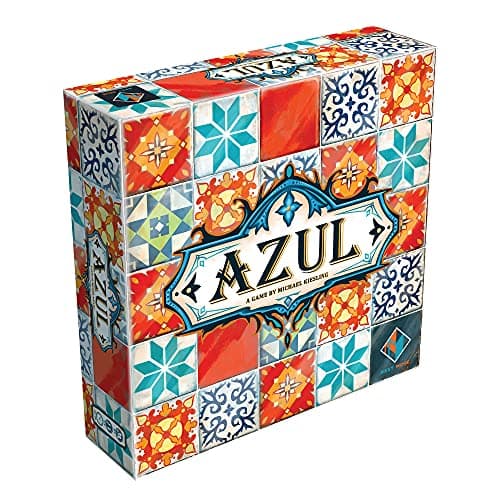
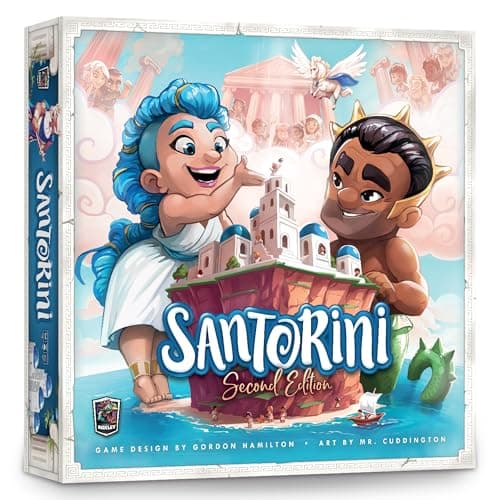
These two get compared for an honest reason: they are the two games we cover that people buy partly because of how they look. Santorini is a three-dimensional island that grows out of the table in chunky molded pieces. Azul is a box of heavy acrylic tiles that people pick up and turn over before anyone has read a rule. Both are genuinely persuasive to someone who does not think board games are for them.
That is where the similarity ends. One is a near-perfect-information abstract where the better player wins almost every time, and the other is a drafting game with enough variance that a weaker player has a real chance. Which of those you want is not a question about quality -- it is a question about the two people who will be playing.
Quick picks
#
Game
Players
Time
Price
1
Santorini
The best-looking game here, and the god powers turn a simple abstract into dozens of different games.
Player counts and playing times come from each publisher, cited on that game's review page. Tap a row to jump to the full write-up.
01
The verified specs
Santorini -- 2-4 players, 20 minutes, ages 8+. Gord Hamilton, Roxley Games. Move a worker then build; the first player to step onto a third level wins. Each side draws a god power that bends one rule.
Azul -- 2-4 players, 30-45 minutes, age rating not stated by any reachable source. Michael Kiesling, Plan B Games, 2017. Winner of the 2018 Spiel des Jahres plus five further major awards.
Both are published for 2-4, so both are Plays at two on this site's labeling rather than Built for two. Neither has a publisher-stated solo mode.
02
How we judged it
Because these two games share a reason for being bought and share nothing else, the comparison turns on exactly one question first: how much does luck contribute to the result?
That question decides who can enjoy the game with whom. A game with no luck is a skill test, which is wonderful between two evenly matched players and miserable when one person has played forty times and the other has played twice. A game with some variance lets a weaker player win occasionally, which is what keeps a game on the table in most households.
After that, two smaller criteria: how short the teach is, and whether the game holds up after twenty plays.
03
Santorini has no luck. That is the feature and the risk.
The base rules are nearly trivial. On your turn you move one of your workers to an adjacent square and then build a level adjacent to that worker. The first player to step onto the third level of a building wins. There is no hidden information, no dice and no cards drawn mid-game.
What stops that from being tic-tac-toe is the god powers. Each side draws a power that bends one rule -- and that is where all of Santorini's variety lives, because the base game underneath is a solved-feeling positional puzzle and the powers are what make each match a different problem.
The consequence is blunt and worth being clear about before you buy. Once both powers are dealt, the game is pure calculation, so the better player wins consistently and the result is never in doubt for luck reasons. For two people who want to get sharper at the same game together, that is exactly right. For a pair where one plays a lot and the other does not, it produces an evening where one person wins every single game, and no amount of good design fixes that.
The other thing to know: it is the shortest game here at 20 minutes, and the 8+ rating is the joint-lowest of any game we cover.
04
Azul has variance, and at two it also has real denial
Azul's rule is that when you take tiles you take every tile of one color from one supply -- all of them, whether or not you can use them -- and arrange them in rows. At the end of a round, one tile from each filled row moves onto your 5x5 board and scores by where it sits relative to the tiles already there; the surplus in that row is discarded at a cost.
Which tiles are available each round is shuffled, so there is genuine variance in what you are offered. That is the thing Santorini does not have, and it is why Azul is the better pick for a pair with different amounts of experience: a less practised player can have a strong round because the tiles fell well, and that keeps the game being played.
But Azul at two is not soft. With one opponent you can see exactly which color they are building toward, so you can take it purely to deny -- forcing them to pick up tiles they cannot place and will lose points discarding. Good two-player Azul is substantially about making the other person waste a turn. It just happens to look serene while you do it.
The cost is that the turn shape never changes. One kind of action, start to finish. The advanced placement mode, where you may place colors anywhere rather than in fixed positions, is effectively a harder second game and is the real answer to replay value here.
05
Both say 2-4, and neither is built for two
This is the unusual thing about this particular comparison and it deserves stating plainly: neither of these games was designed for two people. Roxley Games lists Santorini at 2-4, Plan B Games lists Azul at 2-4, so both carry this site's Plays at two label.
Both are nonetheless good at two, and for the same structural reason -- each is a game about a shared, visible position rather than about managing a table of several opponents, so removing players removes chaos rather than removing the game. Santorini at two is the purest version of itself. Azul at two is the tightest version of itself.
If what brought you here is specifically wanting designs built for exactly two, neither of these is it, and the honest redirect is worth more than a forced pick. Since 2025 Next Move Games publishes Azul Duel for exactly 2 players at 45 minutes, ages 10+, which takes the Azul draft and makes it adversarial. For the Santorini side there is no two-player-only equivalent we cover, and the nearest things in spirit are Onitama and Hive -- both published for exactly two, both pure-skill abstracts, and both covered here.
06
Table presence, and which one actually sells the hobby
If the job is convincing a sceptic that board games are worth an evening, Santorini is the stronger tool and it is not close. The island is three-dimensional and it grows while you play, so the game produces a thing on the table that did not exist twenty minutes ago. People who do not play games respond to that.
Azul's appeal is tactile rather than architectural -- the tiles are heavy and pleasant and the finished board looks like a mosaic. It photographs better than it demonstrates.
Against that, Azul has the record. The 2018 Spiel des Jahres, the As d'Or, Origins Best Family Game and Fan Favorite, a Dice Tower award and Mensa Select. If you want evidence rather than a reaction -- for a gift, or because you want a safe purchase -- that matters more than the pieces do, and Santorini has nothing comparable to show.
The length difference is worth planning around too, because 20 minutes against 30-45 is not a small gap in practice. Santorini is short enough that losing is cheap: you reset the island and go again, and a pair will often play three or four in a sitting, which is the format that makes a pure-skill game bearable for the weaker player. Azul is a single sitting of its own -- long enough that a bad round is something you carry for the rest of the game, and short enough that you will not resent it. If what you want is a game to fill exactly one half-hour before bed, Azul fits that shape better. If you want something you can play once in ten minutes of spare time or five times across an evening, Santorini is the more flexible box.
07
Pick this if
Pick Santorini if the two of you are evenly matched and want pure skill, if you want the shortest game here at 20 minutes, if a child as young as eight will play, or if you need a box that will persuade someone who does not think they like board games. No luck once the powers are dealt.
Pick Azul if the two of you have different amounts of experience, if you want the award winner, or if you want a draft where reading your opponent and denying them a color is the main skill. Some variance, which is the point.
Pick Azul Duel if you want the tile drafting built for exactly two. Pick Onitama or Hive if you want Santorini's pure-skill feeling in a game whose publisher states exactly two players.
The best-looking game here, and the god powers turn a simple abstract into dozens of different games.
A supports-more abstract that plays well at two. Move a worker, then build. First to step onto a third level wins -- and each side draws a god power that bends one rule.
Players
2-4
Playing time
20 minutes
Age
8+
Designer
Gord Hamilton
Publisher
Roxley Games
Who should skip it
Skip it if you want your two-player game to be two-player only. It supports up to four, and the base rules are thin without the god powers.
Five major awards in 2018, and a draft where you must take every tile of the color you want -- including the ones you cannot use.
A tile-drafting game for 2-4 players. You take every tile of one color from a shared supply and arrange them in rows, then move one tile from each filled row onto a 5x5 board where it scores by where it sits relative to the others. Rounds continue until a player completes a row across their board, with bonuses for complete rows, columns and full color sets. Designed by Michael Kiesling, published by Plan B Games in 2017.
Players
2-4
Playing time
30-45 minutes
Designer
Michael Kiesling
Publisher
Plan B Games
Published
2017
Who should skip it
Skip it if you want a game built only for two. Plan B Games lists 2-4, and a two-player-only Azul exists separately as Azul Duel.
Santorini if the two of you are evenly matched and want a pure skill test -- it has no luck once the god powers are dealt. Azul if your experience levels differ, because the shuffled tile supply gives a less practised player a real chance of a good game.
+−Are Santorini and Azul two-player games?
Both are published for 2-4 players, so neither is built for two -- they are both labeled Plays at two here. Both are genuinely good at two. If you want the Azul drafting in a two-player-only box, Azul Duel is published by Next Move Games for exactly 2.
+−Which is easier to learn?
Santorini's base rules are simpler -- move a worker, then build, and reaching a third level wins. But each god power adds a rule exception, so the effective teach is similar to Azul's five minutes.
+−Which is better for a child?
Santorini. Roxley Games rates it 8 and up, it finishes in 20 minutes, and the growing island holds attention. No reachable source states an age rating for Azul at all, so we cannot tell you -- read the box.
+−Which has more replay value?
Santorini's variety comes from the god powers, which change what the match is about each time. Azul's comes from its advanced placement mode, where you may place colors anywhere instead of in fixed positions -- effectively a second, harder game.
+−Which looks better on the table?
Santorini, for most people. It builds a three-dimensional island as you play, which is the most visually striking thing in anything we cover. Azul's appeal is the weight and finish of its acrylic tiles and the mosaic you end up with.