Santorini is the best two-player board game for a kid and an adult: Roxley publishes it for 2 to 4 players at 20 minutes, ages 8+, it teaches in about two minutes, and the god powers let you handicap the match without anyone having to pretend. Forbidden Island is the co-op pick, and Carcassonne has the youngest age rating here at 7+.
We earn a commission when you buy through links on this page, at no extra cost to you. It does not change which games we recommend or what we say about them. How this site is funded.
This is a different question from which games are easy. A child and an adult at the same table is a skill gap with feelings attached, and the games that work are the ones where the gap does not decide every result -- or where the two of you are not opposed in the first place.
It is also a question where made-up age ratings are everywhere. Every rating on this page comes from the publisher's own stated minimum and nothing on it is a guess, which is why a couple of obvious titles are missing: we do not store an age for them, so we cannot put them on a page about ages.
The six below are ranked for a two-person table, with the publisher's figures, an honest downside each, and one explicit note for parents about the last pick.
Quick picks
#
Game
Players
Time
Price
1
Santorini
The best-looking game here, and the god powers turn a simple abstract into dozens of different games.
The gateway tile-layer, and the one game here whose setup does not change at two at all -- you get the whole 72-tile stack between you, which makes it longer and calmer rather than tighter.
The best-selling gateway game there is, and at two you get the whole 1910 map to yourselves -- which removes most of the blocking that makes it tense at four.
Player counts and playing times come from each publisher, cited on that game's review page. Tap a row to jump to the full write-up.
01
What we judged on
Four criteria, in this order.
The publisher's stated minimum age, not a vibe. Carcassonne is rated 7+ by Z-Man Games; Santorini, Patchwork, Ticket to Ride and Memoir '44 are 8+; Forbidden Island is 10+ from Gamewright. Those are the numbers, and they set the order of the shelf more than our opinion does.
Does the skill gap decide it? An adult who plays games will beat a child at most abstracts every time. The picks that handle this well either build in a handicap, like Santorini's god powers, or put the two of you on the same side, like Forbidden Island.
Is there reading? Several picks here need none at all once the rules are explained, which widens the age range in practice more than any rating does.
Does it end before attention does? Everything here is under an hour by its publisher's figures, and the top pick is twenty minutes.
02
Who each pick is for
One line each.
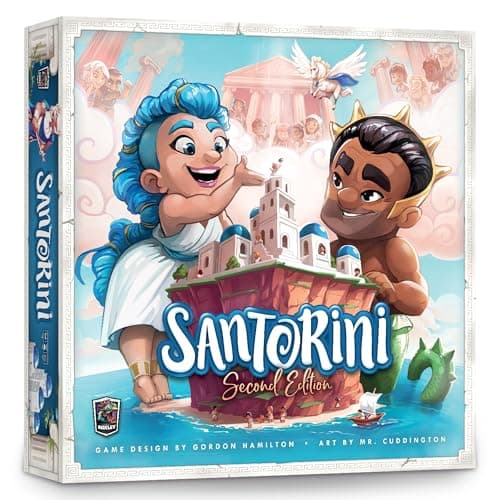
Santorini -- best for the pair who want a real abstract that a child can beat an adult at. Roxley publishes it for 2 to 4 players at 20 minutes, ages 8+: move a worker, then build, and the first onto a third level wins. Each side draws a god power that bends one rule, which is also the fairest handicap on this page.
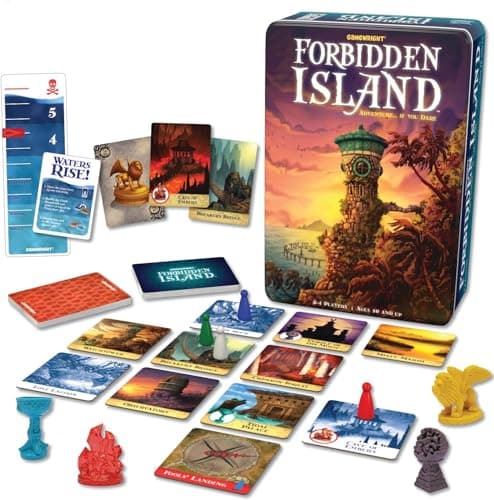
Forbidden Island -- best when losing to a parent is the problem. Gamewright publishes it for 2 to 4 at 30 minutes, ages 10+. You are both collecting treasures from a sinking island and you win or lose together, so there is nothing to be upset about across the table.
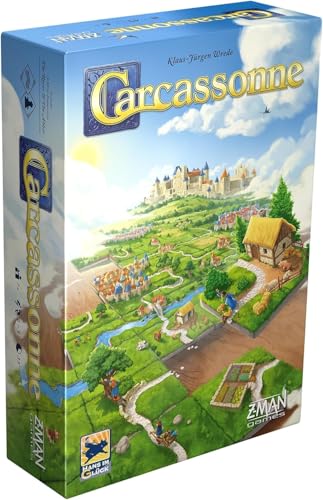
Carcassonne -- best for the youngest player on this page. Z-Man Games rates it 7+ and publishes it for 2 to 5 at 30 to 45 minutes. One tile a turn, placed so the roads and cities match, and the map grows in front of both of you.
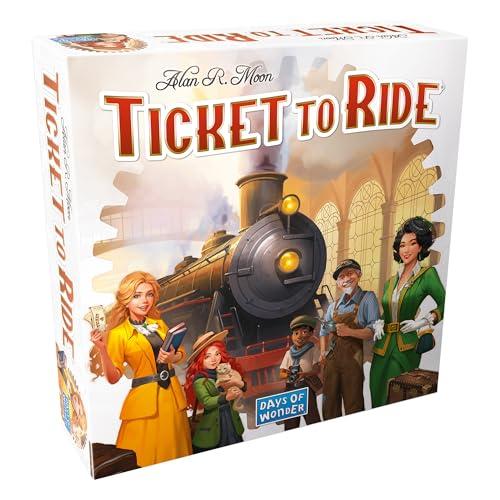
Ticket to Ride -- best for a child who likes maps and collecting. Days of Wonder publishes it for 2 to 5 at 30 to 60 minutes, ages 8+. At two the blocking largely disappears, which for this particular table is a point in its favor.
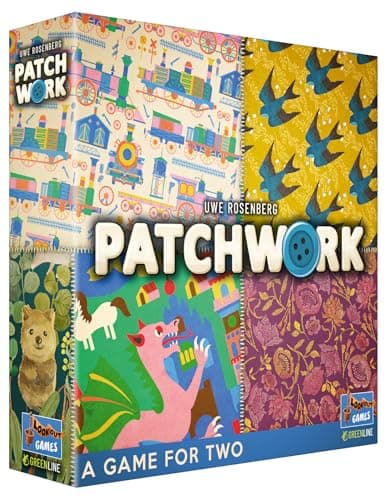
Patchwork -- best for a quiet child who would rather solve a puzzle than be attacked. Lookout Games publishes it for exactly 2 players at about 30 minutes, ages 8+, and you are fitting fabric pieces onto your own quilt board.
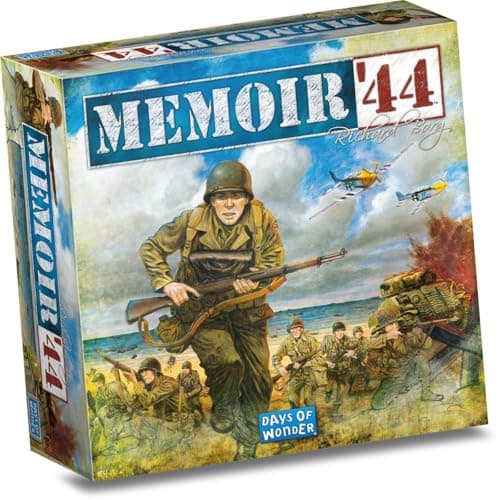
Memoir '44 -- best for the child who is specifically interested in history and soldiers. Days of Wonder publishes it for 2 to 4 at 30 to 45 minutes, ages 8+. See the note below before you buy it: it is a World War II game and the rating is the publisher's, not a judgment about your child.
03
A plain note about Memoir '44
It is a war game. The subject is the Second World War, the components are 144 army miniatures and a hex battlefield, and the scenarios are real battles. Days of Wonder rates it 8+, and that rating is about the rules complexity -- a hand of command cards decides which part of the battlefield you may give orders to, which is a genuinely elegant way to make a war game teachable to a child.
Whether that subject belongs on your table is not a question a specifications table can answer, and we are not going to pretend it is. It is on this list because it is a genuinely good two-player game at a child-friendly rules weight, and it is flagged here because a parent deserves to know what is in the box before the box arrives.
If the answer is no, the five picks above it are all abstract, cooperative or about trains and tiles.
04
How to handle the skill gap without pretending
Deliberately losing is the worst option available, and most children work it out faster than adults expect.
The better approach is to change the game rather than your play. Santorini is the clearest case: each side draws a god power, and the powers are not equal, so giving the stronger player the weaker power is a real handicap that neither of you has to be dishonest about. Carcassonne allows something similar by agreeing before the game that one player is playing for cities only.
The alternative is to stop being opponents. Forbidden Island puts both of you against the board, which removes the problem rather than managing it, and is the reason it sits second on this list despite having the highest age rating here.
What does not work is picking a game that is too simple. A child who is capable of Carcassonne and is handed something aimed at a five-year-old works that out immediately, and the evening goes the same way the deliberate-losing evening goes.
One more thing worth saying to a parent: an age rating is a floor for the rules, not a ceiling for the player. A seven-year-old who already handles Carcassonne is not served by being kept on 7+ boxes, and the step up to Santorini or Ticket to Ride costs nothing in reading ability. Rate the child, not the box.
05
Why some obvious games are not here
Two reasons, and both are about this site's rules rather than the games.
The first is that we only print an age rating a publisher or a reference entry states. Azul is an obvious candidate for this list -- it is colorful, short and easy -- and it is not on it, because no source we accept prints an age for the edition we link. It appears in the tile-laying roundup on this site instead, where the rating is not part of the recommendation.
The second is availability. We do not rank a game we cannot confirm is purchasable on the day the page is built, which keeps a few plausible titles off every list here.
If you want a sixth or seventh option, the beginner hub on this site covers the same ground without the age constraint.
06
What we did instead of playing these
We have not played these games with a child or with anybody else. Every age rating, player count and playing time on this page comes from the publisher where the publisher states it -- Roxley, Gamewright, Z-Man Games, Lookout Games and Days of Wonder -- and from the game's reference entry where it does not. Each is linked at the bottom.
There are no prices in this prose. The buy buttons carry live prices with the date checked.
The best-looking game here, and the god powers turn a simple abstract into dozens of different games.
A supports-more abstract that plays well at two. Move a worker, then build. First to step onto a third level wins -- and each side draws a god power that bends one rule.
Players
2-4
Playing time
20 minutes
Age
8+
Designer
Gord Hamilton
Publisher
Roxley Games
Who should skip it
Skip it if you want your two-player game to be two-player only. It supports up to four, and the base rules are thin without the god powers.
The cheapest way to find out whether co-op games work for the two of you.
A supports-more cooperative game that plays at two. You collect four treasures from a sinking island of 24 tiles and escape before the water level rises past the exit.
Players
2-4
Playing time
30 minutes
Age
10+
Designer
Matt Leacock
Publisher
Gamewright
Who should skip it
Skip it if you have already played a modern co-op. It is deliberately gentle and you will solve it inside a handful of games.
The gateway tile-layer, and the one game here whose setup does not change at two at all -- you get the whole 72-tile stack between you, which makes it longer and calmer rather than tighter.
A tile-laying game for 2-5 players. You draw and place a land tile so its roads, cities and fields match their neighbors, then optionally place one of your followers on it as a thief, knight, monk or farmer. Completed roads, cities and monasteries score during play; incomplete ones and the farmers score at the end, and the game ends on the turn the last tile is placed. 72 land tiles, 40 meeples, 12 river tiles, 5 abbots and a scoreboard. Setup does not change with the player count.
Players
2-5
Playing time
30-45 minutes
Age
7+
Designer
Klaus-Jurgen Wrede
Publisher
Hans im Gluck / Z-Man Games
Published
2000
Who should skip it
Skip it if you want every turn contested. Nothing is scaled down for a pair, so the board sprawls with half the competition for placements, and a two-player-only design will give you more friction per turn.
The best-selling gateway game there is, and at two you get the whole 1910 map to yourselves -- which removes most of the blocking that makes it tense at four.
A route-building game for 2-5 players on a 1910 map of the United States and southern Canada. You collect colored transport cards and spend matching sets to claim railway routes between cities, trying to complete the destination tickets in your hand before the trains run out. Nine card colors plus a multicolored locomotive wild card. Below a stated threshold of players, only one of each pair of parallel double routes may be claimed.
Players
2-5
Playing time
30-60 minutes
Age
8+
Designer
Alan R. Moon
Publisher
Days of Wonder
Published
2004
Who should skip it
Skip it if you want a contested game. The board does not shrink for a pair, so the main interaction -- racing someone to a route before they take it -- mostly evaporates with only one opponent.
The gentlest good game on this site. Two quilts, no attacking, and a surprisingly sharp puzzle underneath.
A two-player-only tile-laying game. You buy fabric patches on a shared time track and fit them onto a personal 9x9 quilt board, paying with buttons and with time.
Players
2
Playing time
about 30 minutes
Age
8+
Designer
Uwe Rosenberg
Publisher
Lookout Games
Published
2014
Who should skip it
Skip it if you want to interact. You are mostly solving your own board, and the only contact is who takes which patch first.
The most approachable historical war game in print, because a hand of command cards does the work a rulebook would otherwise do.
A supports-more historical war game that plays at two. You command Axis or Allied forces on a hex battlefield split into three sections, and the command cards in your hand decide which section you can give orders to each turn. 144 army miniatures, 44 double-sided terrain tiles, 60 command cards, 8 attack dice and a scenario book.
Players
2-4
Playing time
30-45 minutes
Age
8+
Designer
Richard Borg
Publisher
Days of Wonder
Published
2004
Who should skip it
Skip it if you want a game built only for two. Days of Wonder lists 2-4 players, and the famous Overlord scenarios need a second copy of the box.
+−What is the best two-player board game for a kid and an adult?
Santorini. Roxley publishes it for 2 to 4 players at 20 minutes, ages 8+. The rules are two steps long -- move, then build -- and the god power each side draws gives you an honest way to handicap an adult without anyone having to lose on purpose.
+−What two-player board game has the youngest age rating?
Carcassonne, which Z-Man Games rates 7+. It is also one of the easiest to teach: draw a tile, place it so the roads and cities match, optionally put one of your followers on it.
+−What board game should we play if my child hates losing?
Forbidden Island. Gamewright publishes it for 2 to 4 at 30 minutes, ages 10+, and it is cooperative -- you both win or both lose against the board, so there is no parent across the table to lose to.
+−Is Ticket to Ride good for kids at two players?
Yes, and the two-player version suits this table particularly well. The board does not shrink for two, so the route-blocking that makes it cut-throat with four largely disappears and it becomes a race to finish your own tickets. Days of Wonder rates it 8+.
+−How do you handicap a board game fairly for a child?
Change the game, not your play. Give the adult the weaker god power in Santorini, or agree one player scores only cities in Carcassonne. Deliberately playing badly is the one approach that reliably backfires, because children notice.
+−Are war games appropriate for children?
That is a parent's call, not a specification. Days of Wonder rates Memoir '44 at 8+, which speaks to its rules weight rather than its subject -- it is a Second World War game with army miniatures. It is listed here with that said plainly, and the five picks above it are not war games.