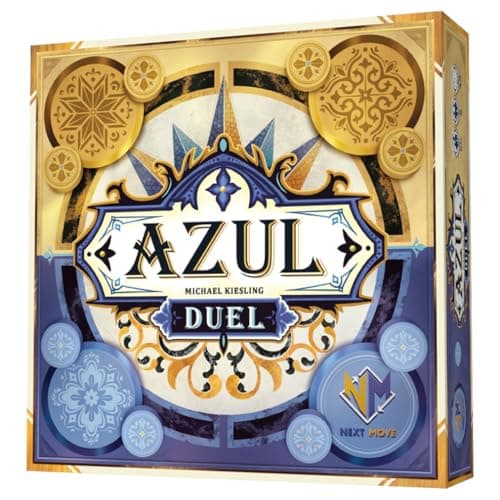
Azul Duel is the best two-player tile game: Next Move Games publishes it for exactly 2 players at 45 minutes, and the draft is built so that every tile you take also decides what your opponent may reach next. Patchwork is the quieter pick, Carcassonne the cheapest way in.
We earn a commission when you buy through links on this page, at no extra cost to you. It does not change which games we recommend or what we say about them. How this site is funded.
Tile games are the one format where the components do the explaining. There is no hidden hand to read and very little text to parse: the tiles are face up, the shapes are obvious, and a new player can usually see what a turn costs before anyone describes it. That is why this shelf keeps winning evenings where one of you is not a gamer.
This site had no roundup for the format until today, which was an oversight. Five of the games we cover are tile games, and three of them -- Azul Duel, Azul and Carcassonne -- had never appeared on a ranked list here at all.
What follows ranks them on what a two-person household actually gets out of a tile game: how much of the box is used at two, how fast it teaches, and whether the pieces give the person who is not concentrating a way back into the game. Every specification comes from the publisher where the publisher states it, and each is linked at the bottom.
Quick picks
#
Game
Players
Time
Price
1
Azul Duel
The Azul family built for exactly two, and the first game here where you draft a tile and decide what the other person is allowed to reach next.
The gateway tile-layer, and the one game here whose setup does not change at two at all -- you get the whole 72-tile stack between you, which makes it longer and calmer rather than tighter.
Player counts and playing times come from each publisher, cited on that game's review page. Tap a row to jump to the full write-up.
01
What counts as a tile game, and what we judged on
A tile game is one where your turn is mostly a physical placement: you take a piece with a fixed shape and commit it to a spot you cannot take back. That covers three different mechanisms which get lumped together, and the difference matters more than the label.
We ranked on four things, in this order.
How much of the game survives at two. A tile game designed for four often loses its pressure at two, because the shared pool refills faster than two players can drain it. Games published for exactly two do not have this problem, which is why two of them lead this list.
Teach time measured against depth. Every game here explains in well under fifteen minutes. The ranking rewards the ones that stay interesting for the hundredth play rather than the ones that are merely easy to start.
Footprint. Tiles need table. Patchwork needs two personal boards and a small ring of pieces; Carcassonne grows a map across the whole table as you play. If your surface is a coffee table, that is a real constraint and we say so per pick.
Whether the losing player has anything to do. A tile game where one person pulls ahead in round two and the other spends twenty minutes placing pieces they no longer care about is a bad two-player game regardless of its reviews.
02
Who each pick is for
One line each, because a ranked list without this is just a list.
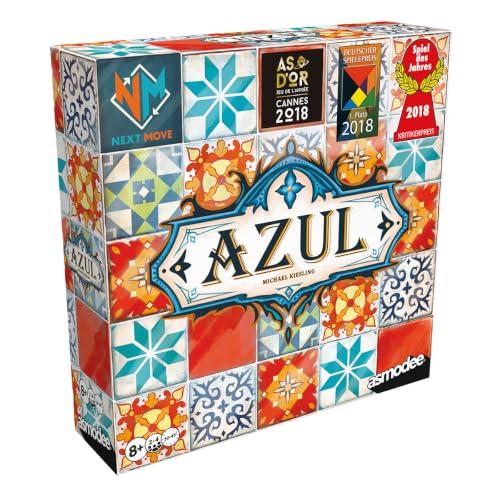
Azul Duel -- best for the pair who want the tile game to have teeth. The draft is the whole point: you take every tile of one color from a factory's sun side and then choose the order the leftovers are stacked for the other person. It is published for exactly 2 players at 45 minutes.
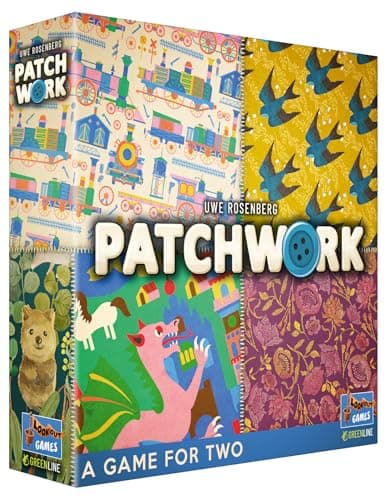
Patchwork -- best for the evening where neither of you wants to be attacked. You are filling your own quilt board and the only interaction is which piece you take before the other person can. Lookout Games publishes it for exactly 2 at about 30 minutes, ages 8+.
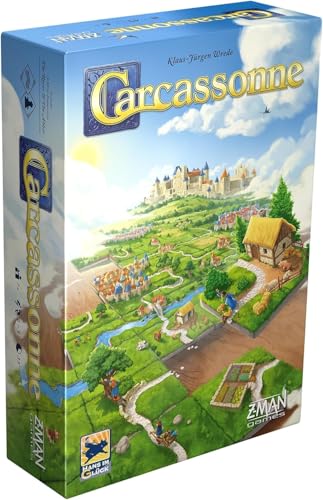
Carcassonne -- best for the household that wants one box to cover both two players and a visit from friends. Z-Man Games publishes it for 2 to 5 at 30 to 45 minutes, ages 7+, which is the youngest age rating on this list.
Azul -- best for the shelf that needs the game everybody has heard of. It is the Spiel des Jahres winner and the one guests recognize, and it seats up to four when your household temporarily is not two.
Hive -- best for the person who wants tiles with no board at all. It is the outlier here and we explain why below: the tiles move after you place them, so it is a tile game but not a tile-laying game.
03
The three mechanisms hiding under the label
Tile-laying proper is Carcassonne. You draw a tile blind, and your decision is where it goes and whether to spend a follower on it. The map is built jointly, so your road and your opponent's city grow out of the same twelve square inches of table. This is the branch with the most luck in it: a tile that does not fit anything you are building is simply a bad turn, and no amount of skill prevents it.
Tile drafting is Azul and Azul Duel. The tiles are visible before anyone takes them, so the decision is which set to take and -- the part that makes it a two-player game -- what you are leaving behind. Azul Duel formalizes this: after you take a color you physically arrange the remainder for the other player, which turns every turn into a small offer.
Polyomino placement is Patchwork. The pieces are irregular shapes and the puzzle is your own board, not a shared map. There is no shuffle and no hidden information at all: everything is on the table in front of both of you from the first turn.
The practical rule: if you want a game you can both laugh at a bad turn in, take the tile-laying branch. If you want the decisions to be the reason someone wins, take drafting. If you want to be left alone to solve your own puzzle, take Patchwork.
04
What changes when there are only two of you
Carcassonne is the clearest case, and it changes in your favor. With fewer players at the table each of you places more of the 72 land tiles over the course of the game, so conserving your followers matters more than it does in a five-player game where the map fills before you can use them all. Two-player Carcassonne is a longer, more deliberate game than the box's reputation suggests.
Azul is the pick where the two-player question has a real answer rather than a slogan, and it has its own page on this site -- we would rather send you there than compress it into a paragraph here.
Patchwork and Azul Duel skip the question entirely. Both are published for exactly two, so nothing is scaled down, no component is unused, and the designer did not have to make the game work for a fourth person who is not coming.
05
Hive is tiles, and it is not tile-laying
We have ranked it fifth rather than left it out, because anyone searching for a two-player tile game will have it suggested to them and deserves to know what it actually is.
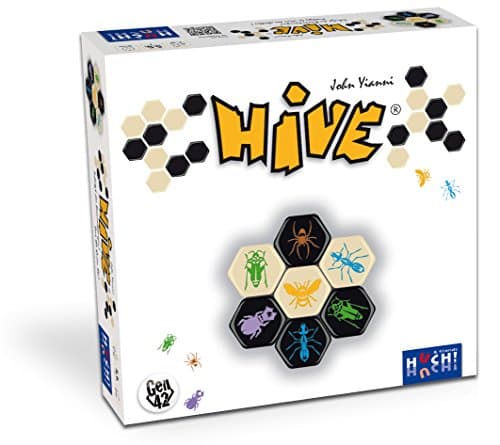
Hive is a bag of thick bakelite tiles with no board. You place a tile, and from then on that tile moves -- the queen shuffles one space, the grasshopper jumps a line, the beetle climbs on top of another piece. The placement is the opening, not the game. What that gives you is the only game here you can play on a train seat, a bench or a bed with no flat surface requirement at all, and a game with no luck in it whatsoever.
If you came here wanting to build something with tiles, it is the wrong recommendation and the four games above it are the right ones. If you came wanting a chess-weight duel that packs into a pocket, it is the best thing on this page.
The same distinction is worth carrying into a shop. Several games are sold as tile games because they contain tiles -- word games, dexterity games, abstract duels -- and the component is not the genre. The question to ask is whether the tile stays where you put it. If it does, you are buying a building game. If it moves afterwards, you are buying an abstract with nice pieces, and you should judge it against Hive and Onitama rather than against Carcassonne.
06
What we did instead of playing these
We have not played these games. What we did: took the player count, playing time and age rating from each publisher's own page where that page is reachable -- Lookout Games for Patchwork, Z-Man Games for Carcassonne, the Asmodee store for Azul Duel, Gen42 for Hive -- and from the game's reference entry where it is not, and ranked on the criteria set out above.
Every figure on this page links to its source at the bottom. There are no ratings out of ten here and no prices in this prose: the buy buttons carry live pricing, stamped with the date it was checked.
The Azul family built for exactly two, and the first game here where you draft a tile and decide what the other person is allowed to reach next.
A two-player-only tile-drafting game in the Azul family. You take every tile of one color from a factory's sun side, then choose the order the leftovers are stacked onto its moon side for your opponent to pick over. Tiles fill a single pattern line at a time and move onto dome tiles that score by row and column, across five rounds. Published by Next Move Games for exactly 2 players at 45 minutes.
Players
2
Playing time
45 minutes
Age
10+
Designer
Michael Kiesling
Publisher
Next Move Games
Published
2025
Who should skip it
Skip it if you want the game everyone recognizes. This is the newer, sharper box; the 2017 Azul is the one your guests have heard of and the one that seats four.
The gentlest good game on this site. Two quilts, no attacking, and a surprisingly sharp puzzle underneath.
A two-player-only tile-laying game. You buy fabric patches on a shared time track and fit them onto a personal 9x9 quilt board, paying with buttons and with time.
Players
2
Playing time
about 30 minutes
Age
8+
Designer
Uwe Rosenberg
Publisher
Lookout Games
Published
2014
Who should skip it
Skip it if you want to interact. You are mostly solving your own board, and the only contact is who takes which patch first.
The gateway tile-layer, and the one game here whose setup does not change at two at all -- you get the whole 72-tile stack between you, which makes it longer and calmer rather than tighter.
A tile-laying game for 2-5 players. You draw and place a land tile so its roads, cities and fields match their neighbors, then optionally place one of your followers on it as a thief, knight, monk or farmer. Completed roads, cities and monasteries score during play; incomplete ones and the farmers score at the end, and the game ends on the turn the last tile is placed. 72 land tiles, 40 meeples, 12 river tiles, 5 abbots and a scoreboard. Setup does not change with the player count.
Players
2-5
Playing time
30-45 minutes
Age
7+
Designer
Klaus-Jurgen Wrede
Publisher
Hans im Gluck / Z-Man Games
Published
2000
Who should skip it
Skip it if you want every turn contested. Nothing is scaled down for a pair, so the board sprawls with half the competition for placements, and a two-player-only design will give you more friction per turn.
Five major awards in 2018, and a draft where you must take every tile of the color you want -- including the ones you cannot use.
A tile-drafting game for 2-4 players. You take every tile of one color from a shared supply and arrange them in rows, then move one tile from each filled row onto a 5x5 board where it scores by where it sits relative to the others. Rounds continue until a player completes a row across their board, with bonuses for complete rows, columns and full color sets. Designed by Michael Kiesling, published by Plan B Games in 2017.
Players
2-4
Playing time
30-45 minutes
Designer
Michael Kiesling
Publisher
Plan B Games
Published
2017
Who should skip it
Skip it if you want a game built only for two. Plan B Games lists 2-4, and a two-player-only Azul exists separately as Azul Duel.
Chess without a board, in tactile tiles, and it survives the hundredth game better than most.
A two-player-only abstract strategy game with no board: 22 tactile tiles that build the playing surface as you place them. Surround the opposing queen bee to win.
Players
2
Playing time
20 minutes
Age
9 and up
Publisher
Gen42 Games
Box size
210mm x 210mm x 50mm
Who should skip it
Skip it if abstract games leave you cold. There is no theme here to carry you through a bad position.
Azul Duel. Next Move Games publishes it for exactly 2 players at 45 minutes, ages 10+, and the sun-and-moon draft means every tile you take also sets up what the other person is allowed to reach. Nothing in the box is scaled down for a player who is not there.
+−Is Carcassonne good with two players?
Yes, and it changes shape. With only two of you, each player places far more of the 72 land tiles, so holding followers back for a big city matters more than it does at four or five. It has a full page on this site if you want the longer answer.
+−What is the difference between tile-laying and tile-drafting?
In tile-laying you draw a tile blind and decide where it goes, as in Carcassonne. In tile-drafting the tiles are face up before anyone takes them, so the decision is which to take and what to leave behind, as in Azul and Azul Duel. Drafting rewards reading your opponent; laying rewards adapting to luck.
+−Do I need Azul if I already own Azul Duel?
Only if you need to seat more than two. Azul Duel is published for exactly 2 players and Azul for 2 to 4, so the original earns its shelf space when guests arrive and not much otherwise. We have a direct comparison of the two.
+−Is Patchwork a tile-laying game?
It is a polyomino placement game, which is the same idea with irregular shapes and a private board. You buy fabric pieces from a shared circle and fit them onto your own quilt, so the only contact between players is which piece gets taken first.
+−Which tile game needs the least table space?
Hive, which needs no table at all -- the tiles interlock into a free-standing hive and people play it on a bench or a bed. Of the games that build something, Patchwork is the smallest, because each player's quilt board stays a fixed size while Carcassonne's map grows all evening.