If you want the same tile draft built for exactly two players, buy Azul Duel. If you want the shared-supply tension without tiles, buy Splendor Duel -- it is the closest in feel. If what you liked was the quiet pattern building, buy Patchwork, and if it was the object on the table, buy Santorini. All four are covered here and all are published for two.
We earn a commission when you buy through links on this page, at no extra cost to you. It does not change which games we recommend or what we say about them. How this site is funded.
Azul is the game most often finished with the question "what else is like this?", and the reason the usual answers are unhelpful is that people mean four genuinely different things by it. Some liked the draft -- the rule that you must take every tile of one color, including the ones you cannot use. Some liked the pattern building. Some liked how it looks on a table. And some simply wanted something light and good that a non-gamer would agree to play again.
Those four point at different games, and a recommendation that ignores which one you mean is a coin flip. So this page sorts by the part you liked rather than by a ranking, which is the same approach we take on games like 7 Wonders Duel.
One framing note, because this site is narrow: Plan B Games publishes Azul for 2-4 players, and everything below is judged on how it plays with exactly two people. We have not played any of these games; the specifications come from each publisher's own page, cited at the bottom.
01
First, which part of Azul did you actually like?
Four axes, and it is worth being honest with yourself about which one before you spend anything, because two of them point away from tile games entirely.
The draft. Azul's one brilliant rule is that you take every tile of the one color you have chosen from the one place you have chosen -- all of them, used or not -- and whatever will not fit is discarded at a cost in points. At two players this becomes a readable fight: you can see what the other person needs and take it purely to deny them. If this is what you liked, you liked a restricted-supply drafting game, and the tiles were incidental.
The pattern building. Filling rows, moving tiles onto a 5x5 board, and scoring by where a tile sits relative to the work already there. If this is what you liked -- the satisfaction of a shape completed -- you liked a spatial puzzle, and the competition was incidental.
The object. Azul's heavy acrylic tiles are a real part of why people agree to play it, and there is no shame in buying partly for that. If this is what you liked, the recommendation changes completely, because the best-looking thing we cover is not a tile game.
The weight. Light rules, a five-minute teach, a first game that is genuinely fun rather than a practice round. If this is what you liked, you want another light game, and you should be careful not to be sold up into something heavier because it is "deeper".
02
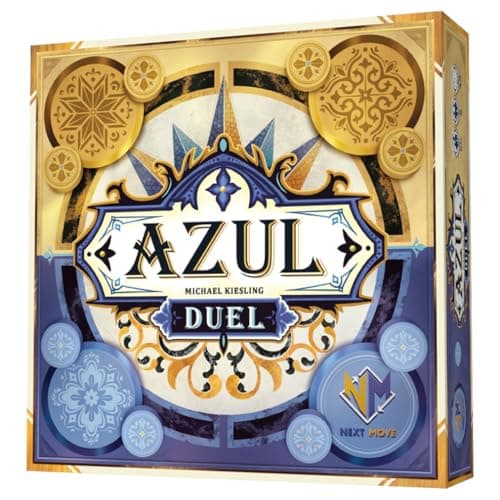
The same draft, built for exactly two: Azul Duel
If the draft is what you liked, this is the most direct answer available and it did not exist until recently. Next Move Games published Azul Duel in 2025 for exactly 2 players at 45 minutes, ages 10+, designed by Michael Kiesling, who designed the original. It is standalone and does not need your copy of Azul.
What it does with the draft is the reason to buy it. Each factory has a sun side and a moon side: when you take all tiles of one color from the sun side, you then choose the order in which the leftover tiles are stacked onto that factory's moon space, and a player can later take one color from the top of the moons. So the tiles you reject are not merely left on the table for whoever gets there first -- you hand them over in an order you chose, with the color they wanted buried at the bottom.
That rule is meaningless with a third player at the table, which is the clearest possible evidence of what the box was designed for. It also makes it the sharper and more confrontational of the two games, and a pattern-plate system gives you a different board layout each game, which matters more to a pair than to a group because two people play a two-player game far more often than four people play a family game.
The honest downside: it is a real step up in rules. Four possible turn actions, dome tiles you must take twice a round, bonus chips, and two separate point penalties. Azul teaches in five minutes; this does not. It also has no award record and no long community verdict, being a 2025 release, and it will never seat a third person.
03
The closest in feel: Splendor Duel
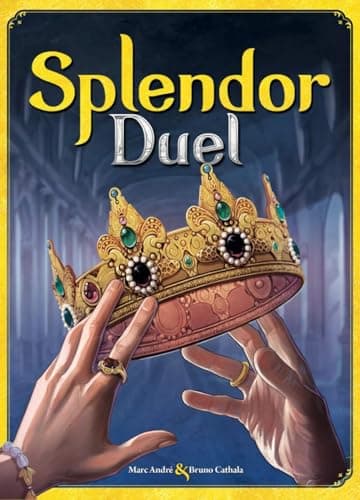
This is the recommendation most "games like Azul" lists miss, and on structure it is the best one on this page. Space Cowboys publishes Splendor Duel for exactly 2 players at 30 minutes, ages 10+, by Bruno Cathala and Marc Andre.
The reason it feels like Azul has nothing to do with theme and everything to do with the supply. Twenty-five gem tokens sit on a grid, and you may only take up to three that form an uninterrupted line. That is the same species of rule as Azul's factory restriction: the thing you want is often not the thing you are allowed to have, and taking what you can reach changes what the other person can reach next. If what you enjoyed about Azul was that specific squeeze, you will recognize it here immediately.
It then goes somewhere Azul does not. Cards you buy leave permanent discounts behind, so the game compounds -- by the end you are buying things that were unreachable at the start -- and three victory conditions run from the first turn, any of which ends the game the instant it is met, with no final scoring round. Azul's ending is a condition you can both see building for rounds. This one can stop while your plan is still a turn away.
The honest downsides: it is abstract where Azul is pretty, so if the object on the table was half the appeal you will find gems and nobles a step down. It punishes inexperience more than Azul does, because knowing which early purchases compound is most of the skill. And the sudden ending that makes it exciting is exactly what some pairs dislike.
04
The pattern building without the fight: Patchwork
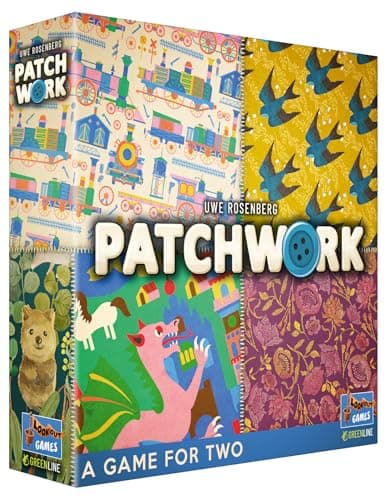
If the part you liked was fitting shapes together and you would happily lose the competition entirely, this is the pick. Lookout Games publishes Patchwork for exactly 2 players at about 30 minutes, ages 8+, designed by Uwe Rosenberg.
You buy fabric patches from a shared circle of 33 patches plus 5 special ones, pay for them in buttons and in time, and fit them onto your own quilt. At the end you count buttons and lose two points for every square you failed to cover. Crucially, nothing in the game lets either player touch the other's board -- no attack, no forced discard, no way to take the thing they needed. It is the gentlest good game we cover.
It also has the strangest good rule on this page. Turns do not alternate: both players move along a shared time track and whoever is furthest behind goes next, so a cheap patch that costs little time can buy you two or three turns in a row while an expensive one hands a run of turns to the other person. That is what stops it from being two people doing jigsaws beside each other.
The honest downsides: it is a spatial puzzle first, and if spatial puzzles make either of you feel slow, no amount of theme rescues it -- that is the most common reason a copy stops being played. The absence of interaction that makes it safe also makes it feel cold to some pairs. And it will never seat more than two.
05
If it was the object on the table: Santorini
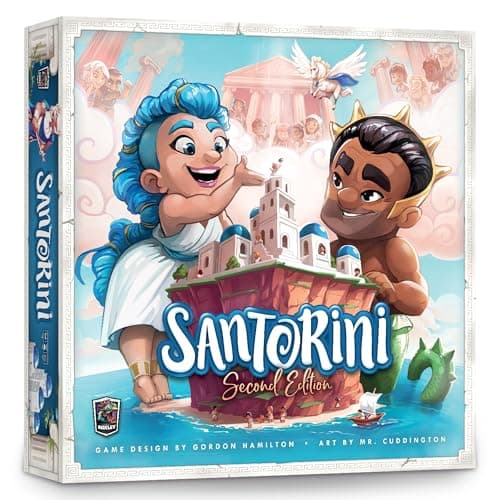
Worth saying plainly because it is the honest answer to a real reason people buy games, and it points away from tiles altogether. Roxley Games lists Santorini at 2-4 players, 20 minutes, ages 8 and up, designed by Gord Hamilton.
It is the best-looking thing on this site by a distance: a three-dimensional island in chunky molded pieces that grows out of the table while you play. Where Azul leaves you with a mosaic at the end, this builds a place. If your copy of Azul got agreed to because it looked good, this will get agreed to faster.
The rules are nearly trivial -- move a worker to an adjacent square, then build a level next to it, and the first player to step onto a third level wins. What stops that from being tic-tac-toe is that each side draws a god power that bends one rule, and that is where all of the variety lives.
The honest downsides, and they are significant. There is no luck at all once the powers are dealt, so the better player wins consistently; for a pair with a real skill gap that produces an evening where one person wins every single game, which is the opposite of what Azul's shuffled supply does for you. It is also published for 2-4 rather than built for two, like Azul itself.
06
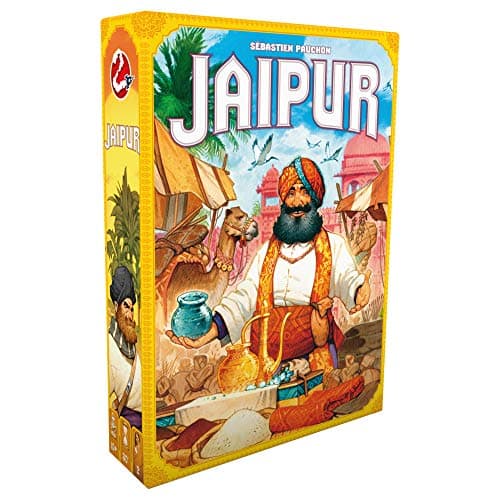
If Azul was slightly too much: Jaipur
A quieter recommendation than the others and the right one more often than people expect. Asmodee and Space Cowboys publish Jaipur for exactly 2 players at 30 minutes, ages 10+, designed by Sebastien Pauchon.
It is a trading card game: you collect goods in sets and sell them, racing the other trader for bonus tokens that shrink as they are taken, best of three rounds. The shrinking-bonus rule is the Azul connection -- the longer you wait to sell, the less the reward is worth, so the pressure comes from the supply rather than from anything either of you does directly.
The reason it is here is teach time. Azul starts in about five minutes; Jaipur starts in about five minutes and costs noticeably less, and it is the game we would hand to someone who enjoyed Azul but found the scoring fiddly. It is also the best first two-player card game there is, and it keeps giving for years rather than being a stepping stone.
The honest downsides: it looks slight. Cards and tokens, no board, and next to a box of acrylic tiles it reads as the cheaper option, because it is. If half of Azul's appeal was the components, this will disappoint on exactly that axis.
07
The rest of the Azul family, and what we can and cannot tell you
Several of the searches that lead here are really asking which other Azul games exist, so here is the family as the game's reference entry names it -- with a clear line between what is sourced and what is not.
Beyond the 2017 original there are Azul: Stained Glass of Sintra (late 2018), Azul: Summer Pavilion (late 2019), Azul: Queen's Garden (2022) and Azul Duel (2025), all standalone games rather than expansions. There is also Azul: Crystal Mosaic, an expansion to the original, Azul: Glazed Pavilion, an expansion to Summer Pavilion, Azul: Master Chocolatier (2022), a limited-edition reskin of the original, and 5211: Azul, which rethemes a different card game.
Here is the limit, and it is the reason this page recommends only two of them. That reference entry states a player count for exactly two games in the family: the original at 2-4, and Azul Duel as designed specifically for two. For Stained Glass of Sintra, Summer Pavilion, Queen's Garden and the rest it gives no player count at all, and we could not reach a publisher page for them. On a site whose entire organizing principle is the publisher's stated player count, we are not going to guess at that figure for a game we would be sending you to buy.
One specific product is worth naming because it is easy to find and we deliberately do not sell it: an Azul: Summer Pavilion Mini exists and is currently purchasable, sold as a portable travel edition. We do not feature it, for a reason that is specific rather than cautious: its whole proposition is that it travels, no publisher page we could reach states its box dimensions, and our travel and small-table pages are built on measured box sizes rather than on the word "mini". If that changes, it belongs here.
08
Who each pick is for
Azul Duel -- best for the pair who liked the draft and are the only two people who will ever play. Built for exactly two, 45 minutes, 10+, and the leftovers are stacked for your opponent in an order you choose. Downside: a clear step up in rules from Azul, no track record yet, and it never seats a third.
Splendor Duel -- best for the pair who liked the squeeze of a restricted shared supply and want a tighter, more competitive game. Built for exactly two, 30 minutes, 10+, with a compounding engine and three live win conditions. Downside: abstract rather than beautiful, punishing to inexperience, and it can end before your plan pays off.
Patchwork -- best for the pair who liked the pattern building and want an evening with no conflict in it at all. Built for exactly two, about 30 minutes, 8+, and neither player can touch the other's board. Downside: a pure spatial puzzle, and some pairs find the lack of interaction cold.
Santorini -- best for the pair who liked how Azul looked on the table, and the best thing here for persuading someone that board games are worth an evening. 2-4 players, 20 minutes, 8+. Downside: no luck once the god powers are dealt, so a skill gap shows up as one person winning every game.
Jaipur -- best for the pair who liked that Azul was light and fast, and the best value on this page. Built for exactly two, 30 minutes, 10+, five-minute teach. Downside: it looks slight, with no board and no components to admire.
Buy nothing yet -- best if you have played Azul fewer than ten times, or only in its basic placement mode. The advanced mode, where you may place colors anywhere rather than in the positions the board dictates, is effectively a second and harder game you already own.
What we would buy
Picks drawn from the games covered on this site, chosen against the criteria above.
We earn a commission when you buy through links on this page, at no extra cost to you. It does not change which games we recommend or what we say about them. How this site is funded.
The Azul family built for exactly two, and the first game here where you draft a tile and decide what the other person is allowed to reach next.
A two-player-only tile-drafting game in the Azul family. You take every tile of one color from a factory's sun side, then choose the order the leftovers are stacked onto its moon side for your opponent to pick over. Tiles fill a single pattern line at a time and move onto dome tiles that score by row and column, across five rounds. Published by Next Move Games for exactly 2 players at 45 minutes.
Players
2
Playing time
45 minutes
Age
10+
Designer
Michael Kiesling
Publisher
Next Move Games
Published
2025
Who should skip it
Skip it if you want the game everyone recognizes. This is the newer, sharper box; the 2017 Azul is the one your guests have heard of and the one that seats four.
The gentler duel: an engine builder where you are racing rather than attacking, and the shared gem board is the whole game.
A two-player-only engine-building game in the Splendor universe. You draft gem tokens from a shared board to buy Jewel cards across three levels, chasing three separate victory conditions -- points, a color majority, or crowns. 67 Jewel cards, 25 tokens, 3 Privilege scrolls, 4 Royal cards.
Players
2
Playing time
30 minutes
Age
10+
Designer
Bruno Cathala and Marc Andre
Publisher
Space Cowboys
Published
2022
Who should skip it
Skip it if you want direct conflict. The tension is in what you take from the shared board before the other person can, never in anything you do to their cards.
The gentlest good game on this site. Two quilts, no attacking, and a surprisingly sharp puzzle underneath.
A two-player-only tile-laying game. You buy fabric patches on a shared time track and fit them onto a personal 9x9 quilt board, paying with buttons and with time.
Players
2
Playing time
about 30 minutes
Age
8+
Designer
Uwe Rosenberg
Publisher
Lookout Games
Published
2014
Who should skip it
Skip it if you want to interact. You are mostly solving your own board, and the only contact is who takes which patch first.
The best-looking game here, and the god powers turn a simple abstract into dozens of different games.
A supports-more abstract that plays well at two. Move a worker, then build. First to step onto a third level wins -- and each side draws a god power that bends one rule.
Players
2-4
Playing time
20 minutes
Age
8+
Designer
Gord Hamilton
Publisher
Roxley Games
Who should skip it
Skip it if you want your two-player game to be two-player only. It supports up to four, and the base rules are thin without the god powers.
The best first two-player card game there is: five minutes to teach, and it keeps giving for years.
A two-player-only trading card game. You collect and sell goods in sets, racing the other trader for bonus tokens that shrink as they are taken. Best of three rounds decides it.
Players
2
Playing time
30 minutes
Age
10+
Designer
Sebastien Pauchon
Publisher
Asmodee / GameWorks
Published
2009
Who should skip it
Skip it if you want a board on the table. This is cards and tokens, and it looks slight next to a game with a map.
Splendor Duel is the closest in feel: its rule that you may only take up to three tokens forming an uninterrupted line creates the same squeeze as Azul's factory restriction. Azul Duel is the closest in family and components, and is the one built for exactly two players.
+−Is there a two-player version of Azul?
Yes. Next Move Games published Azul Duel in 2025 for exactly 2 players at 45 minutes, ages 10+. It is a standalone game, not an expansion, and it does not need the original box. The 2017 Azul is published for 2-4 and plays well at two without it.
+−What should I buy if I liked Azul but want something calmer?
Patchwork. Lookout Games publishes it for exactly 2 players at about 30 minutes, rated 8+, and nothing in it lets either player interfere with the other's board. It keeps the pattern-building satisfaction and removes the competition entirely.
+−Which other Azul games are there?
The reference entry names Stained Glass of Sintra (2018), Summer Pavilion (2019), Queen's Garden (2022) and Azul Duel (2025) as standalone games, plus the Crystal Mosaic and Glazed Pavilion expansions, a 2022 Master Chocolatier reskin and 5211: Azul. It states a player count for only two of them -- the original at 2-4 and Azul Duel at two -- so those are the only two we recommend.
+−Is Splendor Duel better than Azul?
It is the better two-player game and the worse-looking one. Splendor Duel was built for exactly two and is tighter and more competitive; Azul was designed as a 2-4 family game, has a far stronger award record, and has the components people reach for. They are answers to different questions rather than ranked.
+−What is a good cheaper alternative to Azul?
Jaipur. It is published for exactly 2 players at 30 minutes, teaches in about five minutes, and sits in a lower price bracket than any tile game on this page. The trade is that it is cards and tokens with no board, so it looks slight by comparison.
+−Do I need a new game at all after Azul?
Often not. If you have only played the basic placement mode, where the board dictates which square each color occupies, the advanced mode -- place any color anywhere -- is a genuinely harder game you already own, and it is the version worth learning before buying anything else.