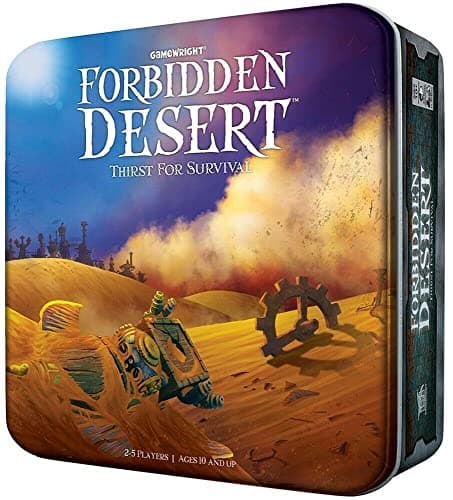
Forbidden Desert is worth it for a pair who want a cooperative game with real teeth: Gamewright publishes it for 2-5 players at 45 minutes, ages 10 and up. You hunt for flying machine parts while a storm moves the board under you. It is harder than most family co-ops, which is the point and also the main reason to skip it.
We earn a commission when you buy through links on this page, at no extra cost to you. It does not change which games we recommend or what we say about them. How this site is funded.
Forbidden Desert is the game people buy after a cooperative game felt too easy, and it is the game people bounce off when they wanted something gentle. Both reactions are correct, because the design is deliberately less forgiving than the family-co-op shelf it sits on.
The two questions worth answering before you spend are therefore how hard it actually is, and whether a game that keeps rearranging itself is a pleasure or a frustration for the two of you. Neither has a universal answer, and both are predictable from things you already know about your household.
01
What you are actually buying
Gamewright publishes it for 2-5 players at 45 minutes, ages 10 and up. You are a team of archaeologists stranded in a desert, digging for the parts of a buried flying machine. The publisher's framing is blunt: find the flying machine and escape before you all become permanent artifacts of the Forbidden Desert.
The box holds 49 cards, 24 tiles, 48 sand markers, 6 pawns, a sand storm meter and the four flying machine parts plus the model itself. The tiles form a modular grid, which is the important part: the map is different every game and it does not stay still once you start.
The storm moves tiles and drops sand on them. A space you cleared is buried again two turns later, and a route you planned is gone. That is the mechanism the whole game is built on, and it is why the stated 45 minutes usually runs longer -- you cannot plan more than a turn ahead, so you re-plan constantly.
02
Is it too hard?
It is harder than the family-game shelf it is sold on, and losing is a normal outcome rather than a failure. That is the honest answer, and whether it is a problem depends entirely on how the two of you treat losing a cooperative game.
The difficulty is not arbitrary. Two clocks run against you at once: the storm intensifies as the game goes on, and your team is losing water the whole time. Digging is slow, the sand keeps coming back, and you need four specific parts before you can leave. There is no single mistake that kills a run -- it is the accumulation, which is a much better kind of hard than a sudden death.
If you want a co-op you will usually win, this is the wrong purchase and Forbidden Island is the gentler game in the same family. If you want a co-op that makes escaping feel earned, this is the one, and the fact that you will lose some runs is the reason winning means anything.
03
How it plays at two specifically
Gamewright lists 2-5 players, so this is a Plays at two game on this site's labeling rather than a two-player-only design. Worth being precise about what that costs you here, because it is less than usual.
Cooperative games suffer least from being played at two, and this one suffers particularly little: each archaeologist has a role with a special ability, and at two you are simply running two roles instead of four. There is no dummy player and no scaling patch. What you lose is variety of roles in a single game, not balance.
What two players gain is speed. The most common complaint about co-ops at four is the table talk between turns; at two the planning is quick and the running time comes down, which matters in a game where the board changes and re-planning is constant.
04
Forbidden Desert or Forbidden Island?
The publisher is explicit that Desert is the sequel, keeping the cooperative play and the modular board while offering a different in-game experience. In practice the difference is temperature: Island is the gentle introduction, Desert is the one with teeth, and Desert costs you about fifteen more minutes.
Our recommendation depends on why you are buying. If nobody in the house has played a modern cooperative game, Island is the better first purchase -- it teaches the vocabulary of the genre in half an hour and you will win often enough to want a second game. If you have played co-ops and found them too soft, skip Island entirely and start here.
One practical note that is not about the design: Forbidden Island currently has no purchasable listing at the retailer we link, although Gamewright still lists it as a current product. We have written about it and we link our review of it, but there is no buy row we can honestly offer you today, which in practice pushes the decision toward Desert.
05
Who this is genuinely for
Pairs who have played a cooperative game, enjoyed it, and wished it had pushed back harder.
Households that like a board which changes -- if a fixed map feels solved after a few plays, the shifting tiles are the fix.
Anyone who wants a real cooperative game for well under an hour, with components that set up fast.
Two people who handle losing together well, because you will lose runs and the game is better for it.
06
Who should skip it
Skip it if you want a short game. The stated 45 minutes assumes you are not re-planning every turn, and because the board shifts you will be. Expect it to run over, and if your evenings are tight that matters more than the box time.
Skip it if losing a cooperative game sours the evening for either of you. This one is designed to be beatable rather than easy, and a run that collapses in the last few turns is a normal Tuesday.
And skip it if you specifically want a two-player-only design. At 2-5 players some of the design went to bigger tables. Co-ops lose the least from that, but if the built-for-two distinction is why you are shopping on this site, it is worth naming.
07
What we did instead of playing it
We have not played this. What we did: took the player count, playing time, age, the full box contents and the win condition from Gamewright's own page for the game, along with the publisher's own statement that it is the sequel to Forbidden Island sharing cooperative play and a modular board. We also re-checked its retail availability before featuring it. No price appears in this prose.
What we would buy
Picks drawn from the games covered on this site, chosen against the criteria above.
We earn a commission when you buy through links on this page, at no extra cost to you. It does not change which games we recommend or what we say about them. How this site is funded.
The sequel that fixes what people find flat about Forbidden Island, at the cost of fifteen more minutes.
A supports-more cooperative game that plays at two. The board physically shifts as the storm moves tiles, so the map you planned around is gone by your next turn.
Players
2-5
Playing time
45 minutes
Age
10+
Designer
Matt Leacock
Publisher
Gamewright
Who should skip it
Skip it if you want a short game. The shifting board means you cannot plan more than a turn ahead, and that stretches the running time.
Built around two people and honest about it, though the publisher lists it as 2+ rather than two only.
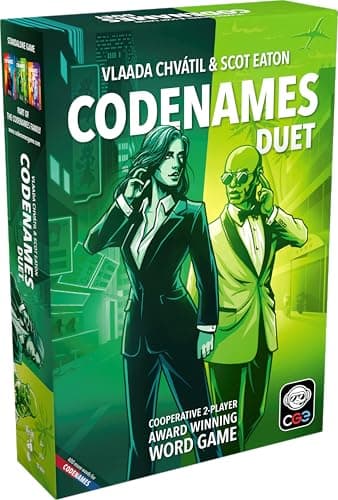
A cooperative word-association game. You each see half of a shared key card and give one-word clues to guide the other to the right agents in a 5x5 grid, avoiding the assassin.
Players
2+
Playing time
15 minutes
Age
11+
Designer
Vlaada Chvatil and Scot Eaton
Publisher
Czech Games Edition
Who should skip it
Skip it if one of you thinks in wildly different associations from the other. That gap is funny once and exhausting by the fourth game.
Plays at two1-4 players · 1-2 hours · ages 14 and up
The campaign game two people can actually finish, because it teaches itself across the first five scenarios.
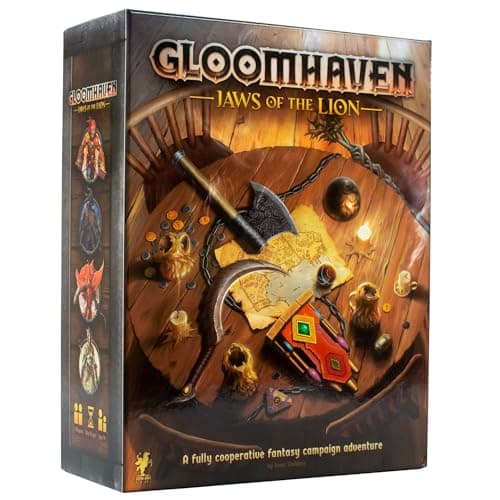
A supports-more cooperative campaign widely played at two. A standalone Gloomhaven entry with a 25-scenario story and a tutorial built into the opening scenarios.
Players
1-4
Playing time
1-2 hours
Age
14 and up
Designer
Isaac Childres
Publisher
Cephalofair Games
Published
2020
Who should skip it
Skip it if you cannot leave a game set up or commit to a run of evenings. A campaign abandoned at scenario four is money spent on a shelf.
Yes, for a pair who want a cooperative game with real difficulty. Gamewright publishes it for 2-5 players at 45 minutes, ages 10 and up. It is not worth it if you want a gentle co-op you will usually win.
+−Is Forbidden Desert hard?
Harder than most family co-ops, and losing is a normal outcome. Two clocks run at once -- the storm intensifies and your water runs down -- and the shifting tiles bury ground you already cleared. The difficulty accumulates rather than arriving suddenly.
+−Is Forbidden Desert good for 2 players?
Yes. It is listed at 2-5, so it is not a two-player-only design, but cooperative games lose little at two and here you simply run two roles instead of four. Planning is faster with two, which helps in a game that makes you re-plan constantly.
+−Forbidden Desert or Forbidden Island?
Island if nobody has played a modern co-op -- it is gentler and shorter. Desert if you have played co-ops and wanted more resistance. Note that Forbidden Island has no purchasable listing at our retailer right now, which pushes the practical answer toward Desert.
+−Do you need Forbidden Island to play Forbidden Desert?
No. Desert is a standalone sequel. It shares the cooperative structure and the modular board but is a separate game with its own components.