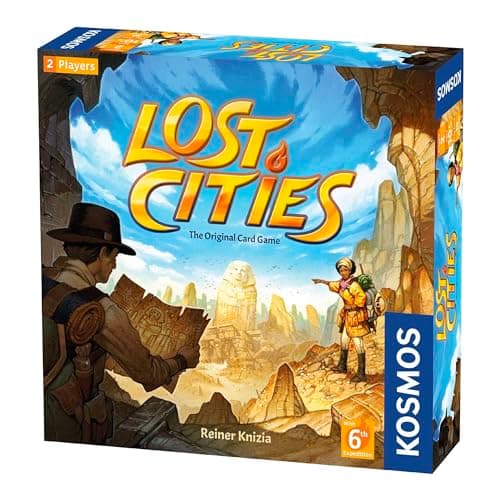
Buy the Lost Cities card game that includes the 6th Expedition. It is the two-player game Knizia designed, Kosmos publishes it for exactly 2 players at 30 minutes, ages 10 and up, and it is both the cheapest box and the only one reliably in stock. Lost Cities: The Board Game is a different game, Keltis, for 2-4.
We earn a commission when you buy through links on this page, at no extra cost to you. It does not change which games we recommend or what we say about them. How this site is funded.
Lost Cities is the oldest game we recommend and one of the best two-player card games ever published. It is also, unhelpfully, a name that now sits on four different boxes, only one of which is the game that made the name worth having. The versions question comes up often enough in search -- which box, which edition, board game or card game -- that it deserves its own page rather than a line on the review.
The good news is that this is the rare buying decision where the cheapest answer is also the correct one. The bad news is that at least two of the wrong answers are easy to reach by accident, one of them costs more than the right box for strictly less game, and one of them is not the same game at all despite carrying a bigger award. Here is the whole family, what each one actually is, and which to put in the basket.
01
The four boxes, and which one is the two-player game
Before the detail, the shape of the family. Only the first of these is the game this site recommends, and it is the one we have reviewed since launch.
Lost Cities (the card game, with the 6th Expedition) -- exactly 2 players, 30 minutes, ages 10 and up. Reiner Knizia, Kosmos and Rio Grande Games, 1999. This is the game. Built for two on our labeling, and the current printing is the cheapest box in the family.
Lost Cities (the older card-game printing) -- the same game before the sixth expedition and the two-sided board were folded in. Still listed, scarcer, and at the time of writing it costs MORE than the current edition. There is no reason to buy this one.
Lost Cities: The Board Game -- 2-4 players, 30 minutes, ages 10 and up. This is not the card game on a board. It is Keltis, a separate Reiner Knizia design from 2008 that won the Spiel des Jahres and was marketed in the US under the Lost Cities name, with what Wikipedia calls "some subtle rules differences". Plays at two rather than built for two, and we cannot find a live US listing for it at all.
Lost Cities: Roll & Write -- a dice-and-paper game from Kosmos carrying the name. It is a genuinely different thing from the card game and we are not ranking it, for reasons in its own section below.
Lost Cities: Rivals also exists and is listed by some retailers. We have not found an Amazon listing for it and it has no reference entry we can check, so it is named here for completeness and nothing more.
02
The 6th Expedition is not an upgrade you have to hunt for
This is the single most common version question and it has a dull, happy answer: you are already getting it.
The sixth expedition started life as a promo pack handed out at Gen Con in 2016 -- a set of gray cards adding one more colored expedition to the five in the base game. From 2019 onward the standard retail box includes it, along with a two-sided board so you can lay out either the classic five-expedition game or the six-expedition version. The listing for the box we recommend says so in its own title.
So if you have read a forum thread from 2017 telling you to track down the expansion separately, that advice has expired. Buy the current box and you have both games in it. Nothing needs adding, and there is nothing to pay extra for.
The one practical consequence: when you compare listings, check that the one you are looking at is the current printing rather than a leftover of the older one. The next section is about why that matters more than it should.
03
The older edition costs more than the current one
Both printings of the card game are still on sale, and the superseded one is the more expensive. That is the opposite of what anyone expects, and it is the easiest way to lose money on this purchase.
The mechanism is ordinary enough. The current edition is in print and in stock, so it sits at its normal price. The older edition is out of print, stock is thin, and thin stock on a well-liked game drifts upward regardless of what is actually in the box. There is also a Kosmos import edition floating about, labeled as a game for two, at a still higher price.
Live prices for the box we recommend are in the panel on this page, each stamped with the date we read it, so you can see the gap for yourself rather than taking our word for a number that moves. What we will commit to in writing is the ordering, which has held every time we have checked: the current edition is the cheapest of the three card-game listings, and it is the one with the most content.
A reader searching for the original Lost Cities card game is, reasonably, trying to avoid buying some diluted later thing. In this specific case that instinct is backwards. The later thing is the fuller game and the better price.
04
Lost Cities: The Board Game is Keltis, and that matters
If you take one thing from this page, take this one. The box sold in the US as Lost Cities: The Board Game is a re-theme of Keltis, a different Reiner Knizia game published in 2008. Wikipedia's Lost Cities entry describes the US board game as a Keltis re-theme supporting up to four players, and the Keltis entry states that Keltis has been marketed in the US as Lost Cities: The Board Game with some subtle rules differences.
Keltis is 2-4 players, 30 minutes, ages 10 and up, and it won the 2008 Spiel des Jahres -- the most meaningful award in the hobby, and a bigger prize than anything the card game has. You can see why the naming happened, and you can also see the trap. A pair comparing the two boxes finds that one of them is a Spiel des Jahres winner and reasonably concludes it is the better game. It may well be the better game. It is not the better game for two.
What you would be buying is a four-player design that functions at two, when the alternative is a two-player design that does nothing else. That is the exact distinction this site exists to make, and it cuts about as cleanly here as it ever does: the card game was built for your situation, and the board game accommodates it.
There is also a blunt practical point. We cannot find a live US listing for Lost Cities: The Board Game. The closest thing available is the German-language Keltis at roughly three times the price of the card game. So this is mostly a warning about a box you may read about rather than a purchase you are likely to make by mistake -- but if you do find it in a shop, now you know what is in it.
The honest qualification: we have not played Keltis and we are not telling you it is worse. The Spiel des Jahres jury liked it more than almost anything else published that year. We are telling you it is a different game with a different player count, sold under a name that implies otherwise.
05
Roll & Write, and why there are no specs for it here
Lost Cities: Roll & Write is real, it is from Kosmos, Knizia designed it, and you can buy it today. We are still not ranking it, and the reason is a rule we hold to rather than an opinion about the game.
Every player count, playtime and age rating on this site comes from the publisher's own page where we can reach it, and from the game's reference entry where we cannot. For Roll & Write we have neither. The publisher's product pages are unreachable from here, and the Lost Cities reference entry does not mention a Roll & Write edition at all. That leaves retailer listings, which we do not treat as specifications because they are written to sell rather than to describe.
So we will tell you it exists, that it is a dice-and-paper game rather than a card game, and that it was the scarcer and dearer of the two buyable boxes when we checked. We will not print a player count for it, because we would be copying a number we cannot stand behind, and on a site whose entire proposition is verified player counts that would be a strange corner to cut.
If a roll-and-write is what you actually want, that is a different question from this page's, and the honest answer is to read the publisher's own box copy before buying.
06
What the card game is like at two, including the part people dislike
It is worth saying what you are buying, since the whole page recommends it. Lost Cities is a hand-management game about committing to expeditions. Each of the five or six colored expeditions is a row in front of you, and every card you add to a row must be numbered higher than the last one you put there. Commit early and you have room to build a long, profitable run. Commit late and you cannot catch up. Investment cards multiply whatever that expedition finally scores, including when it scores badly.
Each completed expedition scores against a fixed negative, so a run you abandoned half-built actively costs you points. That is the whole tension: the game keeps offering you a card that is useful but not quite useful enough, and taking it forecloses something better later.
At two players it works because the discard piles are shared. The card you throw away is a card the other person can take, which turns every discard into a small decision about what you are willing to hand over. There is no third player to muddy that, and it is why the game has not been improved on in twenty-five years of trying.
The honest con, and it is a real one: the cards decide more here than in anything else we recommend. A run of draws that never gives you the low numbers you need in a color you have committed to will lose you the game, and no amount of good play will rescue it. If a run of bad luck will sour the evening for either of you, buy something with less variance -- 7 Wonders Duel and Patchwork both put more of the outcome in your hands.
The second con is thematic rather than mechanical. There is no expedition here in any meaningful sense. It is a numbers game with archaeology printed on it, beautifully, and if what you wanted was adventure you will not find much.
07
If you want Lost Cities but not Lost Cities
A fair number of people arrive at this family looking for something adjacent rather than something identical, so here are the two we would actually name, both of which we cover in full.
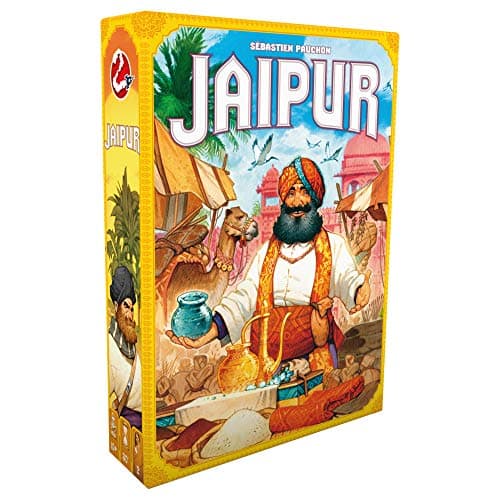
Jaipur is the closest thing in spirit and the one we recommend most often alongside it. Asmodee and GameWorks publish it for exactly 2 players at 30 minutes, rated 10+, designed by Sebastien Pauchon. It is also a two-player-only card game about collecting and committing, it teaches in about five minutes, and it has more texture than Lost Cities because you are choosing between selling now at a good price and holding for a better one. It is less punishing on bad draws, which for some pairs is the deciding factor. Our head-to-head between the two is the most-read comparison on this site.
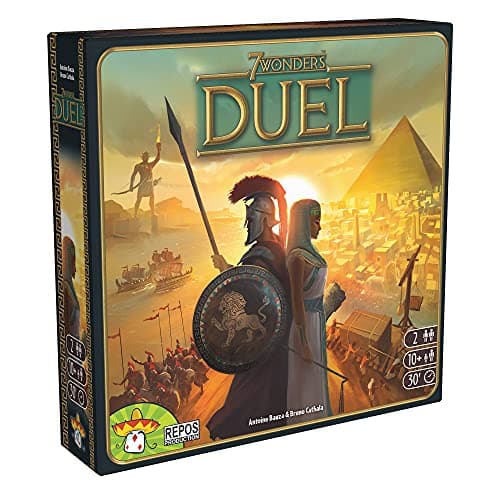
7 Wonders Duel is the step up rather than the sideways move. Repos Production publishes it for exactly 2 players at 30 minutes, rated 10+, by Antoine Bauza and Bruno Cathala. It is a considerably heavier game with three ways to win and far more to learn, and it is the game we would name if the two of you have worn out every light card game in the house. It is the wrong answer if you wanted something you can teach over a drink.
What we would not do is send you to the Lost Cities board game as the natural next purchase, for all the reasons above. The next purchase after Lost Cities is another two-player game, not a four-player game with the same artwork.
08
Pick this if
Buy the card game with the 6th Expedition if you want the game this family is famous for. Exactly 2 players, 30 minutes, ages 10 and up, the cheapest box, the most content, and the only one reliably in stock.
Do not buy the older card-game printing. It is the same game minus the sixth expedition and the two-sided board, and it currently costs more.
Buy Lost Cities: The Board Game only if you specifically want Keltis and knew that is what it is. It is 2-4 players, it is a different 2008 Knizia design, and it is a worse fit for a pair than the card game regardless of its award.
Skip Roll & Write unless a dice-and-paper game is what you came for. We will not print specs for it because we cannot source them.
Pick Jaipur instead if you want the same shape of game with less luck, or 7 Wonders Duel if you want something substantially heavier. Both are published for exactly two.
What we would buy
Picks drawn from the games covered on this site, chosen against the criteria above.
We earn a commission when you buy through links on this page, at no extra cost to you. It does not change which games we recommend or what we say about them. How this site is funded.
Lost Cities
Built for two2 players · 30 minutes · ages 10 and up
Old enough to vote and still the cleanest press-your-luck card game for two.
A two-player-only card game about mounting expeditions. Every card you play must be higher than the last on that color, so committing early is how you score and also how you go negative.
Players
2
Playing time
30 minutes
Age
10 and up
Designer
Reiner Knizia
Publisher
Kosmos / Rio Grande Games
Published
1999
Who should skip it
Skip it if a run of bad draws will sour the evening. The cards decide more here than in anything else we recommend.
The best first two-player card game there is: five minutes to teach, and it keeps giving for years.
A two-player-only trading card game. You collect and sell goods in sets, racing the other trader for bonus tokens that shrink as they are taken. Best of three rounds decides it.
Players
2
Playing time
30 minutes
Age
10+
Designer
Sebastien Pauchon
Publisher
Asmodee / GameWorks
Published
2009
Who should skip it
Skip it if you want a board on the table. This is cards and tokens, and it looks slight next to a game with a map.
The strongest all-round two-player game in print, and the one most couples settle on.
A two-player-only card drafting game where each side builds a civilization across three ages. Three ways to win -- civilian points, military supremacy and scientific dominance -- run at once, so every card you take is also a card denied.
Players
2
Playing time
30 minutes
Age
10+
Designer
Antoine Bauza and Bruno Cathala
Publisher
Repos Production
Published
2015
Who should skip it
Skip it if you want a relaxing evening. Three win conditions run at once, so you are always watching what the other person is about to do.
+−What is the difference between Lost Cities the card game and Lost Cities: The Board Game?
They are different games. The card game is Reiner Knizia's 1999 design for exactly 2 players, 30 minutes, ages 10 and up. Lost Cities: The Board Game is a re-theme of Keltis, a separate Knizia design from 2008 for 2-4 players that won the Spiel des Jahres, sold in the US under the Lost Cities name with some subtle rules differences. If you are two people, you want the card game.
+−Do I need to buy the 6th Expedition separately?
No. It began as a Gen Con 2016 promo pack of gray cards, but from 2019 the standard retail box includes it along with a two-sided board, so you can play either the classic five-expedition game or the six-expedition version out of the one box. Older advice to hunt the expansion down separately is out of date.
+−Should I buy the original Lost Cities card game edition?
No, and this is the counter-intuitive one. The older printing is out of print, scarce, and currently costs more than the current edition while containing less -- no sixth expedition and no two-sided board. The current box is both cheaper and fuller. There is also a Kosmos import listing at a higher price again.
+−How many players is Lost Cities?
The card game is exactly 2 -- Kosmos states a minimum and maximum of 2, which is why it is labeled Built for two here. There are fan variants for three or four and Knizia later published semi-official four-player rules, but the published game is a two-player game. Lost Cities: The Board Game, being Keltis, is 2-4.
+−Is Lost Cities still worth buying in 2026?
Yes. It was published in 1999 and it is still the cleanest press-your-luck card game for two that we have found, which is why it remains one of our picks. The one caveat has not changed in twenty-five years either: the draw decides more of the outcome than in most games we recommend.
+−What about Lost Cities: Roll & Write or Lost Cities: Rivals?
Both exist and neither is ranked here. Roll & Write is buyable but was the scarcer and dearer option when we checked, and the Lost Cities reference entry does not mention it, so we have no sourced player count, playtime or age to print. Rivals has no Amazon listing we can find and no reference entry at all. We name them rather than pretend they do not exist, and we do not print specifications we cannot stand behind.
+−Which should I buy, Lost Cities or Jaipur?
Jaipur if a run of bad draws would spoil the evening, Lost Cities if you want the tighter, meaner game. Both are published for exactly 2 players at 30 minutes and rated 10+, both teach in minutes, and Jaipur puts more of the outcome in your hands because you are choosing when to sell rather than hoping for a number. We have a full head-to-head between them.
+−Why can you not cite the publisher's own page for these?
Because we cannot reach it. The publisher's store is unreachable from our end and the US distributor blocks product pages, so the figures on this page come from the Lost Cities and Keltis reference entries instead. That is our documented fallback when a publisher page is unavailable, and we would rather say which source a number came from than imply we read it somewhere we did not.